Binghamton in Broome County, New York — The American Northeast (Mid-Atlantic)
Confluence Park
Photographed by Anton Schwarzmueller, May 13, 2022
1. Confluence Park Marker
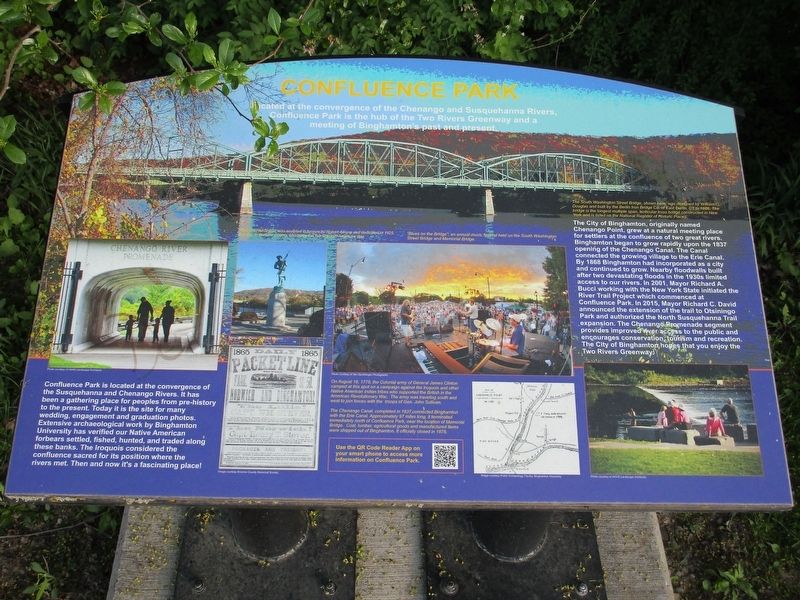
[captions] The South Washington Street Bridge, shown here, was designed by William O. Douglas and built by the Berlin Iron Bridge Co. of East Berlin, CT in 1886. The bridge is the longest multiple span, lenticular truss bridge constructed in New York and is listed on the National Register of Historic Places. “The Skirmisher” was sculpted in bronze by Robert Aikens and dedicated in 1925, to those in Broome County who served in the Spanish-American War. “Blues on the Bridge”, an annual music festival held on the South Washington Street Bridge and Memorial Bridge.
Confluence Park is located at the convergence of the Susquehanna and Chenango Rivers. It has been a gathering place for peoples from pre-history to the present. Today it is the site for many wedding, engagement and graduation photos. Extensive archaeological work by Binghamton University has verified our Native American settles, fished, hunted, and traded along these banks. The Iroquois considered
this page online
On August 18, 1779, the colonial army of General James Clinton camped at this spot on a campaign against the Iroquois and other Native American Indian tribes who supported the British in the American Revolutionary War. The army was traveling south and west to join forces with the troops of Gen. John Sullivan.
The Chenango Canal, completed in 1837, connected Binghamton with the Erie Canal. Approximately 97 miles long, it terminated immediately north of Confluence Park, near the location of Memorial Bridge. Coal, lumber, agricultural goods and manufactured items were shipped out of Binghamton. It officially closed in 1878.
The City of Binghamton, originally named Chenango Point, grew at a natural meeting place for settlers at the confluence of two great rivers. Binghamton began to grow rapidly upon the 1837 opening of the Chenango Canal. The Canal connected the growing village to the Erie Canal. By 1868 Binghamton had incorporated as a city and continued to grow. Nearby floodwalls built after two devastating floods in the 1930s limited
Photographed by Anton Schwarzmueller, May 13, 2022
2. Confluence Park Marker
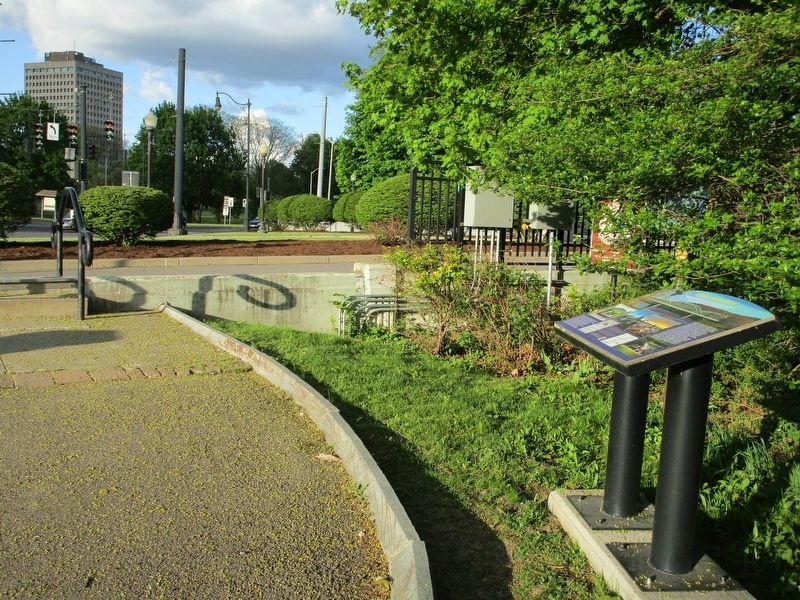
View is eastward.
Erected by City of Binghamton.
Topics. This historical marker is listed in these topic lists: Indigenous Peoples and Communities • Parks & Recreational Areas • Settlements & Settlers • Waterways & Vessels. A significant historical date for this entry is August 18, 1779.
Location. 42° 5.588′ N, 75° 54.92′ W. Marker is in Binghamton, New York, in Broome County. It can be reached from the intersection of North Shore Drive and Water Street. Touch for map. Marker is in this post office area: Binghamton NY 13901, United States of America. Touch for directions.

Regionally, this marker is in Upstate New York and in the Southern Tier. It is also
Photographed by Anton Schwarzmueller, May 13, 2022
3. Confluence Park Marker
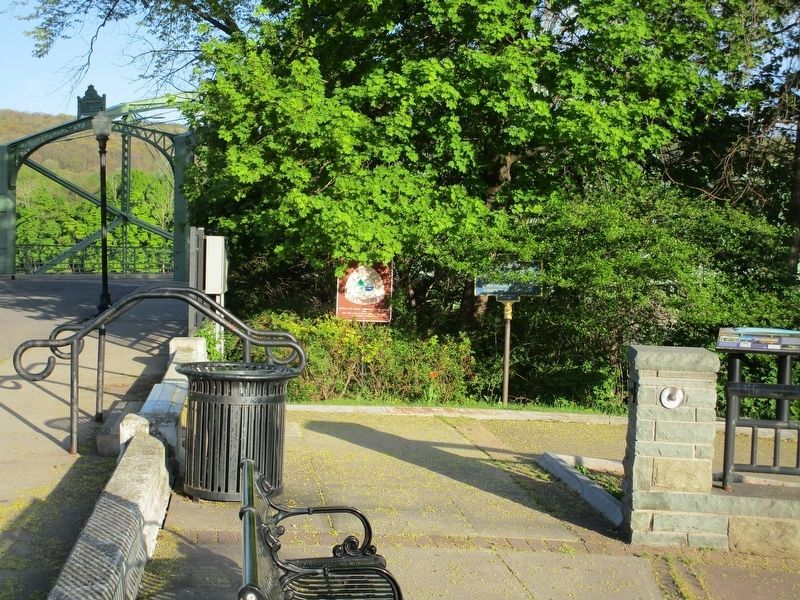
View is southward. From left to right: North end of South Washington Street Bridge; Chenango Canal marker (hidden by leaves), Confluence Park marker.
Other nearby markers. At least 8 other markers are within walking distance of this marker: Chenango Canal (here, next to this marker); Near This Point 18 August 1779 (here, next to this marker); 1st N.Y. and 108th Ambulance Co's Memorial (a few steps from this marker); The Skirmisher (within shouting distance of this marker); Men of Broome (within shouting distance of this marker); a different marker also named Confluence Park (within shouting distance of this marker); Dedicated to the Memory (about 600 feet away, measured in a direct line); Routes of the Armies of General John Sullivan and General James Clinton (about 700 feet away). Touch for a list and map of all markers in Binghamton.
Also see . . . South Washington Street Parabolic Bridge - National Archives. National Register of Historic Places documentation (Submitted on December 19, 2023, by Anton Schwarzmueller of Wilson, New York.)
Credits. This page was last revised on December 19, 2023. It was originally submitted on May 19, 2022, by Anton Schwarzmueller of Wilson, New York. This page has been viewed 979 times since then and 115 times this year. Photos: 1, 2, 3. submitted on May 19, 2022, by Anton Schwarzmueller of Wilson, New York.
