Swanton in Franklin County, Vermont — The American Northeast (New England)
First People of the Missisquoi Delta

Photographed by Alexander Schwarzmueller, June 21, 2022
1. First People of the Missisquoi Delta Marker
Left Panel - The Swanton Route 78 Archaeology Project
Archaeological excavations were undertaken along Route 78 intermittently between 2000 and 2013 on behalf of the Vermont Agency of Transportation. This work was required to comply with federal regulations concerning the evaluation and treatment of important archeological sites prior to safety upgrades to the heavily traveled road. Archaeologists concentrated on a two-mile stretch of road from Louie’s Landing eastward toward the village of Swanton.
Archaeologists and volunteers use a number of techniques to sift through the soil and to investigate artifacts that they find along
this page online
The archaeological sites along Route 78 are rich with information about how Native Americans lived in the past. Unlike many areas in Vermont, each time people made their camp or settled close to the Missisquoi River, the things they left behind were eventually buried by flood sands. Over time, the sites and flood layers built upon one another like an earthen history book, with each layer of sediment representing a chapter from the past. Using these layers, archaeologists were able to “read” the story of the people and their homes over thousands of years.
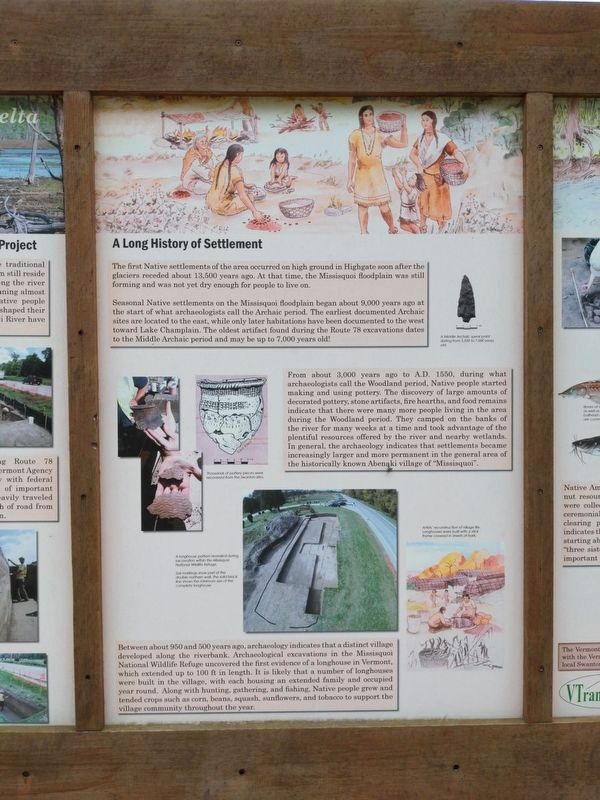
A Long History of Settlement The first Native settlements of the area occurred on high ground in Highgate soon after the glaciers receded about 13,500 years ago. At that time, the Missisquoi floodplain was still forming and was not yet dry enough for people to live on.
Seasonal Native settlements on the Missisquoi floodplain began about 9,000 years ago at the start of what archaeologists call the Archaic period. The earliest documented Archaic sites are located to the east, while only later habitations have been documented to the west toward Lake Champlain. The oldest artifact

Photographed by Alexander Schwarzmueller, June 21, 2022
2. First People of the Missisquoi Delta Marker
From about 3,000 years ago to A.D. 1550, during what archaeologists call the Woodland period, Native people started making and using pottery. The discovery of large amounts of decorated pottery, stone artifacts, fire hearths, and food remains indicate that there were many more people living in the area during the Woodland period. They camped on the banks of the river for many weeks at a time and took advantage of the plentiful resources offered by the river and nearby wetlands. In general, the archaeology indicates that settlements became increasingly larger and more permanent in the general area of the historically known Abenaki village of “Missisquoi”.
A Middle Archaic spear point dating from 5,500 to 7,000 years old. Thousands of pottery pieces were recovered from the Swanton sites. Artists’ reconstruction of village life. Longhouses were built with a stick frame covered in sheets of bark. A longhouse pattern revealed during excavation within the Missisquoi National Wildlife Refuge. Soil markings show part of the double northern
Photographed by Alexander Schwarzmueller, June 21, 2022
3. First People of the Missisquoi Delta Marker
Center Panel - A Long History of Settlement
Between about 950 and 500 years ago, archaeology indicates that a distinct village developed along the riverbank. Archaeological excavations in the Missisquoi National Wildlife Refuge uncovered the first evidence of a longhouse in Vermont, which extended up tp 100 ft in length. It is likely that a number of longhouses were built in the village, with each housing an extended family and occupied year round. Along with hunting, gathering, and fishing, Native people grew and tended crops such as corn, beans, squash, sunflowers, and tobacco to support the village community throughout the year.
Clues from the Past Archaeologists recovered thousands of Native American artifacts during the Route 78 project, including chipped stone tools, waste flakes from stone tool making, pottery, and rare decorative adornments. Other evidence of past Native habitation identified during the excavations included refuse and storage pits, fire hearths, and stains where posts and structures once stood. A variety of food remains were recovered from the pits and hearths, which help archaeologists

Photographed by Alexander Schwarzmueller, June 21, 2022
4. First People of the Missisquoi Delta Marker
Right panel - Clues from the Past
A dark stain marks the location of an 800-year-old storage pit. This pit contained many burned plant remains such as acorn and hickory nutshell, wood from maple, ash, oak and beech, and many seeds including bramble, blueberry, huckleberry, grape, goosefoot, wild rice, and maize. Bones of sturgeon (above) have been recognized, as well as many other fish species. Bones of bullhead catfish (below) are easily identified and are common at the sites. The presence of Maize in nearly all the hearths dating to the Late Woodland period suggests it was an important part of the diet.
The large sample of fragmentary animal bones recovered from the excavations suggests the local Native communities were fisherfolk who also hunted animals, birds, reptiles and amphibians. Although most of us don’t have quite as broad a diet as they had in the past, many of the resources available to Native Americans thousands of years ago are still available in and along the river today.
Native Americans also used a wide variety of plant and nut resources. Seeds found at the sites are varied and were collected for food, medicines, and perhaps special ceremonial purposes. Many seeds also likely reflect field clearing practices related to agriculture. Archaeology indicates that Native peoples intensified their use of plants starting about 3,000 years ago, and that the farming of the “three sisters” – maize, beans, and squash – became an important part of village life by about 1000 A.D.
The Route 78 excavations enrich local Abenaki history and oral tradition and document remarkable continuity in the settlements and uses of the Missisquoi Delta over thousands of years and into the present day. Fortunately, the Missisquoi National Wildlife Refuge protects both the natural and cultural resources that abound in the area. Their stewardship ensures that we will be able to learn from, appreciate and enjoy these resources now and in the future.
Erected by Vermont Agency of Transportation and Federal Highway Administration.
Topics. This historical marker is listed in these topic lists: Anthropology & Archaeology • Indigenous Peoples and Communities • Roads & Vehicles.
Location. 44° 56.664′ N, 73° 9.079′ W. Marker is in Swanton, Vermont, in Franklin County. It is on North River Road (Vermont Route 78) 1.6 miles west of Babbie Boulevard, on the left when traveling west. Touch for map. Marker is at or near this postal address: 371 North River Road, Swanton VT 05488, United States of America. Touch for directions.

Regionally, this marker is in Vermont’s Champlain Valley. It is also in the American Northeast and in New England. Globally, it is in North America, the Great North Woods, the Western Hemisphere, the Western World, and the Anglosphere. Historically, it finds itself in what was once the Viceroyalty of New France and also the Vermont Republic.
Other nearby markers. At least 8 other markers are within 8 miles of this marker, measured as the crow flies: 10,000 Years of Fishing / 10 000 ans de pêche (approx. 1.2 miles away); Mazipskoik (Missisquoi) Native Village and Jesuit Mission / Village Autochtone et Mission Jesuite de (approx. 1.7 miles away); Swanton (approx. 2.2 miles away); The Bohannon Site (approx. 4.3 miles away); Highgate Falls Lenticular Truss Bridge (approx. 5.1 miles away); Saxe's Mills (approx. 5.4 miles away); The International Boundary is Settled / La frontière internationale est définie (approx. 7.6 miles away); Missile Site (approx. 7.6 miles away). Touch for a list and map of all markers in Swanton.
Another marker is no longer nearby. Missisquoi Village and Mission (was approx. 2.2 miles away but has been permanently removed).
Credits. This page was last revised on June 25, 2022. It was originally submitted on June 24, 2022, by Anton Schwarzmueller of Wilson, New York. This page has been viewed 865 times since then and 86 times this year. Photos: 1. submitted on June 24, 2022, by Anton Schwarzmueller of Wilson, New York. 2, 3, 4. submitted on June 25, 2022, by Anton Schwarzmueller of Wilson, New York.
