Turtlecreek Township near Lebanon in Warren County, Ohio — The American Midwest (Great Lakes)
Ohio Native Plants
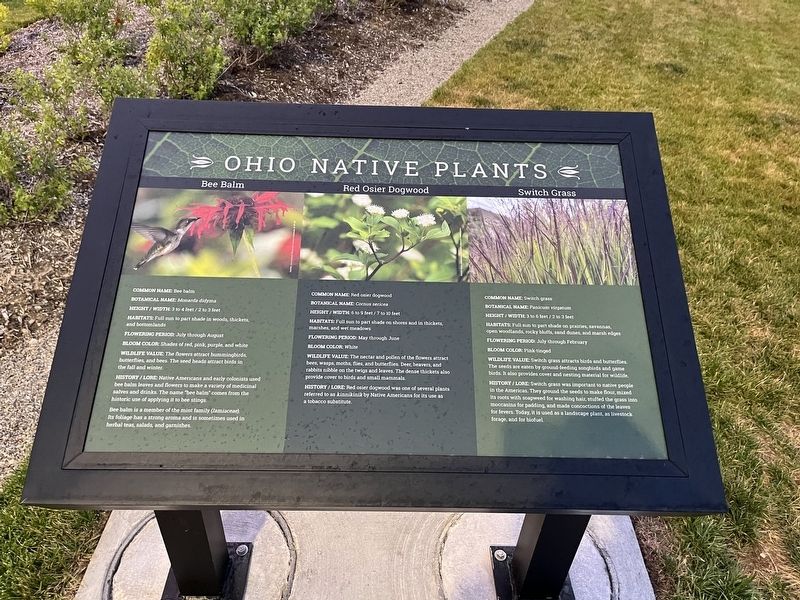
Botanical Name: Monarda didyma
Height / Width: 3 to 4 feet / 2 to 3 feet Habitats: Full sun to part shade in woods, thickets, and bottomlands
Flowering Period: July through August
Bloom Color: Shades of red, pink, purple, and white
Wildlife Value: The flowers attract hummingbirds, butterflies, and bees. The seed heads attract birds in the fall and winter.
History / Lore: Native Americans and early colonists used bee balm leaves and flowers to make a variety of medicinal salves and drinks. The name "bee balm" comes from the historic use of applying it to bee stings.
Bee balm is a member of the mint family (lamiaceae). Its foliage has a strong aroma and is sometimes used in herbal teas, salads, and garnishes.
Botanical Name: Cornus sericea
Height / Width: 6 to 9 feet / 7 to 10 feet
Habitats: Full sun to part shade on shores and in thickets, marshes, and wet meadows.
Flowering Period: May through June
Bloom Color: White
Wildlife Value: The nectar and pollen of the flowers attract bees, wasps,
this page online
History / Lore: Red osier dogwood was one of several plants referred to as kinnikinik by Native Americans for its use as a tobacco substitute.
Botanical Name: Panicum virgatum
Height / Width: 3 to 6 feet / 2 to 3 feet
Habitats: Full sun to part shade on prairies, savannas, open woodlands, rocky bluffs, sand dunes, and marsh edges.
Flowering Period: July through February
Bloom Color: Pink-tinged
Wildlife Value: Switch grass attracts birds and butterflies. The seeds are eaten by ground-feeding songbirds and game birds. It also provides cover and nesting material for wildlife.
History / Lore: Switch grass was important to native people in the Americas. They ground the seeds to make flour, mixed its roots with soapweed for washing hair, stuffed the grass into moccasins for padding, and made the concoctions of the leaves for fevers. Today, it is used as a landscape plant, as livestock forage, and for biofuel.
Topics.
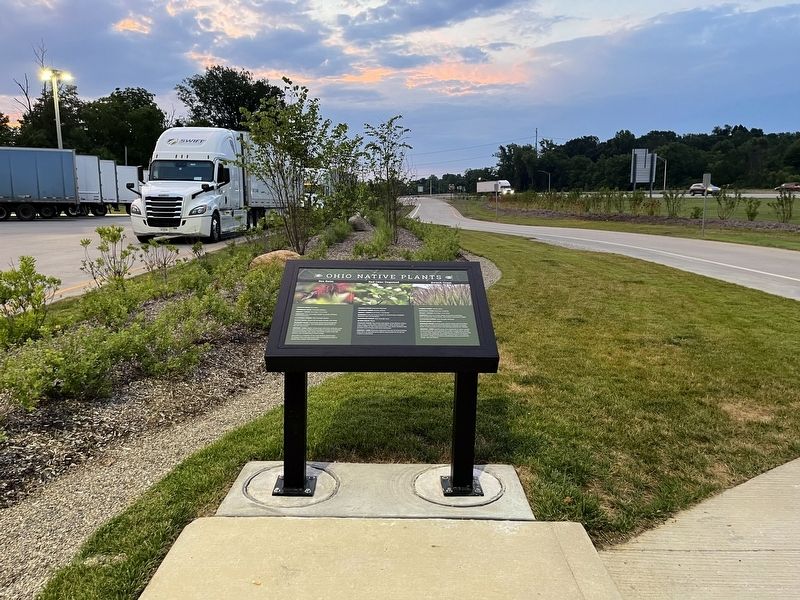
Location. 39° 24.938′ N, 84° 7.337′ W. Marker is near Lebanon, Ohio, in Warren County. It is in Turtlecreek Township. It is on Interstate 71 east of Ohio Route 123, on the right when traveling south. Touch for map. Marker is in this post office area: Oregonia OH 45054, United States of America. Touch for directions.

Regionally, this marker is in Greater Cincinnati and in the Miami Valley. It is also in the American Midwest and in the Corn Belt. Globally, it is in North America, the Western Hemisphere, the Western World, and the Anglosphere. Historically, it finds itself in what was once the Haudenosaunee (Iroquois) Confederacy, the territory of the Mississippian Culture, and the Northwest Territory.
Other nearby markers. At least 8 other markers are within walking distance of this marker: Ohio Buckeye Tree (within shouting distance of this marker); a different marker also named Ohio Native Plants (within shouting distance of this marker); a different marker also named Ohio Native Plants (within shouting distance of this marker); a different marker also named Ohio Native Plants (within shouting distance of this marker); a different marker also named Ohio Native Plants (about 300 feet away, measured in a direct line); a different marker also named Ohio Native Plants (about 600 feet away); a different marker also named Ohio Native Plants (about 600 feet away); a different marker also named Ohio Buckeye Tree (about 700 feet away). Touch for a list and map of all markers in Lebanon.
Credits. This page was last revised on February 6, 2023. It was originally submitted on July 1, 2022, by Devry Becker Jones of Washington, District of Columbia. This page has been viewed 293 times since then and 25 times this year. Photos: 1, 2. submitted on July 1, 2022, by Devry Becker Jones of Washington, District of Columbia.
