Caddo Gap in Montgomery County, Arkansas — The American South (West South Central)
De Soto at Caddo Gap
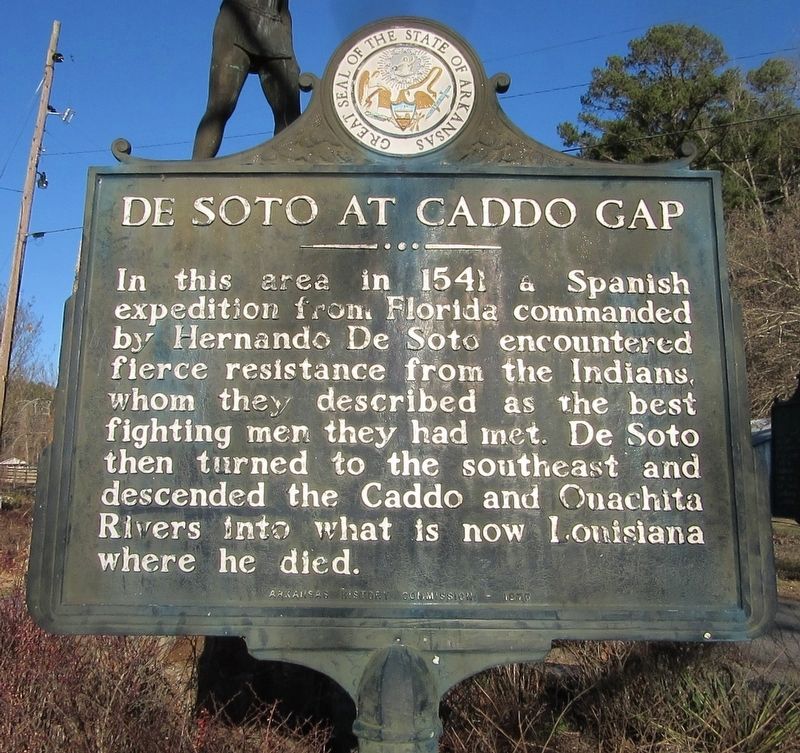
Photographed by Jason Armstrong, January 23, 2022
1. De Soto at Caddo Gap Marker
Erected 1976 by Arkansas History Commission.
Topics. This historical marker is listed in these topic lists: Exploration • Hispanic Americans • Indigenous Peoples and Communities • Wars, US Indian. A significant historical year for this entry is 1541.
Location. 34° 24.093′ N, 93° 37.142′ W. Marker is in Caddo Gap, Arkansas, in Montgomery County. It is at the intersection of Indian Valley Road and Vaught Street, on the right when traveling east on Indian Valley Road. Touch for map. Marker is at or near this postal address: 11 Indian Valley Rd, Caddo Gap AR 71935, United States of America. Touch for directions.

Regionally, this marker is in the Ouachita Mountains and in Caddo Territory. It is also in the American South and specifically in the Upper South. Globally, it is in North America,
this page online
Other nearby markers. At least 8 other markers are within 11 miles of this marker, measured as the crow flies: The Narrows on Caddo River (here, next to this marker); The Caddo People (here, next to this marker); The Town of Caddo Gap (here, next to this marker); Archeological Analysis of Norman Caddo Indian Burial Ground (approx. 4.8 miles away); Arkansas State Quarter (approx. 10.7 miles away); Montgomery County (approx. 10.8 miles away); Montgomery County in the Civil War (approx. 10.8 miles away); Montgomery County Civil War Memorial (approx. 10.8 miles away). Touch for a list and map of all markers in Caddo Gap.
Additional commentary.
1. The De Soto Commission and Modern Archaeology
The Hernando de Soto Expedition's precise route has been difficult to determine and was poorly understood until the late twentieth century. Many markers were placed based upon the report of the
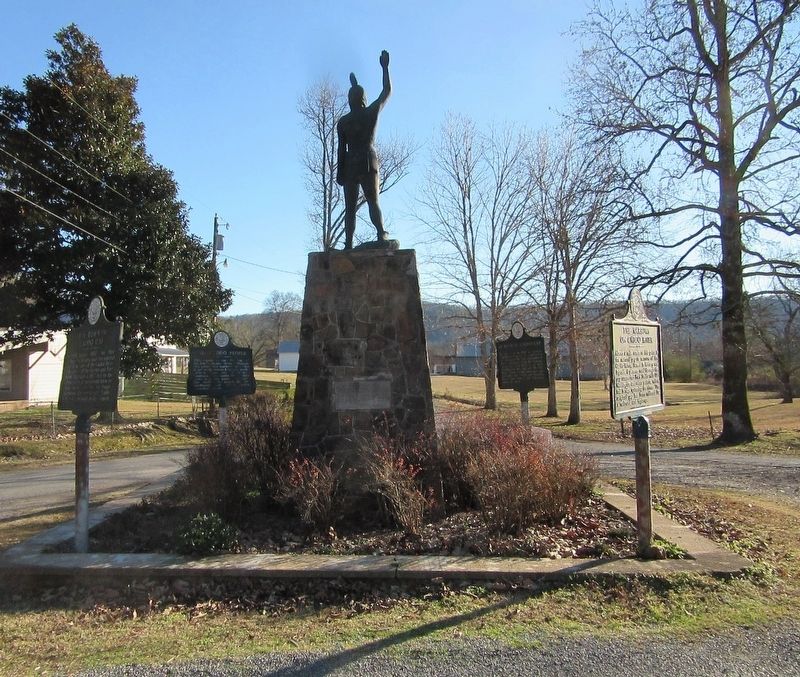
Photographed by Jason Armstrong, January 23, 2022
2. De Soto at Caddo Gap Marker at the Caddo Gap Historical Monument
The De Soto Commission was established in the 1930s by the U.S. government and led by John R. Swanton. Driven primarily by the input of local stakeholders eager to drive tourism into their towns, the De Soto Commission's route (published in "The United States De Soto Commission Final Report," 1939) has not held up to scrutiny by later historians, anthropologists, and archaeologists.
A more accurate reconstruction of the De Soto route was published in the book "Knights of Spain, Warriors of the Sun" by Charles M. Hudson in 1998. Unlike Swanton and the Commission, Hudson used archaeological evidence, including town sites where known, as the basis for his reconstruction. Hudson's book (in Chapter 12) identifies the site of the encounter with the Tula people as being near the present-day site of Fort Smith, some 80 miles to the northwest of Caddo Gap.
— Submitted May 11, 2026, by Jonathon Lance of Nashville, Arkansas.
Credits. This page was last revised on May 19, 2026. It was originally submitted on July 8, 2022, by Jason Armstrong of Talihina, Oklahoma. This page has been viewed 1,506 times since then and 125 times this year. Photos: 1, 2. submitted on July 8, 2022, by Jason Armstrong of Talihina, Oklahoma. • Devry Becker Jones was the editor who published this page.
