Laredo in Webb County, Texas — The American South (West South Central)
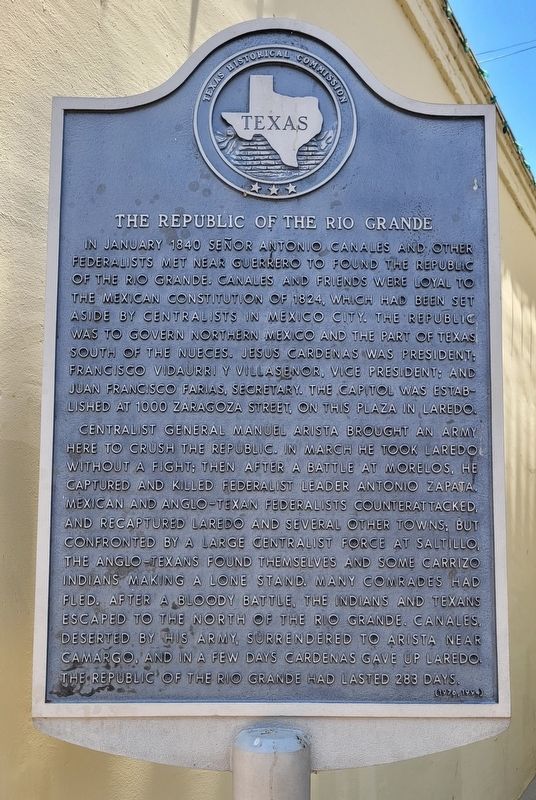
The Republic of the Rio Grande
Photographed by James Hulse, July 29, 2022
1. The Republic of the Rio Grande Marker
Centralist General Manuel Arista brought an army here to crush the republic. In March he took Laredo without a fight; then after a Battle at Morelos, he captured and killed Federalist leader Antonio Zapata. Mexican and Anglo-Texan Federalists counterattacked, and recaptured Laredo and several other towns; but confronted by a large Centralist force at Saltillo, the Anglo-Texan found themselves and some Carrizo Indians making a lone stand. Many comrades had fled. After a bloody battle, the Indians and Texans escaped to the north of the Rio Grande. Canales, deserted by his army, surrendered to Arista near Camargo, and in a few days Cardenas gave up Laredo. The Republic of the Rio Grande had lasted 283 days.
Erected 1976 by Texas Historical Commission. (Marker Number 4249.)
Topics. This historical marker is listed in these topic lists: Hispanic Americans • Indigenous Peoples and Communities • Wars, Non-US. A significant historical month for this entry is January 1840.
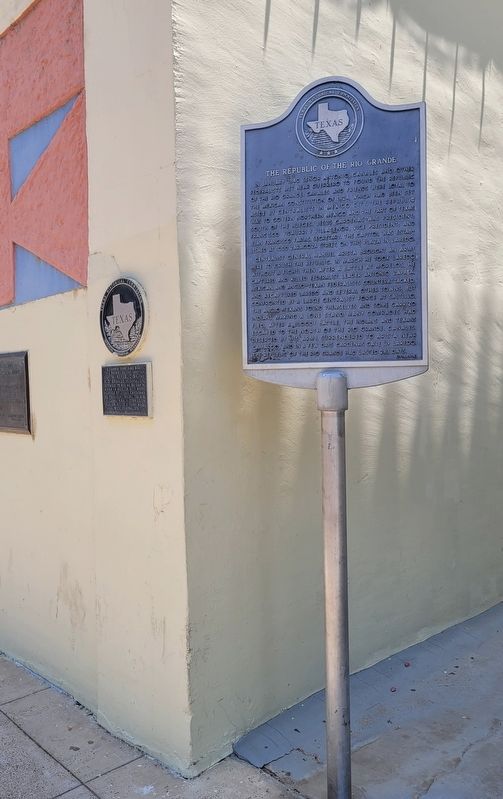
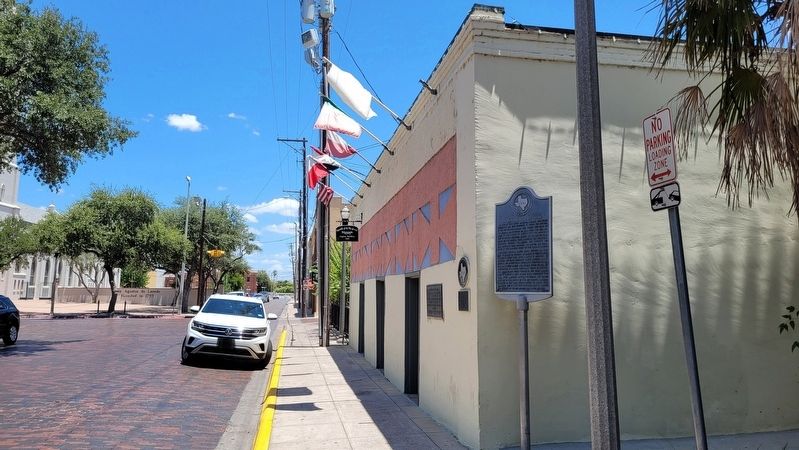
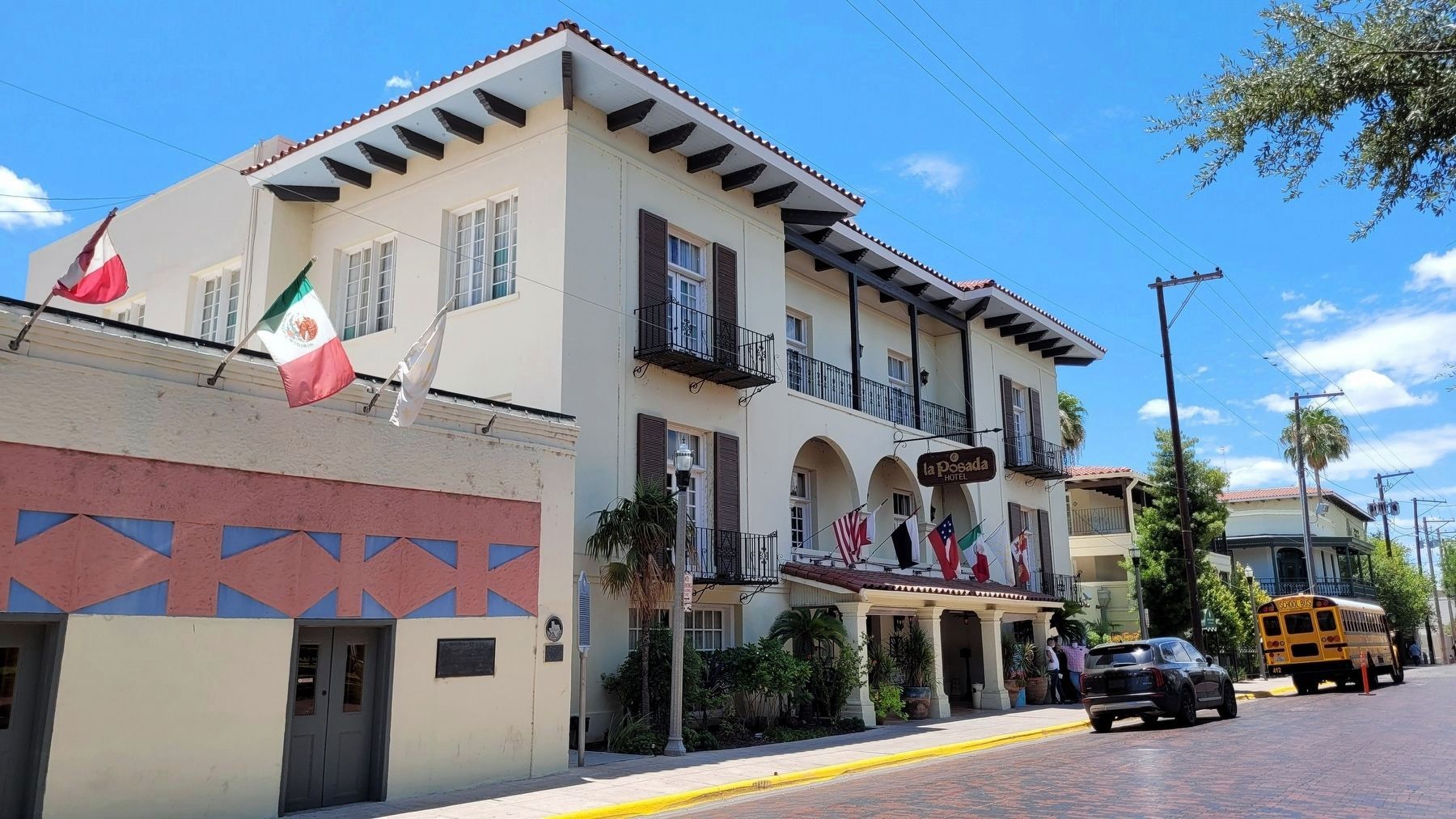
Location. 27° 30.13′ N, 99° 30.363′ W. Marker is in Laredo, Texas, in Webb County. It is at the intersection of Zaragoza Street and San Agustin Avenue, on the left when traveling west on Zaragoza Street. The marker is located east of the La Posada Hotel next to the Republic of the Rio Grande Museum. Touch for map. Marker is
this page online

Regionally, this marker is in South Texas. It is also in the American Borderlands. Globally, it is in North America, a Gulf of Mexico state, the Western Hemisphere, the Western World, and the Anglosphere. Historically, it finds itself in what was once New Spain, the Republic of Texas, and one of the Confederate States of America.
Other nearby markers. At least 8 other markers are within walking distance of this marker: Capitol, Republic of the Rio Grande (here, next to this marker); Benavides Brothers (within shouting distance of this marker); Original Site of Villa De Laredo (within shouting distance of this marker); Laredo Election Riot, 1886 (within shouting distance of this marker); Laredo Telephone Exchange (within shouting distance of this marker); St. Augustine Parochial School (within shouting distance of this marker); Casa Ortiz, 1830 (within shouting distance of this marker); Leyendecker House (within shouting distance of this marker). Touch for a list and map of all markers in Laredo.
Also see . . .
1. Republic of the Rio Grande.
Photographed by James Hulse, July 29, 2022
2. The Republic of the Rio Grande Marker is the marker on the right side
The Republic of the Rio Grande was an effort on the part of Federalist leaders in Tamaulipas, Nuevo Leon, and Coahuila to break away from the centralistic government of Mexico in 1840 and to form a new confederation. Since 1835, with the ascension of Antonio López de Santa Anna, then a Centralist, to the presidency of Mexico, Federalist leaders throughout the nation had attempted to force a return to the federalistic Constitution of 1824. This feeling was particularly strong in the northern states of Mexico, and, when they failed to achieve success in that enterprise, the northern Federalists worked to win independence from the Mexican Republic. Contiguity with Texas, recently successful in winning de facto independence, in all probability influenced their action. After much Federalistic flurry in the northern frontier Mexican states, leaders of the party met at Laredo, Texas, in convention on January 17, 1840. The convention declared independence from Mexico and claimed for its territory the areas of Tamaulipas and Coahuila north to the Nueces and Medina rivers, respectively, and Nuevo León, Zacatecas,(Submitted on August 2, 2022, by James Hulse of Medina, Texas.)Durango, Chihuahua, and New Mexico.Photographed by James Hulse3. The view of the Republic of the Rio Grande Marker looking east
2. Canales Rosillo, Antonio (1802–1852). Texas State Historical Association
As commander of Federalist forces in Tamaulipas, Canales sent envoys to appraise Anglo-Texan, Tejano, and Indian sentiments. When he discovered that the Texans' intentions were to secede from Mexico, he practiced neutrality while he fostered the idea of an independent border republic. The geographical and ideological boundaries of this republic fluctuated, but Canales easily raised armed forces from both sides of the Rio Grande.(Submitted on August 2, 2022, by James Hulse of Medina, Texas.)
Photographed by James Hulse
4. The view of the Republic of the Rio Grande Marker next to La Posada Hotel
Credits. This page was last revised on August 2, 2022. It was originally submitted on August 1, 2022, by James Hulse of Medina, Texas. This page has been viewed 934 times since then and 93 times this year. Photos: 1, 2, 3, 4. submitted on August 2, 2022, by James Hulse of Medina, Texas.
