Oxford in Talbot County, Maryland — The American Northeast (Mid-Atlantic)
1668-1710: Oxford's Beginnings
The Oxford Museum
| — | A Special Place; A Special Heritage | — |
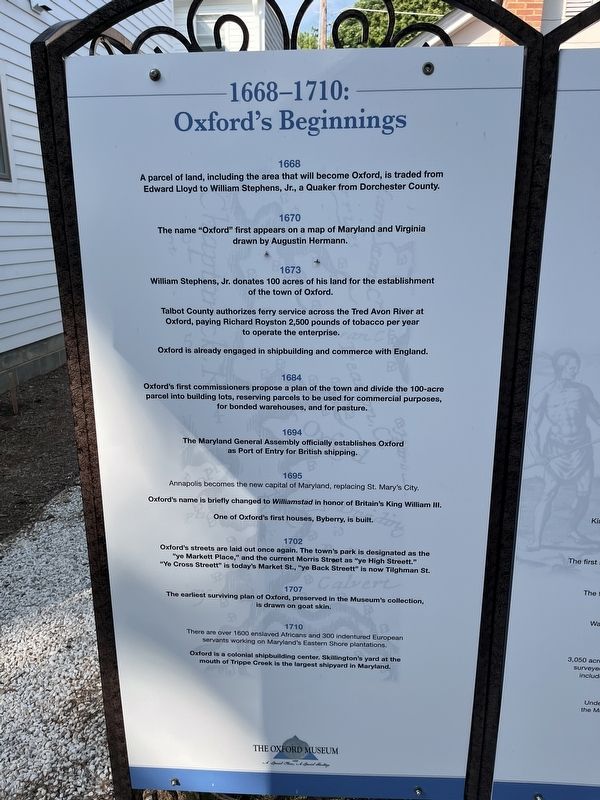
1668
A parcel of land, including the area that will become Oxford, is traded from Edward Lloyd to William Stephens, Jr., a Quaker from Dorchester County.
1670
The name "Oxford" first appears on a map of Maryland and Virginia drawn by Augustin Hermann.
1673
William Stephens, Jr. donates 100 acres of his land for the establishment of the town of Oxford.
Talbot County authorizes ferry service across the Tred Avon River at Oxford, paying Richard Royston 2,500 pounds of tobacco per year to operate the enterprise.
Oxford is already engaged in shipbuilding and commerce with England.
1684
Oxford's first commissioners propose a plan of the town and divide the 100-acre parcel into building lots, reserving parcels to be used for commercial purposes, for bonded warehouses, and for pasture.
1694
The Maryland General Assembly officially establishes Oxford as Port of Entry for British shipping.
1695
Annapolis becomes the new capital of Maryland, replacing St. Mary's City.
Oxford's name is briefly changed to Williamstad in honor of Britain's king William III.
One of Oxford's first houses, Byberry, is
this page online
1702
Oxford's streets are laid out once again. The town's park is designated as the "ye Market Place," and the current Morris Street as "ye High Streett." "Ye Cross Streett" is today's Market St., "ye Back Streett" is now Tilghman St.
1707
The earliest surviving plan of Oxford, preserved in the Museum's collection, is drawn on goat skin.
1710
There are over 1600 enslaved Africans and 300 indentured European servants working on Maryland's Eastern Shore plantations.
Oxford is a colonial shipbuilding center. Skillington's yard at the mouth of Trippe Creek is the largest shipyard in Maryland.
Erected by The Oxford Museum.
Topics and series. This historical marker is listed in these topic lists: African Americans • Agriculture • Colonial Era • Industry & Commerce • Settlements & Settlers • Waterways & Vessels. In addition, it is included in the Quakerism series list. A significant historical year for this entry is 1668.
Location. 38° 41.344′ N, 76° 10.345′ W. Marker is in Oxford, Maryland, in Talbot County. It can be reached from the intersection of South Morris Street and Market Street,

Regionally, this marker is on the Eastern Shore. It is also in the American Mid-Atlantic, on the Delmarva Peninsula, in the Tidewater, in the Chesapeake Bay Region, and on the Eastern Seaboard. Globally, it is in the North Atlantic Region, North America, the Western Hemisphere, the Western World, and the Anglosphere. Historically, it finds itself in what was once one of the original Thirteen Colonies and also the Antebellum South.
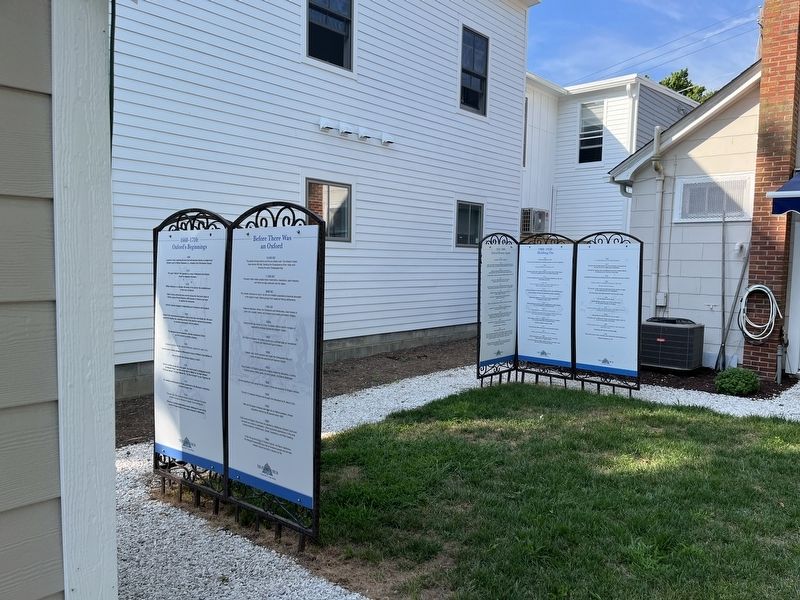
Other nearby markers. At least 8 other markers are within walking distance of this marker: Before There Was an Oxford (here, next to this marker); 1812-1865: Rebuilding (here, next to this marker); 1738-1793: Boom and Bust (here, next to this marker); 1900-1950: Holding On (here, next to this marker); 1870-1900: Oxford Booms Again (here, next to this marker); 1952-Present: Oxford Rises Again (here, next to this marker); Remembering Ancestors: The Middle Passage in Oxford, Maryland (approx. ¼ mile away); The Robert Morris Inn (approx. ¼ mile away). Touch for a list and map of all markers in Oxford.
Credits. This page was last revised on August 28, 2022. It was originally submitted on August 28, 2022, by Devry Becker Jones of Washington, District of Columbia. This page has been viewed 697 times since then and 99 times this year. Photos: 1, 2. submitted on August 28, 2022, by Devry Becker Jones of Washington, District of Columbia.
