Southside in San Antonio in Bexar County, Texas — The American South (West South Central)
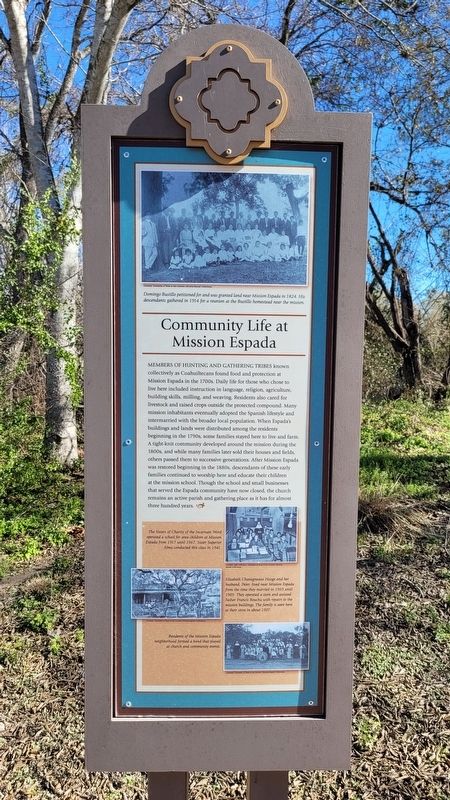
Community Life at Mission Espada
Photographed by James Hulse, December 27, 2022
1. Community Life at Mission Espada Marker
Captions
Top: Domingo Bustillo petitioned for and was granted land near Mission Espada in 1824. His descendants gathered in 1914 for a reunion at the Bustillo homestead near the mission.
Courtesy: University of Texas at San Antonio Libraries Special Collections.
Bottom 1: The Sisters of Charity of the Incarnate Word operated a school for area children at Mission Espada from 1917 until 1967. Sister Superior Alma conducted this class in 1941.
Courtesy: Light Collection, University of Texas at San Antonio Libraries Special Collections.
Bottom 2: Elizabeth Chavagneaux Hooge and her husband, Peter, lived near Mission Espada from the time they married in 1903 until 1909. They operated a store and assisted Father Francis Bouchu with repairs to the mission buildings. The family is seen here at their store in about 1907.
Courtesy: University of Texas at San Antonio Libraries Special Collections.
Bottom 3: Residents of the Mission Espada neighborhood formed a band that played at church and community events.
Courtesy: University of Texas at San Antonio Libraries Special Collections.
Erected by San
this page online
Topics. This historical marker is listed in these topic lists: Colonial Era • Hispanic Americans • Indigenous Peoples and Communities • Religion & Religious Structures. A significant historical year for this entry is 1824.
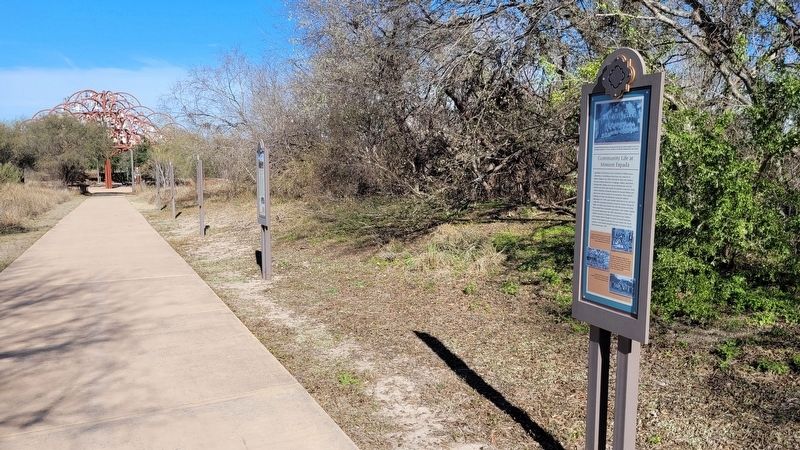
Location. 29° 19.168′ N, 98° 27.059′ W. Marker is in San Antonio, Texas, in Bexar County. It is in Southside. It can be reached from the intersection of Espada Road and Camino Coahuilteca. The marker is located north of the Mission Espada along the River Walk. Touch for map. Marker is at or near this postal address: 10040 Espada Road, San Antonio TX 78214, United States of America. Touch for directions.

Regionally, this marker is in South Texas. It is also in the American South. Globally, it is in North America, a Gulf of Mexico state, the Western Hemisphere, the Western World, and the Anglosphere. Historically, it finds itself in what was once New Spain, the Republic of Texas, and one of the Confederate States of America.
Other nearby markers. At least 8 other markers are within walking distance of this marker: Mission Espada: The Restoration Period
Photographed by James Hulse, December 27, 2022
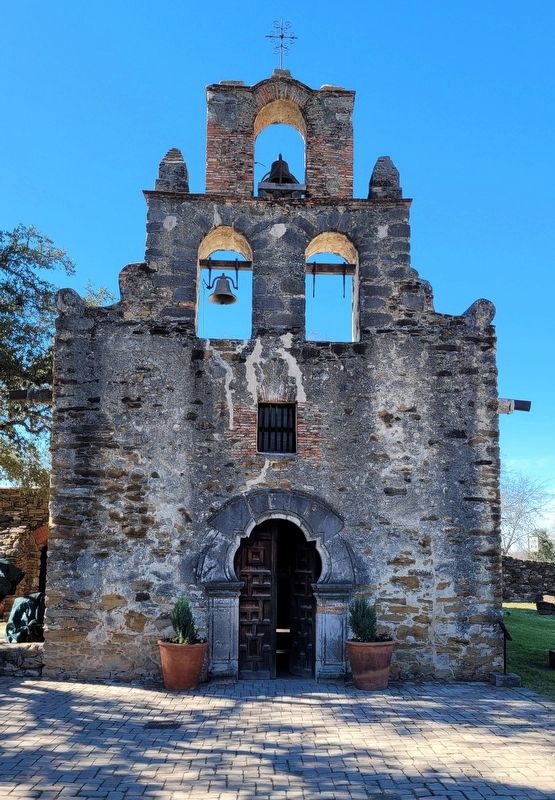
2. The Mission Espada Church
Also see . . .
1. Mission Espada. San Antonio Missions - World Heritage
Mission San Francisco de la Espada was the first Spanish Mission in Texas. It was founded in 1690 as San Francisco de los Tejas near present-day Nacogdoches in East Texas. It was renamed as Mission San Francisco de la Espada when it moved to San Antonio in 1731. Distinctive Spanish design features can be seen in the church doorway, bell tower, and brick archways. Espada’s ranch, Rancho de las Cabras, is 23 miles south of the Mission and had as many as 1,262 head of cattle and 4,000 sheep. Mission Espada’s(Submitted on January 9, 2023, by James Hulse of Medina, Texas.)acequia is the nation’s oldest in continuous use. It still uses San Antonio River water to irrigate local crops today illustrating the connection the river makes between the past and the present.Photographed by James Hulse, December 27, 20223. The view of the Community Life at Mission Espada Marker along the River Walk
2. Coahuiltecan Indians. Texas State Historical Association
The lowlands of northeastern Mexico and adjacent southern Texas were originally occupied by hundreds of small, autonomous, distinctively named Indian groups that lived by hunting and gathering. During the Spanish colonial period a majority of these natives were displaced from their traditional territories by Spaniards advancing from the south and Apaches retreating from the north. The Spaniards had little interest in describing the natives or classifying them into ethnic units. There was no obvious basis for classification, and major cultural contrasts and tribal organizations went unnoticed, as did similarities and differences in the native languages and dialects. Spaniards referred to an Indian group as a nación, and described them according to their association with major terrain features or with Spanish jurisdictional units.(Submitted on January 9, 2023, by James Hulse of Medina, Texas.)
Credits. This page was last revised on February 2, 2023. It was originally submitted on January 9, 2023, by James Hulse of Medina, Texas. This page has been viewed 957 times since then and 26 times this year. Photos: 1, 2, 3. submitted on January 9, 2023, by James Hulse of Medina, Texas.
