Spy Run in Fort Wayne in Allen County, Indiana — The American Midwest (Great Lakes)
Meshekinnoquah
(Chief Little Turtle)
Photographed by Dale K. Benington, July 20, 2009
1. Meshekinnoquah Marker
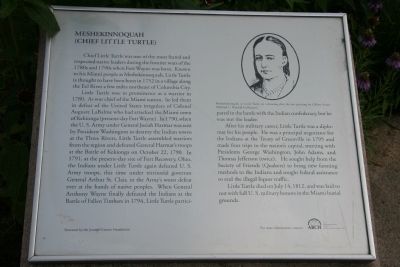
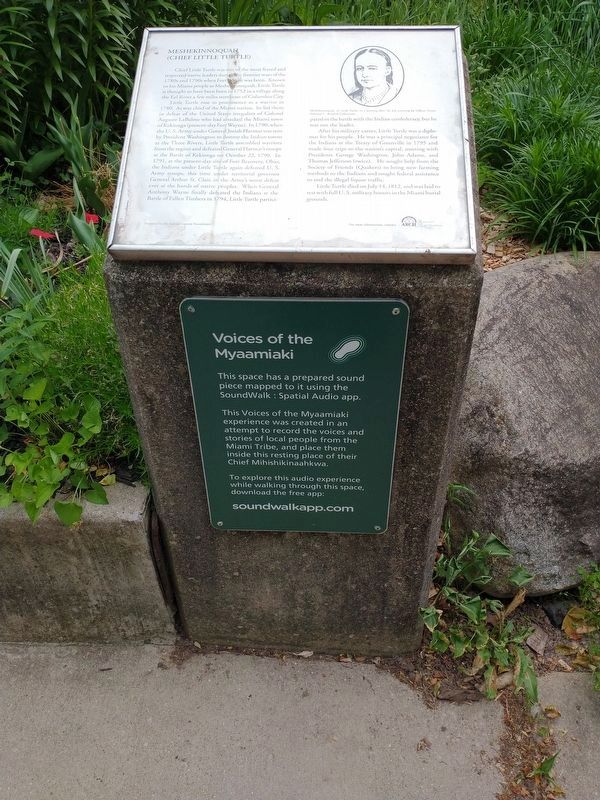
Little Turtle rose to prominence as a warrior in 1780. As war chief of the Miami nation, he led them in defeat of the united States irregulars of Colonel LaBalme who attacked the Miami town of Kekionga (present-day Fort Wayne). In 1790, when the U.S. Army under General Josiah Harmar was sent by President Washington to destroy the Indian towns at the Three Rivers, Little Turtle assembled warriors from the region and defeated General Harmar's troops at the Battle of Kekionga on October 22, 1790. In 1791, at the present-day site of Fort Recovery, Ohio, the Indians under Little Turtle again defeated U.S. Army troops, this time under territorial governor General Arthur St. Clair, in the Army's worst defeat ever at the hands of native peoples. When General Anthony Wayne finally defeated the Indians at the Battle of Fallen
this page online
After his military career, Little Turtle was a diplomat for his people. He was a principal negotator for the Indians at the Treaty of Greenville in 1795 and made four trips to the nation's capital, meeting with Presidents George Washington, John Adams, and Thomas Jefferson (twice). He sought help from the Society of Friends (Quakers) to bring new farming methods to the Indians and sought federal assistance to end the illegal liquor traffic.
Little Turtle died on July 14, 1812, and was laid to rest with full U.S. military honors in the Miami burial grounds.
Erected by the Journal-Gazette Foundation.
Topics and series. This historical marker is listed in these topic lists: Cemeteries & Burial Sites • Indigenous Peoples and Communities • Wars, US Indian. In addition, it is included in the Former U.S. Presidents: #01 George Washington, the Former U.S. Presidents: #02 John Adams, the Former U.S. Presidents: #03 Thomas Jefferson, and the Quakerism series lists. A significant historical month for this entry is July 1863.
Location. 41° 5.484′ N,
Photographed by Dale K. Benington, July 20, 2009
2. Meshekinnoquah Marker
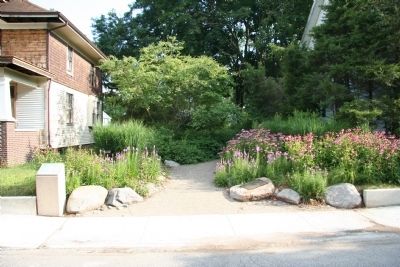
View of historical marker in the left foreground, with a view of a second marker, the plaque to dedicated to Chief Little Turtle affixed to the large flat rock in the center foreground of the picture. Both markers being located at the site of Chief Little Turtle's final resting place.

Regionally, this marker is in Northern Indiana. It is also in the American Midwest and in the Corn Belt. Globally, it is in North America, the Western Hemisphere, the Western World, and the Anglosphere. Historically, it finds itself in what was once the Viceroyalty of New France, the territory of the Mississippian Culture, and the Northwest Territory.
Other nearby markers. At least 8 other markers are within walking distance of this marker: Chief Little Turtle (here, next to this marker); Site of Last French Fort
Photographed by Dale K. Benington, July 20, 2009
3. Meshekinnoquah (Chief Little Turtle) Marker
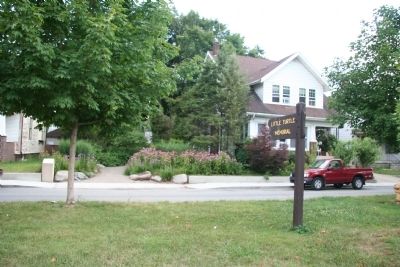
View of the Little Turtle Memorial Park, as seen from across the street, with the historical marker in the left background.
Another marker is no longer nearby. Jail Flats (was approx. half a mile away but has been confirmed missing).
Also see . . . Wikipedia entry for Michikinikwa. (Submitted on August 9, 2009, by Dale K. Benington of Toledo, Ohio.)
Photographed by Tom Bosse, June 3, 2023
4. Meshekinnoquah Marker
Credits. This page was last revised on July 10, 2026. It was originally submitted on August 9, 2009, by Dale K. Benington of Toledo, Ohio. This page has been viewed 2,822 times since then and 36 times this year. Photos: 1, 2, 3. submitted on August 9, 2009, by Dale K. Benington of Toledo, Ohio. 4. submitted on June 13, 2023, by Tom Bosse of Jefferson City, Tennessee. • Craig Swain was the editor who published this page.
