The Port in Cambridge in Middlesex County, Massachusetts — The American Northeast (New England)
Charlotte Hawkins Brown
Educator, Lecturer, Social Worker, and Religious Leader
| — | 1883 - 1961 | — |
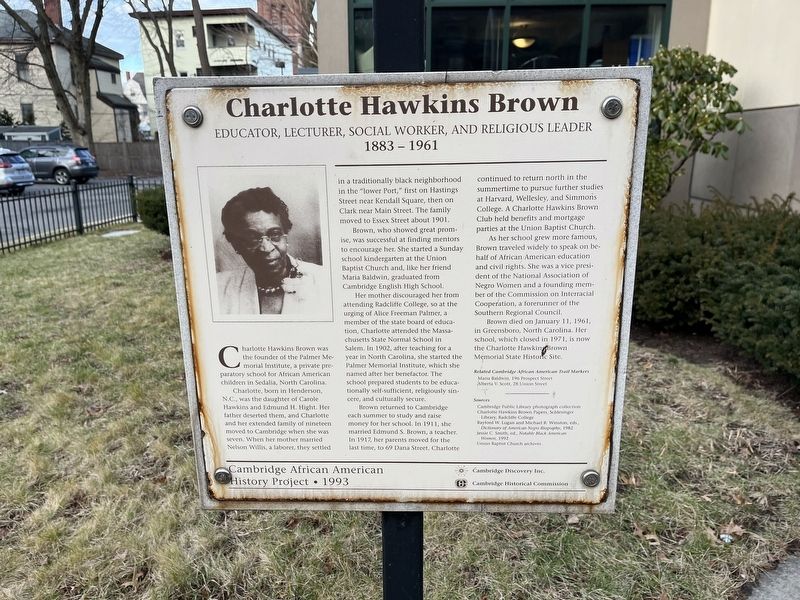
Charlotte Hawkins Brown was the founder of the Palmer Memorial Institute, a private preparatory school for African American children in Sedalia, North Carolina.
Charlotte, born in Henderson, N.C., was the daughter of Carole Hawkins and Edmund H. Hight. Her father deserted them, and Charlotte and her extended family of nineteen moved to Cambridge when she was seven. When her mother married Nelson Willis, a laborer, they settled in a traditionally black neighborhood in the "lower Port," first on Hastings Street near Kendall Square, then on Clark near Main Street. The family moved to Essex Street about 1901.
Brown, who showed great promise, was successful at finding mentors to encourage her. She started a Sunday school kindergarten at the Union Baptist Church and, like her friend Maria Baldwin, graduated from Cambridge English High School.
Her mother discouraged her from attending Radcliffe College, so at the urging of Alice Freeman Palmer, a member of the state board of education, Charlotte attended the Massachusetts State Normal School in Salem. In 1902, after teaching for a year in North Carolina, she started
this page online
Brown returned to Cambridge each summer to study and raise money for her school. In 1911, she married Edmund S. Brown, a teacher. In 1917, her parents moved for the last time, to 69 Dana Street. Charlotte continued to return north in the summertime to pursue further studies at Harvard, Wellesley, and Simmons College. A Charlotte Hawkins Brown Club held benefits and mortgage parties at the Union Baptist Church.
As her school grew more famous, Brown traveled widely to speak on behalf of African American education and civil rights. She was a vice president of the National Association of Negro Women and a founding member of the Commission on Interracial Cooperation, a forerunner of the Southern Regional Council.
Brown died on January 11, 1961, in Greensboro, North Carolina. Her school, which closed in 1971, is now the Charlotte Hawkins Brown Memorial State Historic Site.
Related Cambridge African American Trail Markers
Maria Baldwin, 196 Prospect Street
Albert V. Scott, 28 Union Street
Sources
Cambridge Public Library photograph collection
Charlotte Hawkins Brown Papers, Schlesinger Library, Radcliffe College
Rayford W. Logan and Michael R. Winston, eds., Dictionary of American Negro Biography, 1982
Jesse C. smith, ed., Notable Black American Women, 1992
Union Baptist Church archives
Erected 1993
Topics. This historical marker is listed in these topic lists: African Americans • Charity & Public Work • Civil Rights • Education • Religion & Religious Structures • Women. A significant historical date for this entry is January 11, 1961.
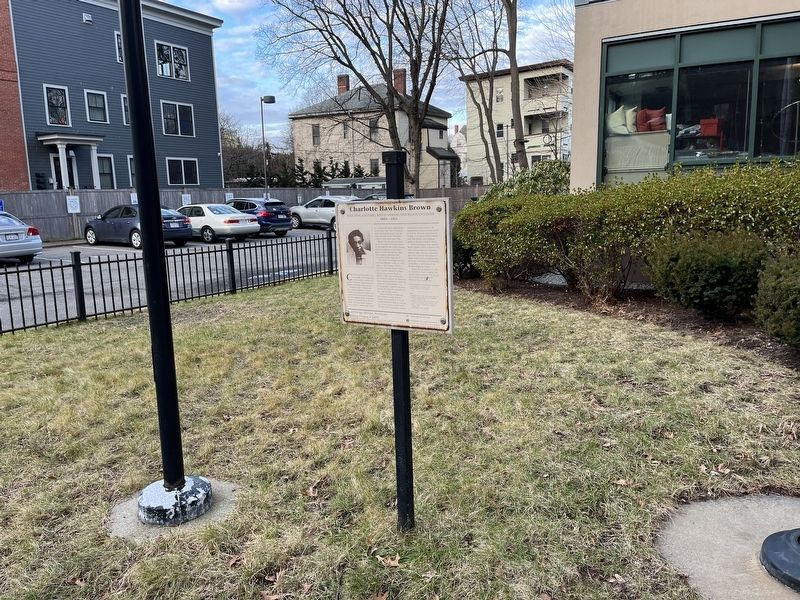
Location. 42° 22.048′ N, 71° 6.074′ W. Marker is in Cambridge, Massachusetts, in Middlesex County. It is in The Port. It is on Essex Street north of Lamson Place, on the left when traveling north. Touch for map. Marker is at or near this postal address: 1 Lamson Pl, Cambridge MA 02139, United States of America. Touch for directions.

Regionally, this marker is in Historic Boston and specifically in Greater Boston. It is also in the American Northeast, in New England, and on the Eastern Seaboard. Globally, it is in the North Atlantic Region, North America, the Western Hemisphere, the Western World, and the Anglosphere. Historically, it finds itself in what was once one of the original Thirteen Colonies.
Other nearby markers. At least 8 other markers are within walking distance of this marker: J. Milton Clarke 1820 - 1902 / Lewis Clarke 1818 - 1897 (about 500 feet away, measured in a direct line); Francis P. Soucie Square (approx. 0.2 miles away); Dr. Martin Luther King (approx. ¼ mile away); The Massachusetts Avenue Baptist Church (approx. 0.3 miles away); Clement G. Morgan (approx. 0.3 miles away); Benedict M. Carvalho Sq. / George Carvalho Sq. (approx. 0.3 miles away); Alberta V. Scott (approx. 0.4 miles away); Jake & Earl's Dixie BBQ (approx. 0.4 miles away). Touch for a list and map of all markers in Cambridge.
Credits. This page was last revised on January 31, 2023. It was originally submitted on January 31, 2023, by Devry Becker Jones of Washington, District of Columbia. This page has been viewed 444 times since then and 30 times this year. Photos: 1, 2. submitted on January 31, 2023, by Devry Becker Jones of Washington, District of Columbia.
