Neighborhood Nine in Cambridge in Middlesex County, Massachusetts — The American Northeast (New England)
Old Cambridge
Newtowne
⎯⎯⎯
From Country Village to City

Newtowne
One of the Neatest and Best Compacted Towns
So wrote William Wood in New England's Prospect in 1633. At this time, sixty families occupied the first planned community in America, in which the houses were required to "range eevn" six feet from the street. Of the original settlement, much remains; the street pattern south of Harvard Square, the marketplace (now Winthrop Square), the Common and Old Burying Ground.
After Governor Winthrop moved his house back to Boston, the Braintree Company with the Reverend Thomas Hooker settled in Newtowne, and a church was gathered. Hooker and his congregation left for wider lands in Connecticut in 1635, and Reverend Thomas Shepard arrived with a new congregation whose members bought the vacant properties. That same year, Governor Dudley and his assistant, Simon Bradstreet, moved to Ipswich. Newtown's brief history as the seat of the Colonial government ended in 1638.
Meetinghouse and Common — Struggles for Freedom
The two most important locations in Newtowne were the Meetinghouse — where town meetings and religious services were held — and the Common, originally used
this page online
Newtowne's "Cow Common," which originally extended to what is now Linnaean Street, remains as the present Cambridge Common.
Advocate of Individual Freedom
In 1637, Ann Hutchinson was accused of "traducing the ministers and their ministry" by holding religious discussion groups in her home. Governor Harry Vane argued publicly for her religious freedom, but Hutchinson was tried in Cambridge, condemned for heresy and exiled. She died in Hellgate, New York.
Harvard College
A college was founded in 1636 to advance "knowledge and godliness," and "perpetuate it to posterity." In 1638, the new school, named after Reverend John Harvard, a generous benefactor, opened in a wooden house with a cow yard behind it. That same year, the General Court, many of whose members were graduates of Cambridge University "ordered that Newtowne shall thenceforward be called Cambridge."
A printing press arrived from England in 1639, the first in the country. It became
Harvard College was the driving force in the development of Old Cambridge. Its future dominance of the community was already expressed in two of its early buildings, criticized at the time as "too gorgeous for a wilderness."
From Country Village to City
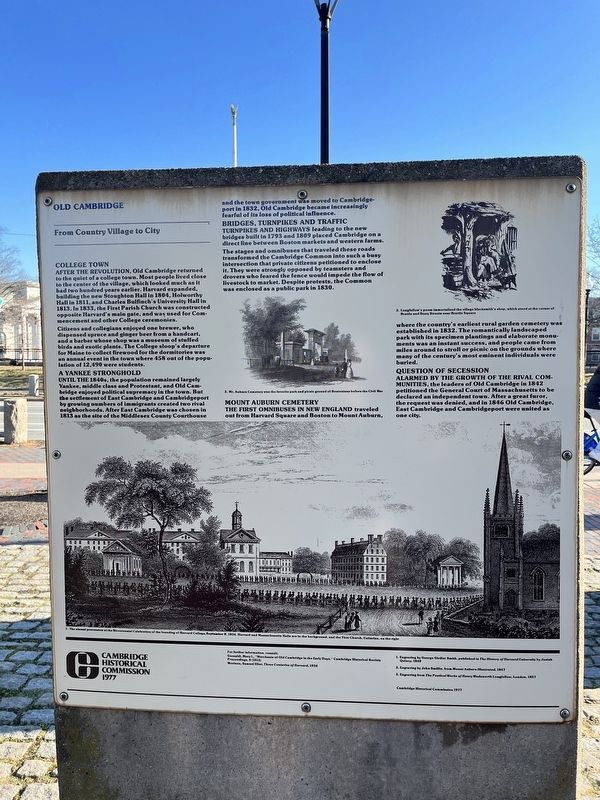
College Town
After the Revolution, Old Cambridge returned to the quiet of a college town. Most people lived close to the center of the village, which looked much as it had two hundred years earlier. Harvard expanded, building the new Stoughton Hall in 1804, Holworthy Hall in 18011, and Charles Bulfinch's University Hall in 1813. In 1833, the First Parish Church was constructed opposite Harvard's main gate, and was used for Commencement and other College ceremonies.
Citizens and collegians enjoyed one brewer, who dispense spruce and ginger beer from a handcart, and a barber whose shop was a museum of stuffed birds and exotic plants. The College sloop's departure for Maine to collect firewood for
A Yankee Stronghold
Until the 1840s, the population remained largely Yankee, middle class and Protestant, and Old Cambridge enjoyed political supremacy in the town. But the settlement of East Cambridge and Cambridgeport by growing numbers of immigrants created two rival neighborhoods. After East Cambridge was chosen in 1813 as the site of the Middlesex County Courthouse and the town government was moved to Cambridgeport in 1832, Old Cambridge became increasingly fearful of its loss of political influence.
Bridges, Turnpikes and Traffic
Turnpikes and highways leading to the new bridges built in 1793 and 1809 placed Cambridge on a direct line between Boston markets and western farms.
The stages and omnibuses that traveled these roads transformed the Cambridge Common into such a busy intersection that private citizens petitioned to enclose it. They were strongly opposed by teamsters and drovers who feared the fence would impede the flow of livestock to market. Despite protests, the Common was enclosed as a public park in 1830.
Mount Auburn Cemetery
The first omnibuses in New England traveled out from Harvard Square and Boston to Mount Auburn, where the country's earliest rural garden cemetery was established in 1832. The romantically landscaped park with its specimen plantings and elaborate monuments was an instant success, and people came from miles around to stroll or picnic on the ground where many of the century's most eminent individuals are buries.
Question of Secession
Alarmed by the growth of the rival communities, the leaders of Old Cambridge in 1842 petitioned the General Court of Massachusetts to be declared an independent town. After a great furor, the request was denied, and in 1846 Old Cambridge, East Cambridge and Cambridgeport were united as one city.
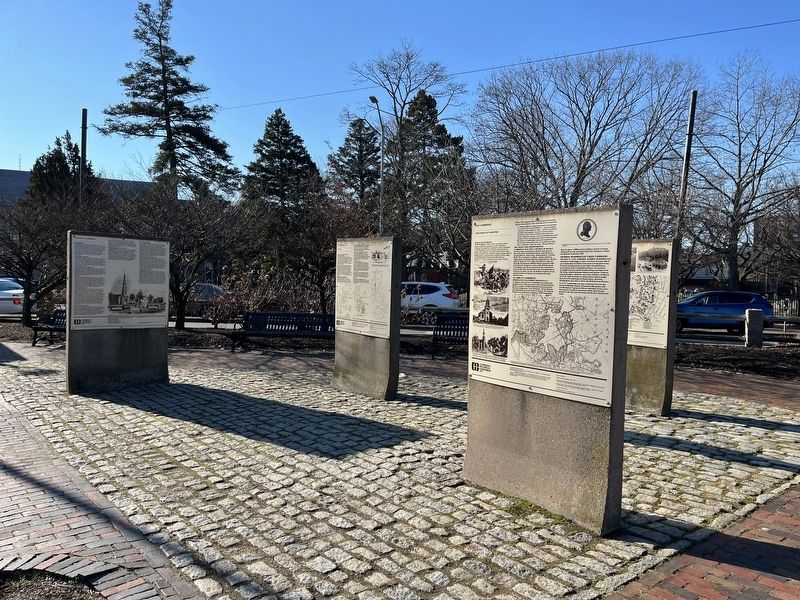
Erected 1977 by Cambridge Historic Commission.
Topics. This historical marker is listed in these topic lists: Colonial Era • Immigration • Religion & Religious Structures • Settlements & Settlers. A significant historical year for this entry is 1633.
Location. 42° 22.527′ N, 71° 7.171′ W. Marker is in Cambridge, Massachusetts, in Middlesex County. It is in Neighborhood Nine. It is at the intersection of Massachusetts Avenue (Route 2A) and Garden Street, on the right when traveling south on Massachusetts Avenue. Touch for map. Marker is in this post office area: Cambridge MA 02138, United States of America. Touch for directions.

Regionally, this marker is in Greater Boston. It is also in the American Northeast, in New England, and on the Eastern Seaboard. Globally, it is in the North Atlantic Region, North America, the Western Hemisphere, the Western World, and the Anglosphere. Historically, it finds itself in what was once one of the original Thirteen Colonies.
Other nearby markers. At least 8 other markers are within walking distance of this marker: History of Cambridge (here, next to this marker); Old Cambridge / Religion and Government in the Early History of Cambridge (here, next to this marker); a different marker also named Old Cambridge (here, next to this marker); Route of William Dawes (here, next to this marker); George Washington (within shouting distance of this marker); Cambridge Common (within shouting distance of this marker); Revolutionary War Memorial (within shouting distance of this marker); Old Burying Ground (within shouting distance of this marker). Touch for a list and map of all markers in Cambridge.
Credits. This page was last revised on February 1, 2023. It was originally submitted on February 1, 2023, by Devry Becker Jones of Washington, District of Columbia. This page has been viewed 525 times since then and 35 times this year. Photos: 1, 2, 3. submitted on February 1, 2023, by Devry Becker Jones of Washington, District of Columbia.
