Thelka in San Antonio in Bexar County, Texas — The American South (West South Central)
Missions in the San Antonio River Valley
Photographed by James Hulse, January 29, 2023
1. Missions in the San Antonio River Valley Marker
Inscription.
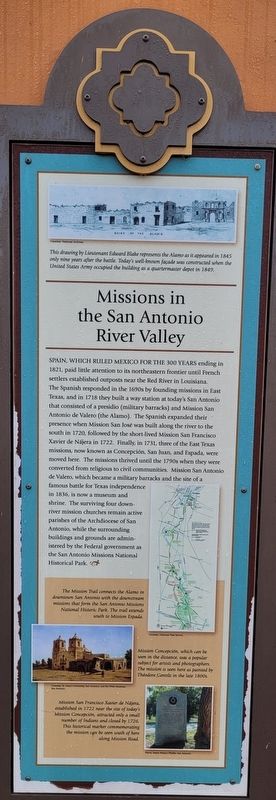
Missions in the San Antonio River Valley. . Spain, Which Ruled Mexico For The 300 Years ending in 1821, paid little attention to its northeastern frontier until French settlers established outposts near the Red River in Louisiana. The Spanish responded in the 1690s by founding missions in East Texas, and in 1718 they built a way station at today's San Antonio that consisted of a presidio (military barracks) and Mission San Antonio de Valero (the Alamo). The Spanish expanded their presence when Mission San José was built along the river to the south in 1720, followed by the short-lived Mission San Francisco Xavier de Nájera in 1722. Finally, in 1731, three of the East Texas missions, now known as Concepción, San Juan, and Espada, were moved here. The missions thrived until the 1790s when they were converted from religious to civil communities. Mission San Antonio de Valero, which became a military barracks and the site of a famous battle for Texas independence in 1836, is now a museum and shrine. The surviving four downriver mission churches remain active parishes of the Archdiocese of San Antonio, while the surrounding buildings and grounds are administered by the Federal government as the San Antonio Missions National Historical Park., Captions , 1. This drawing by Lieutenant Edward Blake represents the Alamo as it appeared in 1845 only nine years after the battle. Today's well-known façade was constructed when the United States Army occupied the building as a quartermaster depot in 1849. , 2. The Mission Trail connects the Alamo in downtown San Antonio with the downstream missions that form the San Antonio Missions National Historic Park. The trail extends south to Mission Espada. , 3. Mission Concepción, which can be seen in the distance, was a popular subject for artists and photographers. The mission is seen here as painted by Theodore Gentilz in the late 1800s. , 4. Mission San Francisco Xavier de Nájera, established in 1722 near the site of today's Mission Concepción, attracted only a small number of Indians and closed by 1726. This historical marker commemorating the mission can be seen south of here along Mission Road., Courtesy: National Archives , Courtesy: National Park Service , Courtesy: St. Mary's University, San Antonio, and the Witte Museum, San Antonio. , Photo: Maria Watson Pfeiffer, San Antonio.
Spain, Which Ruled Mexico For The 300 Years ending in 1821, paid little attention to its northeastern frontier until French settlers established outposts near the Red River in Louisiana. The Spanish responded in the 1690s by founding missions in East Texas, and in 1718 they built a way station at today's San Antonio that consisted of a presidio (military barracks) and Mission San Antonio de Valero (the Alamo). The Spanish expanded their presence when Mission San José was built along the river to the south in 1720, followed by the short-lived Mission San Francisco Xavier de Nájera in 1722. Finally, in 1731, three of the East Texas missions, now known as Concepción, San Juan, and Espada, were moved here. The missions thrived until the 1790s when they were converted from religious to civil communities. Mission San Antonio de Valero, which became a military barracks and the site of a famous battle for Texas independence in 1836, is now a museum and shrine. The surviving four downriver mission churches remain active parishes of the Archdiocese of San Antonio, while the surrounding buildings and grounds are administered by the Federal government as the San Antonio Missions National Historical Park.
Captions 1. This drawing by Lieutenant Edward Blake represents the Alamo as it appeared in 1845 only
Click or scan to see this page online
nine years after the battle. Today's well-known façade was constructed when the United States Army occupied the building as a quartermaster depot in 1849. 2. The Mission Trail connects the Alamo in downtown San Antonio with the downstream missions that form the San Antonio Missions National Historic Park. The trail extends south to Mission Espada. 3. Mission Concepción, which can be seen in the distance, was a popular subject for artists and photographers. The mission is seen here as painted by Theodore Gentilz in the late 1800s. 4. Mission San Francisco Xavier de Nájera, established in 1722 near the site of today's Mission Concepción, attracted only a small number of Indians and closed by 1726. This historical marker commemorating the mission can be seen south of here along Mission Road.
Courtesy: National Archives
Courtesy: National Park Service
Courtesy: St. Mary's University, San Antonio, and the Witte Museum, San Antonio.
Photo: Maria Watson Pfeiffer, San Antonio.
Location. 29° 23.304′ N, 98° 29.877′ W. Marker is in San
Photographed by James Hulse, January 29, 2023
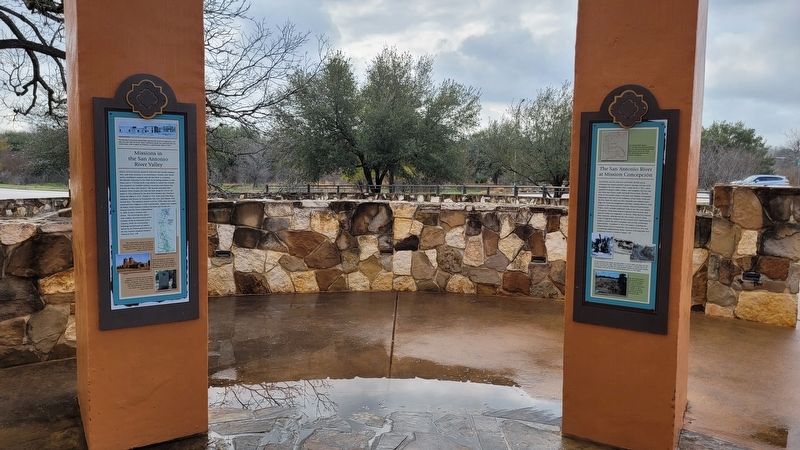
2. The Missions in the San Antonio River Valley Marker is on the left side of the two markers
Antonio, Texas, in Bexar County. It is in Thelka. It is on East Theo Avenue 0.4 miles west of Mission Road, on the right when traveling west. The marker is located in the western section of the Concepción Park near the River Walk. Touch for map. Marker is at or near this postal address: 1800 River Walk, San Antonio TX 78210, United States of America. Touch for directions.

Regionally, this marker is in South Texas. It is also in the American South. Globally, it is in North America, a Gulf of Mexico state, the Western Hemisphere, the Western World, and the Anglosphere. Historically, it finds itself in what was once New Spain, the Republic of Texas, and one of the Confederate States of America.
Also see . . . Concepcion Park. City of San Antonio (Submitted on February 15, 2023, by James Hulse of Medina, Texas.)
Photographed by James Hulse, January 29, 2023
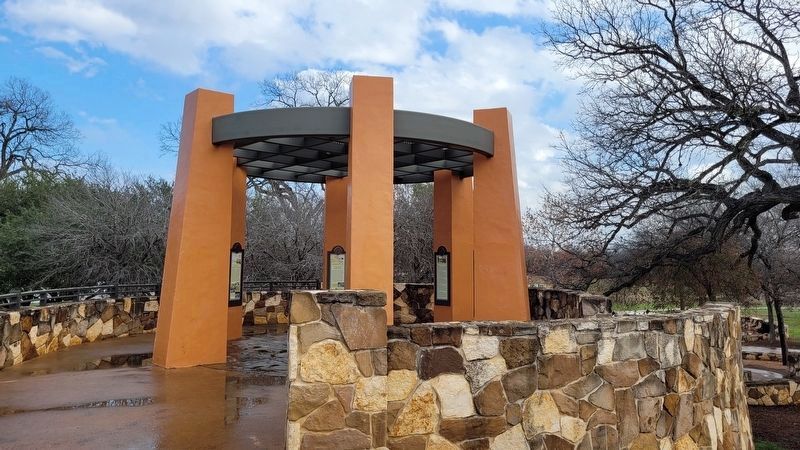
3. The pavilion has 6 markers on it
Credits. This page was last revised on February 15, 2023. It was originally submitted on February 15, 2023, by James Hulse of Medina, Texas. This page has been viewed 174 times since then and 6 times this year. Photos:1, 2, 3. submitted on February 15, 2023, by James Hulse of Medina, Texas.