East Village in Calgary in Calgary Metropolitan Region, Alberta — Canada’s Prairie Region (North America)
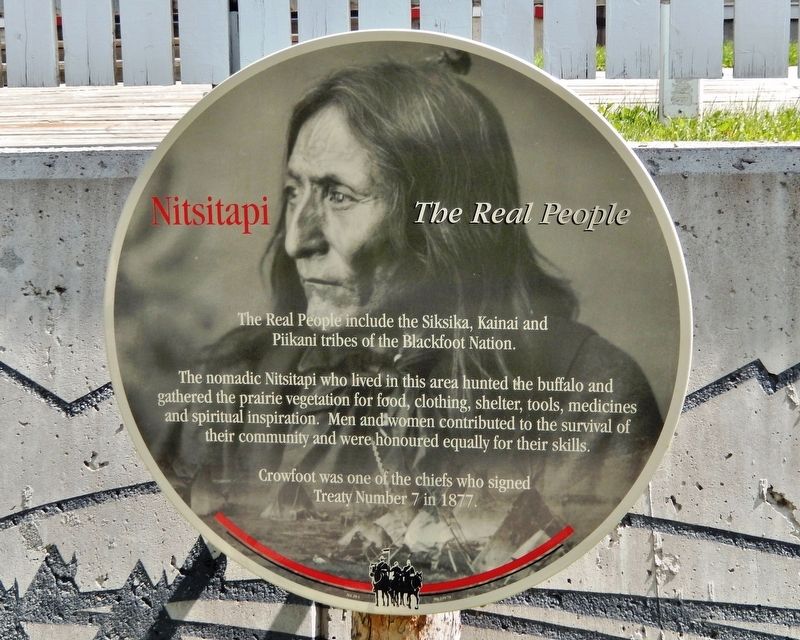
Nitsitapi
The Real People
Photographed by Cosmos Mariner, July 1, 2022
1. Nitsitapi Marker
The Real People include the Siksika, Kainai and Piikani tribes of the Blackfoot Nation.
The nomadic Nitsitapi who lived in this area hunted the buffalo and gathered the prairie vegetation for food, clothing, shelter, tools, medicines and spiritual inspiration. Men and women contributed to the survival of their community and were honoured equally for their skills.
Crowfoot was one of the chiefs who signed Treaty Number 7 in 1877.
Topics. This historical marker is listed in these topic lists: Anthropology & Archaeology • Indigenous Peoples and Communities • Settlements & Settlers. A significant historical year for this entry is 1877.
Location. 51° 2.685′ N, 114° 2.678′ W. Marker is in Calgary, Alberta, in Calgary Metropolitan Region. It is in East Village. It can be reached from 9 Avenue Southeast 0.3 kilometers east of 6 Street Southeast, on the left when traveling east. Marker is located along the interpretive trail at Fort Calgary National Historic Site. Touch for map. Marker is at or near this postal address: 750 9 Avenue Southeast, Calgary AB T2G 5E1, Canada. Touch for directions.

Regionally, this marker
this page online
Other nearby markers. At least 8 other markers are within walking distance of this marker: Early Explorers (here, next to this marker); Métis, Whiskey Traders, Missionaries and Settlers (here, next to this marker); The North West Mounted Police (here, next to this marker); The North West Territories (a few steps from this marker); The North West Mounted Police March West (a few steps from this marker); An Outpost on the Bow River (a few steps from this marker); The Train Arrives in Calgary (a few steps from this marker); The Mounties Sell Calgary Barracks (a few steps from this marker). Touch for a list and map of all markers in Calgary.
Regarding Nitsitapi. Niitsítapi is a term used by the Blackfoot to refer to themselves. It translates to “The Real People”. The Blackfoot Confederacy consists of four tribes of Niitsítapi (The Real People): the Kainai (Bloods), the Piikani (Peigans),
Photographed by Cosmos Mariner, July 1, 2022
2. Nitsitapi Marker
Related markers. Click here for a list of markers that are related to this marker. Fort Calgary National Historic Site
Also see . . .
1. Niitsitapi (Blackfoot). Canadian Encyclopedia website entry (Submitted on June 27, 2025, by Larry Gertner of New York, New York.)
2. Crowfoot. Wikipedia entry:
Chief Crowfoot was born in 1830 to the Kainai, known to traders and settlers as the Bloods, one of the tribes of the Blackfoot Confederacy. Crowfoot was a warrior who fought in as many as nineteen battles and sustained many injuries, but he tried to obtain peace instead of warfare. Crowfoot is well known for his involvement in Treaty Number 7 and did much negotiating for his people.(Submitted on May 1, 2023, by Cosmos Mariner of Cape Canaveral, Florida.)
3. Treaty 7. Wikipedia entry:
Treaty 7 is one of eleven Numbered Treaties signed between First Nations and the Crown between 1871 and 1921. The treaty established a delimited area of land for the tribes (a reserve), promised annual payments, provisions, or both, from the Crown to the tribes and promised continued hunting and trapping rights on the "tract surrendered". In exchange, the tribes ceded their rights to their traditional territory, of which they had earlier been recognized as the owners.(Submitted on May 1, 2023, by Cosmos Mariner of Cape Canaveral, Florida.)
Credits. This page was last revised on June 27, 2025. It was originally submitted on April 30, 2023, by Cosmos Mariner of Cape Canaveral, Florida. This page has been viewed 417 times since then and 54 times this year. Photos: 1, 2. submitted on May 1, 2023, by Cosmos Mariner of Cape Canaveral, Florida.
