
East Village in Calgary in Calgary Metropolitan Region, Alberta — Canada’s Prairie Region (North America)
The Frontier Community Disappears
Business and culture change the face of Calgary

Photographed by Cosmos Mariner, July 1, 2022
1. The Frontier Community Disappears Marker
Calgary began to change from a small community whose economy was based in ranching and agriculture. Entrepreneurs opened businesses like a brewery, sandstone quarries, and a steam tractor dealership. Calgarians enjoyed a zoo, city parks, schools, hospitals and impressive public buildings. Automobiles and the electric streetcar replaced the horse and wagon.
Women played an active role in the growth of the city. Through their efforts cultural activities flourished in Calgary with organization such as the Opera Society, Philharmonic Orchestra and the Carnegie Library. Jean McWilliams, a boarding house owner and social activist encouraged local politicians to provide for the less fortunate.
Alberta achieved provincial status in 1905. To Calgarians' great disappointment Edmonton became the capital city.
Topics. This historical marker is listed in these topic lists: Fraternal or Sororal Organizations • Industry & Commerce • Parks & Recreational Areas • Women. A significant historical year for this entry is 1905.
Location. 51° 2.693′ N, 114° 2.68′ W. Marker is in Calgary, Alberta, in Calgary Metropolitan Region. It
this page online

Regionally, this marker is in Alberta’s Calgary Area. It is also in the Prairies. Globally, it is in North America, the Western Hemisphere, the Western World, and the Anglosphere. Historically, it finds itself in what was once a British colony and also Rupert’s Land.
Other nearby markers. At least 8 other markers are within walking distance of this marker: The City of Calgary (here, next to this marker); The Mounties Sell Calgary Barracks (here, next to this marker); Wars, Depression and Oil (here, next to this marker); The Train Arrives in Calgary (here, next to this marker); The NWMP Build Calgary Barracks (here, next to this marker); An Outpost on the Bow River (here, next to this marker); The North West Mounted Police March West (here, next to this marker);
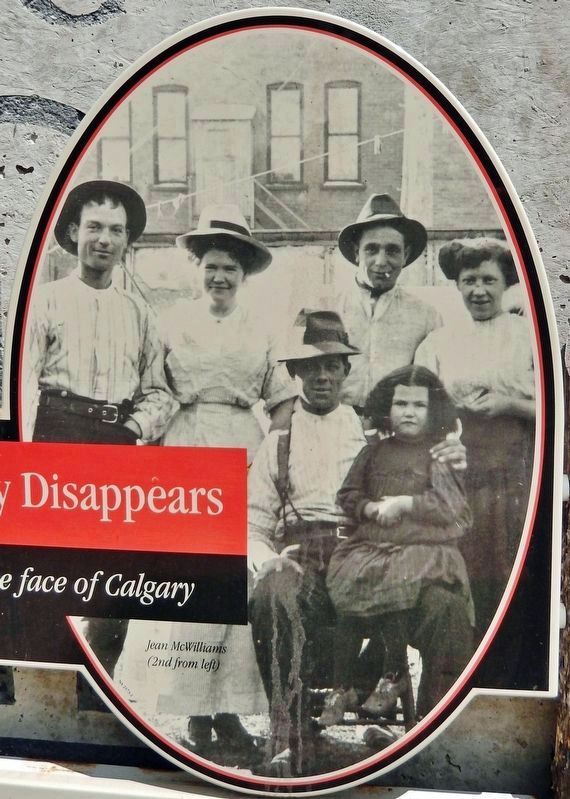
Glenbow Archives NA 2173-2
2. Marker detail: Jean McWilliams
(2nd from left)
(2nd from left)
Related markers. Click here for a list of markers that are related to this marker. Fort Calgary National Historic Site
Also see . . . Mrs. Jean McWilliams with children Mollie and John,.
William and Jean McWilliams and family emigrated from Scotland in 1907. William and Jean separated in 1910 and Jean moved to Calgary where she ran a boarding house, was a city police matron and working women's rights activist. She remarried in 1937 to William Andrew McDonald.(Submitted on May 3, 2023, by Cosmos Mariner of Cape Canaveral, Florida.)

Photographed by Cosmos Mariner, July 1, 2022
3. The Frontier Community Disappears Marker
Credits. This page was last revised on May 4, 2023. It was originally submitted on May 2, 2023, by Cosmos Mariner of Cape Canaveral, Florida. This page has been viewed 238 times since then and 27 times this year. Photos: 1, 2, 3. submitted on May 3, 2023, by Cosmos Mariner of Cape Canaveral, Florida.
