
Brownsville in Cameron County, Texas — The American South (West South Central)
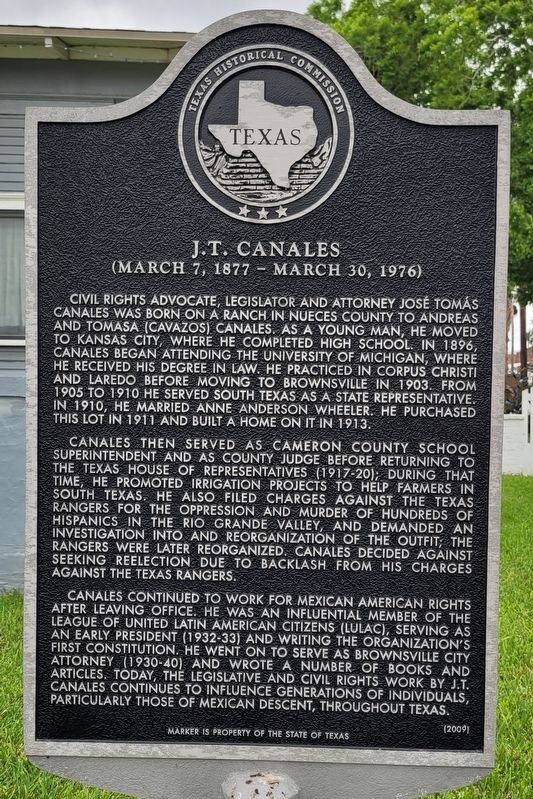
J.T. Canales
(March 7, 1877 - March 30, 1976)
Photographed by James Hulse, April 19, 2023
1. J.T. Canales Marker
Canales then served as Cameron County School Superintendent and as County Judge before returning to the Texas House of Representatives (1917-20); during that time, he promoted irrigation projects to help farmers in South Texas. He also filed charges against the Texas Rangers for the oppression and murder of hundreds of Hispanics in the Rio Grande Valley, and demanded an investigation into and reorganization of the outfit, the rangers were later reorganized. Canales decided against seeking reelection due to backlash from his charges against the Texas Rangers.
Canales continued to work for Mexican American Rights after leaving office. He was an influential member of the League of United Latin American Citizens (LULAC), serving as an early president (1932-33) and writing the organization's first constitution. He went on to serve as Brownsville City Attorney (1930-40) and wrote a number of books and articles. Today, the legislative and Civil Rights work by J.T. Canales continues to influence generations of individuals, particularly those of Mexican descent, throughout Texas.
Erected 2009 by Texas Historical Commission. (Marker Number 15938.)
Topics. This historical marker is listed in these topic lists: Civil Rights • Education •
this page online
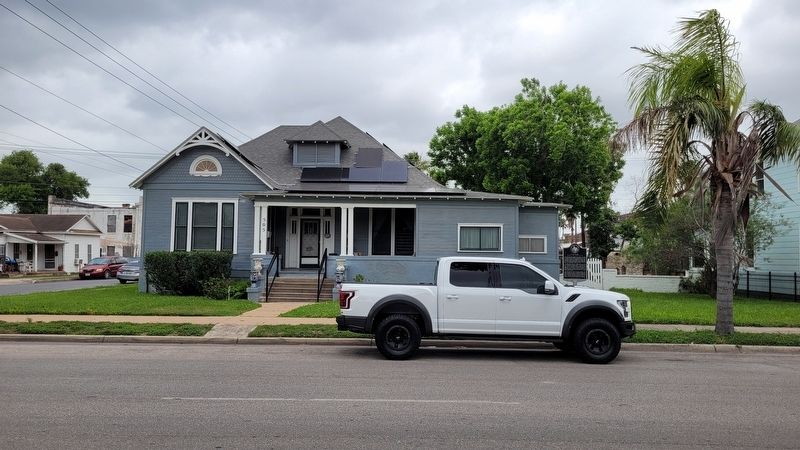
Location. 25° 54.269′ N, 97° 30.261′ W. Marker is in Brownsville, Texas, in Cameron County. It is at the intersection of East Saint Charles Street and East 5th Street, on the left when traveling south on East Saint Charles Street. The marker is located in front of the house by the street. Touch for map. Marker is at or near this postal address: 505 East St Charles Street, Brownsville TX 78520, United States of America. Touch for directions.

Regionally, this marker is in South Texas. It is also in the American South and on the Gulf Coast. Globally, it is in North America, a Gulf of Mexico state, the Western Hemisphere, the Western World, and the Anglosphere. Historically, it finds itself in what was once New Spain, the Republic of Texas, and one of the Confederate States of America.
Other nearby markers. At least 8 other markers are within walking distance of this marker: Alonso Complex (within shouting distance of this marker); Alonso Building (within shouting distance of this marker); Rock-Gomez Residence (within shouting distance
Photographed by James Hulse, April 19, 2023
2. The J.T. Canales Marker is located behind the white truck
Also see . . . Canales, José Tomás [J. T.] (1877–1976). Texas State Historical Association (TSHA)
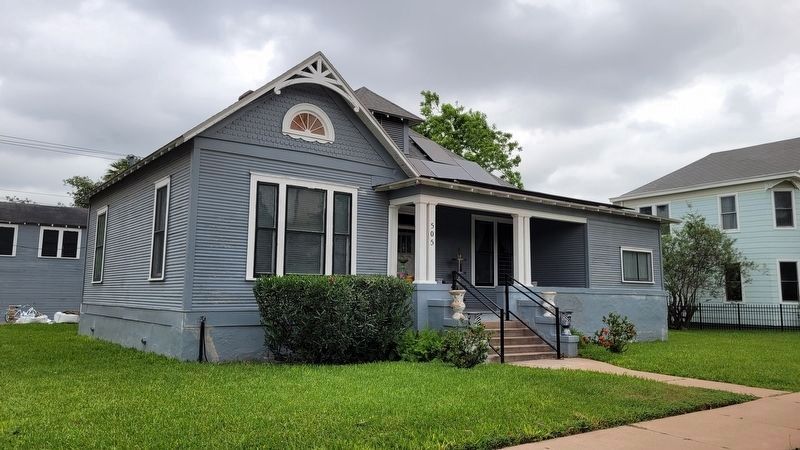
José Tomás “J. T.” Canales, lawyer, judge, legislator, landowner, author, philanthropist, and a founder of the League of United Latin American Citizens (LULAC), the son of Andreas and Tomasa (Cavazos) Canales, was born on a ranch in Nueces County, Texas, on March 7, 1877. His mother was a descendant of José Salvador de la Garza, the recipient of the Espíritu Santo grant, an enormous Spanish land grant that occupied most of what is now Cameron County. His mother's family still retained extensive holdings of ranchland in Nueces County at the time of Canales's birth. As a child, Canales lived with his parents and with several relatives and attended a variety of schools in Nueces(Submitted on May 15, 2023, by James Hulse of Medina, Texas.)County and at Tampico, Matamoros, and Mier, Tamaulipas.Photographed by James Hulse, April 19, 20233. Homesite next to the J.T. Canales Marker
Credits. This page was last revised on May 15, 2023. It was originally submitted on May 15, 2023, by James Hulse of Medina, Texas. This page has been viewed 624 times since then and 39 times this year. Photos: 1, 2, 3. submitted on May 15, 2023, by James Hulse of Medina, Texas.
