Marker Logo
THE HISTORICAL
MARKER DATABASE
“Bite-Size Bits of Local, National, and Global History”
Downtown in San Antonio in Bexar County, Texas — The American South (West South Central)
 

The Barrio del Norte
 
 
The Barrio del Norte Marker image. Click for full size.
Photographed by James Hulse, March 24, 2023
1. The Barrio del Norte Marker
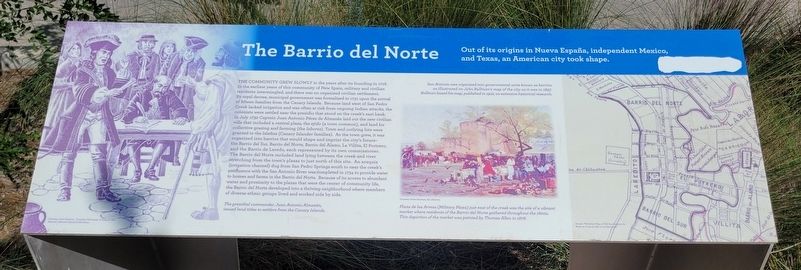
Inscription. The Community Grew Slowly in the years after its founding in 1718. In the earliest years of this community of New Spain, military and civilian residents intermingled, and there was no organized civilian settlement. By royal decree, municipal government was formalized in 1731 upon the arrival of fifteen families from the Canary Islands. Because land west of San Pedro Creek lacked irrigation and was often at risk from ongoing Indian attacks, the colonists were settled near the presidio that stood on the creek's east bank. In July 1733 Captain Juan Antonio Pérez de Almazán laid out the new civilian villa that included a central plaza, the ejido (a town common), and land for collective grazing and farming (the labores). Town and outlying lots were granted to the Isleños (Canary Islander families). As the town grew, it was organized into barrios that would shape and imprint the city's future - the Barrio del Sur, Barrio del Norte, Barrio del Alamo, La Villita, El Portrero, and the Barrio de Laredo, each represented by its own commissioner. The Barrio del Norte included land lying between the creek and river stretching from the town's plazas to just north of this site. An acequia (irrigation channel) dug from San Pedro Springs south to near the creek's confluence with the San Antonio River was completed in 1734 to provide
Paid Advertisement
Click or scan to see
this page online
water to homes and farms in the Barrio del Norte. Because of its access to abundant water and proximity to the plazas that were the center of community life, the Barrio del Norte developed into a thriving neighborhood where members of diverse ethnic groups lived and worked side by side.

Captions
Left: The presidial commander, Juan Antonio Almazán, issued land titles to settlers from the Canary Islands.
Drawing: José Cisneros. Courtesy: University of Texas at San Antonio Libraries Special Collections.

Right Top: San Antonio was organized into governmental units known as barrios as illustrated on John Rullman's map of the city as it was in 1837. Rullman based his map, published in 1912, on extensive historical research.
Source: “Historical Map of Old San Antonio de Bexar as it was in 1837 or 75 Years Ago.”

Right Bottom: Plaza de las Armas (Military Plaza) just east of the creek was the site of a vibrant market where residents of the Barrio del Norte gathered throughout the 1800s. This depiction of the market was painted by Thomas Allen in 1878.
Courtesy: Witte Museum, San Antonio

 
Erected 2018 by San Pedro Creek Culture Park. (Marker Number 16.)
 
Topics. This historical marker is listed in these
The view of the Barrio del Norte Marker along the trail image. Click for full size.
Photographed by James Hulse, March 24, 2023
2. The view of the Barrio del Norte Marker along the trail
topic lists: Colonial EraHispanic AmericansImmigrationSettlements & Settlers. A significant historical month for this entry is July 1733.
 
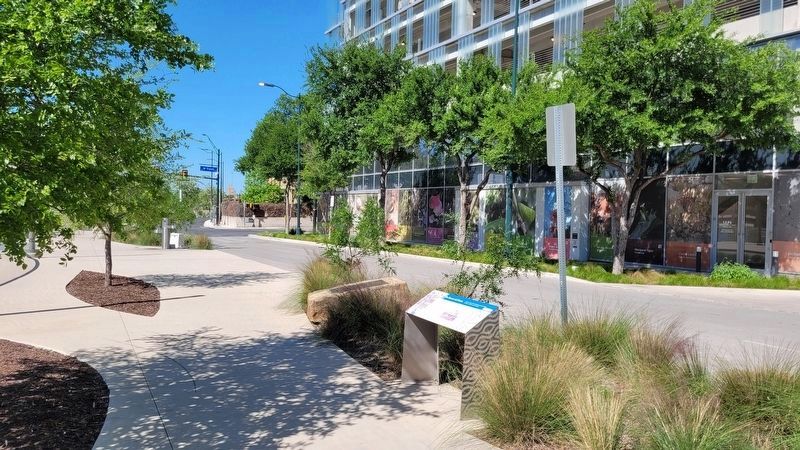
Location. 29° 25.614′ N, 98° 29.77′ W. Marker is in San Antonio, Texas, in Bexar County. It is in Downtown. It is on Camaron Street 0.1 miles north of West Houston Street, on the left when traveling north. The marker is located on the north side of the Houston Street Bridge in the San Pedro Creek Culture Park along the hiking trail. Touch for map. Marker is in this post office area: San Antonio TX 78205, United States of America. Touch for directions.

Regionally, this marker is in South Texas. It is also in the American South. Globally, it is in North America, a Gulf of Mexico state, the Western Hemisphere, the Western World, and the Anglosphere. Historically, it finds itself in what was once New Spain, the Republic of Texas, and one of the Confederate States of America.

Other nearby markers. At least 8 other markers are within walking distance of this marker: Houston Street (within shouting distance of this marker); The Golden Age of Entertainment Along the Creek (within shouting distance of this marker); St. James African Methodist Episcopal Church on San Pedro Creek (within shouting distance of this marker); A Richly Layered History (about 300 feet away, measured in a direct line); Thomas Claiborne Frost (about 500 feet away); A Living Heritage: City Streets and the Legacy of Early Settlers (about
The Barrio del Norte Map image. Click for full size.
Source: “Historical Map of Old San Antonio de Bexar”, 1912
3. The Barrio del Norte Map
San Antonio was organized into governmental units known as barrios as illustrated on John Rullman's map of the city as it was in 1837.
500 feet away); The New Blossoming of San Pedro Creek (about 600 feet away); T.C. Frost (about 700 feet away). Touch for a list and map of all markers in San Antonio.
 
Also see . . .  Where beauty meets purpose. San Pedro Creek Culture Park (Submitted on June 8, 2023, by James Hulse of Medina, Texas.) 
 
 
Credits. This page was last revised on June 8, 2023. It was originally submitted on June 8, 2023, by James Hulse of Medina, Texas. This page has been viewed 895 times since then and 104 times this year. Photos:   1, 2, 3. submitted on June 8, 2023, by James Hulse of Medina, Texas.

m=225449

CeraNet Cloud Computing sponsors the Historical Marker Database.
This website earns income from purchases you make after using our links to Amazon.com. We appreciate your support.
Paid Advertisement
Jun. 25, 2026