
Cahaba in Dallas County, Alabama — The American South (East South Central)
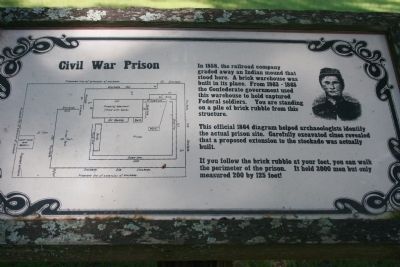
Civil War Prison
Photographed by Tim Carr, August 15, 2009
1. Civil War Prison Marker
This official 1864 diagram helped archaeologists identify the actual prison site. Carefully excavated clues revealed that a proposed extension to the stockade was actually built.
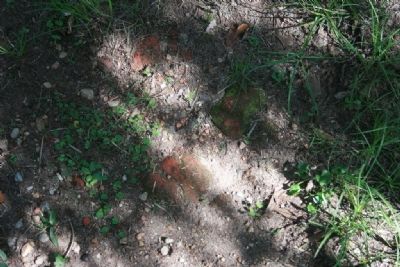
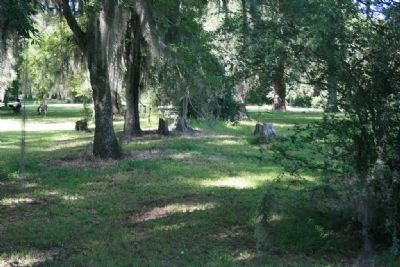
If you follow the brick rubble at your feet, you can walk the perimeter of the prison. It held 3000 men but only measured 200 by 125 feet!
Topics. This historical marker is listed in these topic lists: Anthropology & Archaeology • Indigenous Peoples and Communities • Railroads & Streetcars • War, US Civil. A significant historical year for this entry is 1858.
Location. 32° 18.984′ N, 87° 5.761′ W. Marker is in Cahaba, Alabama, in Dallas County. It can be reached from Capitol Avenue near Vine Street. In a park area at the end of Capitol Avenue. About 100 yards southeast of the Cahaba First State Capital stone marker. Touch for map. Marker is in this post
this page online

Regionally, this marker is in the American South, specifically in the Deep South, and in the Black Belt. Globally, it is in North America, a Gulf of Mexico state, the Western Hemisphere, the Western World, and the Anglosphere. Historically, it finds itself in what was once New Spain, the territory of the Mississippian Culture, one of the Confederate States of America, and the Antebellum South.
Other nearby markers. At least 8 other markers are within walking distance of this marker: Castle Morgan & Jesse Hawes (here, next to this marker); Major Hiram Solon Hanchett (here, next to this marker); A Prison Chimney? (here, next to this marker); Captive Boys in Blue (within shouting distance of this marker); Cahawba - circa 1500 (within shouting distance of this marker); Footprint of a Church (about 300 feet away, measured in a direct line); The Mound at Old Cahawba Archaeological Park (about 400 feet away); Railroad Depot and Commissary (about 400 feet away). Touch for a list and map of all markers in Cahaba.
Other markers no longer nearby.
Photographed by Tim Carr, August 15, 2009
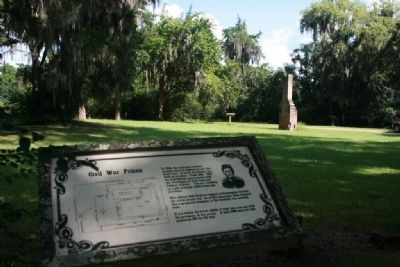
2. Civil War Prison Marker and Site
More about this marker. Marker located on the west side of the Chimney.
Also see . . . Old Cahawba, "Alabama's most famous Ghost Town". (Submitted on September 23, 2009, by Timothy Carr of Birmingham, Alabama.)
Photographed by Tim Carr, August 15, 2009
3. Brick Rubble of the Prison Perimeter
Photographed by Tim Carr, August 15, 2009
4. The Perimeter Line
Credits. This page was last revised on January 7, 2025. It was originally submitted on September 23, 2009, by Timothy Carr of Birmingham, Alabama. This page has been viewed 3,243 times since then and 27 times this year. Photos: 1, 2, 3, 4. submitted on September 23, 2009, by Timothy Carr of Birmingham, Alabama. • Craig Swain was the editor who published this page.
