North Waterfront in San Francisco City and County, California — The American West (Pacific Coastal)
Army Soldiers
Alcatraz Landing
| — | Keepers & the Kept | — |

Photographed by Joseph Alvarado
1. Army Soldiers Marker
Military Outcasts & Prisoners of War
Prisoners were kept at the Pacific Branch, U.S. Military Prison/Disciplinary Barracks from 1861 to 1934. The U.S. Army sent its own troublesome soldiers – thieves, drunks, and deserters – to desolate Alcatraz Island for confinement and rehabilitation. During this time, alongside these military outcasts, the government also imprisoned enemies who ranged from Confederate spies to Native American rebels to Hindu-German conspirators. During World War I, conscientious objectors were kept on the island.
Hard Labor
Army soldiers guarding the island did not permit idleness. They ordered Alcatraz prisoners to do backbreaking work like smashing rocks, building roads, and expanding the prison complex.
In the early 1900s, the Army began to increase the size of the prison and replace many of the original fire-prone Alcatraz facilities with permanent concrete buildings. During periods of large prisoner populations, other army forts around the Bay were able to utilize the surplus labor.
Prisoners of Culture
During the late 19th century, soldiers imprisoned aggressive American Indian leaders
this page online
The army also detained passive Indian resisters from the Paiute, Hopi, and other tribes. The military separated them from their families, brought them to Alcatraz, and tried to coerce them into conforming to white culture.
”The overseer in charge switched on the electric light and took me down a flight of stairs to the basement, hollowed out of the rock under the prison…in complete darkness.”
- Philip Grosser, Conscientious Objector, 1918
Topics. This historical marker is listed in these topic lists: Forts and Castles • Indigenous Peoples and Communities • Parks & Recreational Areas • War, US Civil. A significant historical year for this entry is 1861.
Location. 37° 48.399′ N, 122° 24.272′ W. Marker is in San Francisco, California, in San Francisco City and County. It is in North Waterfront. It can be reached from The Embarcadero south of Bay Street, on the right when traveling north. The resin marker is mounted in a flower box on Alcatraz Landing. Touch for map. Marker is at or near
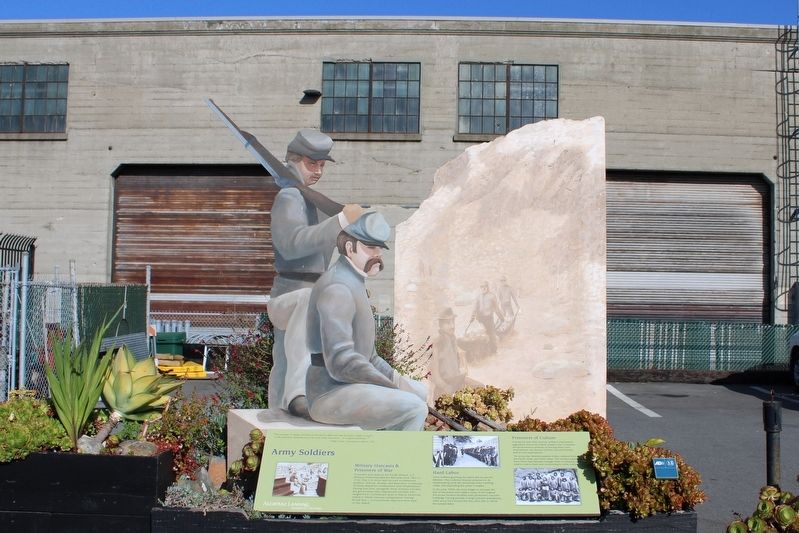
Photographed by Joseph Alvarado, June 15, 2023
2. Army Soldiers Marker

Regionally, this marker is on California’s Coast Ranges. It is also on the American Pacific Coast. Globally, it is in North America, on the Ring of Fire, on the Pacific Rim, in the Western Hemisphere, in the Western World, and in the Anglosphere. Historically, it finds itself in what was once New Spain and also Mexico’s Alta California.
Other nearby markers. At least 8 other markers are within walking distance of this marker: National Park Service (here, next to this marker); Lighthouse Keepers (here, next to this marker); Correctional Officers (a few steps from this marker); The Dock (a few steps from this marker); Industrial Buildings (a few steps from this marker); Main Prison Building (a few steps from this marker); The Post Exchange & Officers' Club (a few steps from this marker); Military Schoolhouse (a few steps from this marker). Touch for a list and map of all markers in San Francisco.
Also see . . .
1. The Army and American Indian Prisoners. National Park Service
"Most prisoners held on Alcatraz were U.S. military personnel. Notable exceptions included Southern sympathizers/supporters during the Civil War, conscientious objectors during WWI, and a number of Native Americans, beginning in 1873. On June 5 of that year the first Indian prisoner arrived. Paiute Tom was on a transfer from Camp McDermit in Nevada for reasons now unknown. Also unknown is the reason why a guard shot and killed him 2 days later. Some authors have speculated that he was shot while attempting to escape."(Submitted on July 20, 2023, by Joseph Alvarado of Livermore, California.)
2. Alcatraz Had Some Surprising Prisoners: Hopi Men. History.com
"...in the 19th century, the infamous island was also home to 19 prisoners rarely found in maximum security cells: Hopi men. Their crime? Rebelling against plans to send their children to “assimilation” boarding schools hundreds of miles away from their reservations. But in 1894, their parents resisted—and paid the price."(Submitted on July 20, 2023, by Joseph Alvarado of Livermore, California.)
Credits. This page was last revised on July 22, 2023. It was originally submitted on July 20, 2023, by Joseph Alvarado of Livermore, California. This page has been viewed 205 times since then and 14 times this year. Photos: 1, 2. submitted on July 20, 2023, by Joseph Alvarado of Livermore, California.
