Joplin in Jasper County, Missouri — The American Midwest (Upper Plains)
Osage Nation

Photographed by Cosmos Mariner, July 22, 2023
1. Osage Nation Marker
More than a thousand years ago, the Osage people migrated from the Ohio Valley up the Mississippi River and onto the tributaries of the Mississippi and Missouri rivers. They occupied this diverse landmass that provided abundant game and natural resources for their people.
Prior to the arrival of European settlers, the Osage Indians made their villages and camps along the riverways. Their territorial empire for hunting, trading, and warfare spread across parts of Missouri and Arkansas as well as the plains of Kansas and Oklahoma.
The Osage cultivated food plants — especially corn, beans, and squash — and gathered nuts, berries, and fruit in addition to hunting game animals. From their villages in Missouri, the Osage traveled out to the plains in Kansas and Oklahoma, as well as into the Ozarks highlands of southern Missouri and northern Arkansas. The Osage people had three annual hunts — in early spring, summer, and in the fall — for buffalo, elk, deer, and bear. After each hunt, they would return to their permanent lodges along the Osage and Missouri river valleys.
The Osage followed various
this page online
Known as the "County of the Six Boils," the area surrounding Joplin was one of the Osage's hunting grounds. This term referred to what is now southwest Missouri, southeast Kansas, and northeast Oklahoma — where the streams of North Fork, Center Creek, Turkey Creek, Shoal Creek, Indian Creek, and Elk River converge into Spring River. These spring-fed, swiftly flowing streams had a boiling, surging quality that gave rise to the term "boils."
An early pioneer of Jasper County named W.C. Cooley, who arrived in 1841, recalled seeing 500 Osage marching single file on one of their hunting trails from one stream to another, and droves of 200 deer crossing the area.
With the aggressive infiltration of Euro-Americans and the pressured westward relocation of Eastern tribes, from the early 1800s to 1850, the Osage people were uprooted and forced from the

Photographed by Cosmos Mariner, July 22, 2023
2. Osage Nation Marker
From this point in history, the Osage were restricted in their movement, no longer free to travel throughout their original domain, to take part in their annual bison hunts out on the plains, hunt deer and bear in the Ozarks, or conduct their war ceremonies and mourning parties. These overwhelming consequences devastated the Osage people, resulting in a fractured community, population loss, the erosion of tribal identity, and many time-honored traditions.
Today, however, the Osage have a vibrant culture with a population of over 22,000; a three-branch government composed of executive, legislative, and judicial systems; a strong economic structure; and lasting Osage cultural traditions.
Burns, Louis F. A History of the Osage People. The University of Alabama Press, 2004.
Hunter, Andrea A. "Osage Veterans: From Tribal Warriors to World War Code Talkers", MO Humanities, Fall/Winter 2019.
North, F.A., ed. The History of Jasper County, Missouri. Mills & Company, 1883.
Renner, G.K. Joplin: From Mining Town to Urban Center. Windsor Publications, Inc., 1985.
Erected by Joplin
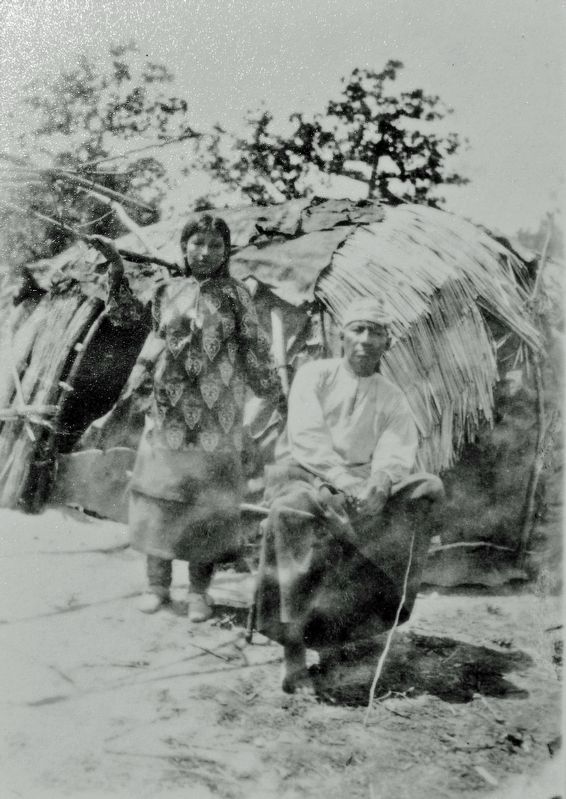
Courtesy Kansas State Historical Society
3. Osage Couple
Topics. This historical marker is listed in these topic lists: Agriculture • Indigenous Peoples and Communities • Settlements & Settlers • Waterways & Vessels. A significant historical year for this entry is 1841.
Location. 37° 5.684′ N, 94° 30.636′ W. Marker is in Joplin, Missouri, in Jasper County. It is on Northwest Murphy Boulevard just south of East Pool Street, on the right when traveling north. Marker is located along the recreational trail in Landreth Park. Touch for map. Marker is at or near this postal address: 1001 Northwest Murphy Boulevard, Joplin MO 64801, United States of America. Touch for directions.

Regionally, this marker is in Southwest Missouri. It is also in the American Lewis & Clark Corridor and in the Corn Belt. Globally, it is in North America, the Western Hemisphere, the Western World, and the Anglosphere. Historically, it finds itself in what was once the territory of the Mississippian Culture, the Louisiana Purchase, and the Antebellum South.
Other nearby markers. At least 8 other markers are within walking distance of this marker: Early Settlers (within shouting

Osage Nation Historic Preservation Office
4. Marker detail: Osage Ancestral Territory
Related markers. Click here for a list of markers that are related to this marker. Joplin Heritage Trail
Also see . . .
1. Osage Nation (Wikipedia). Excerpt:
The tribe developed in the Ohio and Mississippi river valleys around 700 BC along with other groups of its language family. They migrated west after the 17th century, settling near the confluence of the Missouri and Mississippi rivers, as a result of Iroquois invading the Ohio Valley in a search for new hunting grounds. By the early 19th century, the Osage had become the dominant power in the region, feared by neighboring tribes. The tribe controlled the area between the Missouri and Red rivers, the Ozarks to the east and the foothills of the Wichita Mountains to the south. They depended on nomadic buffalo hunting and agriculture.(Submitted on August 9, 2023, by Cosmos Mariner of Cape Canaveral, Florida.)
2. Osage Nation. Excerpt:
The mission of Osage Nation Congress is to adopt a system of laws that promote the health, education, and well-being of Osage citizens. They preserve the checks and balances of the government by the independent exercise of legislative powers, and they carry out oversight responsibilities to enhance government accountability. They encourage and support the raising of tribal revenues and appropriate monies that support necessary government services. They are also tasked with preserving and protecting the Nation’s environment.(Submitted on August 9, 2023, by Cosmos Mariner of Cape Canaveral, Florida.)
Credits. This page was last revised on July 13, 2025. It was originally submitted on August 8, 2023, by Cosmos Mariner of Cape Canaveral, Florida. This page has been viewed 1,729 times since then and 180 times this year. Photos: 1, 2, 3, 4. submitted on August 9, 2023, by Cosmos Mariner of Cape Canaveral, Florida.
