Near Goliad in Goliad County, Texas — The American South (West South Central)
Blazing New Trails
⎯⎯⎯
Abriendo Nuevos Horizontes
Photographed by James Hulse, October 23, 2023
1. Blazing New Trails / Abriendo Nuevos Horizontes Marker
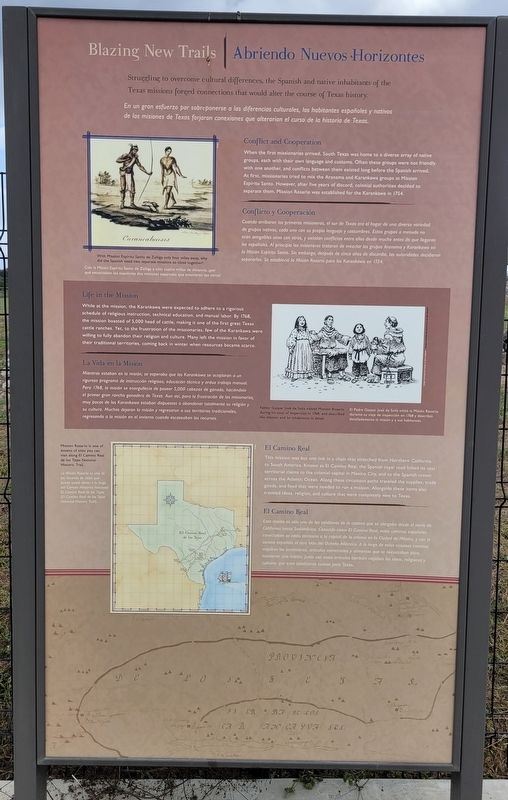
 Struggling to overcome cultural differences, the Spanish and native inhabitants of the Texas missions forged connections that would alter the course of Texas history.
Conflict and Cooperation
When the first missionaries arrived, South Texas was home to a diverse array of native groups, each with their own language and customs. Often these groups were not friendly with one another, and conflicts between them existed long before the Spanish arrived. At first, missionaries tried to mix the Aranama and Karankawa groups at Mission Espíritu Santo. However, after five years of discord, colonial authorities decided to separate them. Mission Rosario was established for the Karankawa in 1754.
Life in the Mission
While at the mission, the Karankawa were expected to adhere to a rigorous schedule of religious instruction, technical education, and manual labor. By 1768, the mission boasted of 5,000 head of cattle, making it one of the first great Texas cattle ranches. Yet, to the frustration of the missionaries, few of the Karankawa were willing to fully abandon their religion and culture. Many left the mission in favor of their traditional territories, coming back in winter when resources became scarce.
El Camino Real
This mission was but one link in a chain that stretched from Northern California to South America. Known as El Camino Real, the Spanish royal road linked its vast territorial claims to the colonial capital in Mexico City, and to the Spanish crown across the Atlantic Ocean. Along these circuitous paths traveled the supplies, trade goods, and food that were needed to run a mission. Alongside these items also traveled ideas, religion, and culture that were completely new to Texas.
Captions
Upper Left: With Mission Espíritu Santo de Zuñiga only four miles away, why did the Spanish need two separate missions so close together?
Middle Right: Father Gaspar José de Solís visited Mission Rosario during his tour of inspection in 1768, and described the mission and its inhabitants in detail.
Lower Left: Mission Rosario is one of dozens of sites you can visit along El Camino Real de los Tejas National Historic Trail.
Spanish:
this page online
Conflicto y Cooperación
Cuando arribaron los primeros misioneros, el sur de Texas era el hogar de una diversa variedad de grupos nativos, cada uno con su propio lenguaje y costumbres. Estos grupos a menudo no eran amigables unos con otros, y existían conflictos entre ellos desde mucho antes de que llegaran los españoles. Al principio los misioneros trataron de mezclar los grupos Aranama y Karankawa en la Misión Espiritu Santo. Sin embargo, después de cinco años de discordia, las autoridades decidieron separarlos. Se estableció la Misión Rosario para los Karankawa en 1754.
La Vida en la Misión
Mientras estaban en la misión, se esperaba que los Karankawa se acoplaran a un riguroso programa de instrucción religiosa, educación técnica y arduo trabajo manual. Para 1768, la misión se enorgullecía de poseer 5,000 cabezas de ganado, haciéndola el primer gran rancho ganadero de Texas. Aun así, para la frustración de los misionarios, muy pocos de
Photographed by James Hulse, October 23, 2023
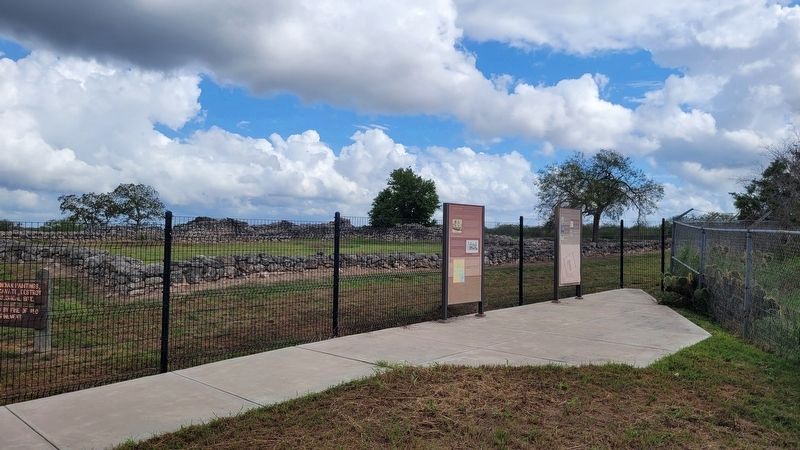
2. The Blazing New Trails / Abriendo Nuevos Horizontes Marker is the left marker of the two markers
The ruins are located directly behind the metal fence.
Subtítulos
Arriba a la izquierda: Con la Misión Espíritu Santo de Zúñiga a sólo cuatro millas de distancia, ¿por qué necesitaban los españoles dos misiones separadas que estuvieran tan cerca?
Centro derecha: El Padre Gaspar José de Solís visitó la Misión Rosario durante su viaje de inspección en 1768 y describió detalladamente la misión y a sus habitantes.
Inferior izquierda: La Misión Rosario es una de las docenas de sitios que puede usted visitar a lo largo del Camino Histórico Nacional El Camino Real de los Tejas (El Camino Real de los Tejas National Historic Trail)
Erected by Mission Nuestra Señora del Rosario.
Topics. This historical marker is listed in these topic lists: Anthropology & Archaeology • Colonial Era • Indigenous Peoples and Communities • Religion & Religious Structures. A significant historical year for this entry is 1754.
Location. 28° 38.672′ N, 97° 26.362′ W. Marker
Photographed by James Hulse, October 23, 2023
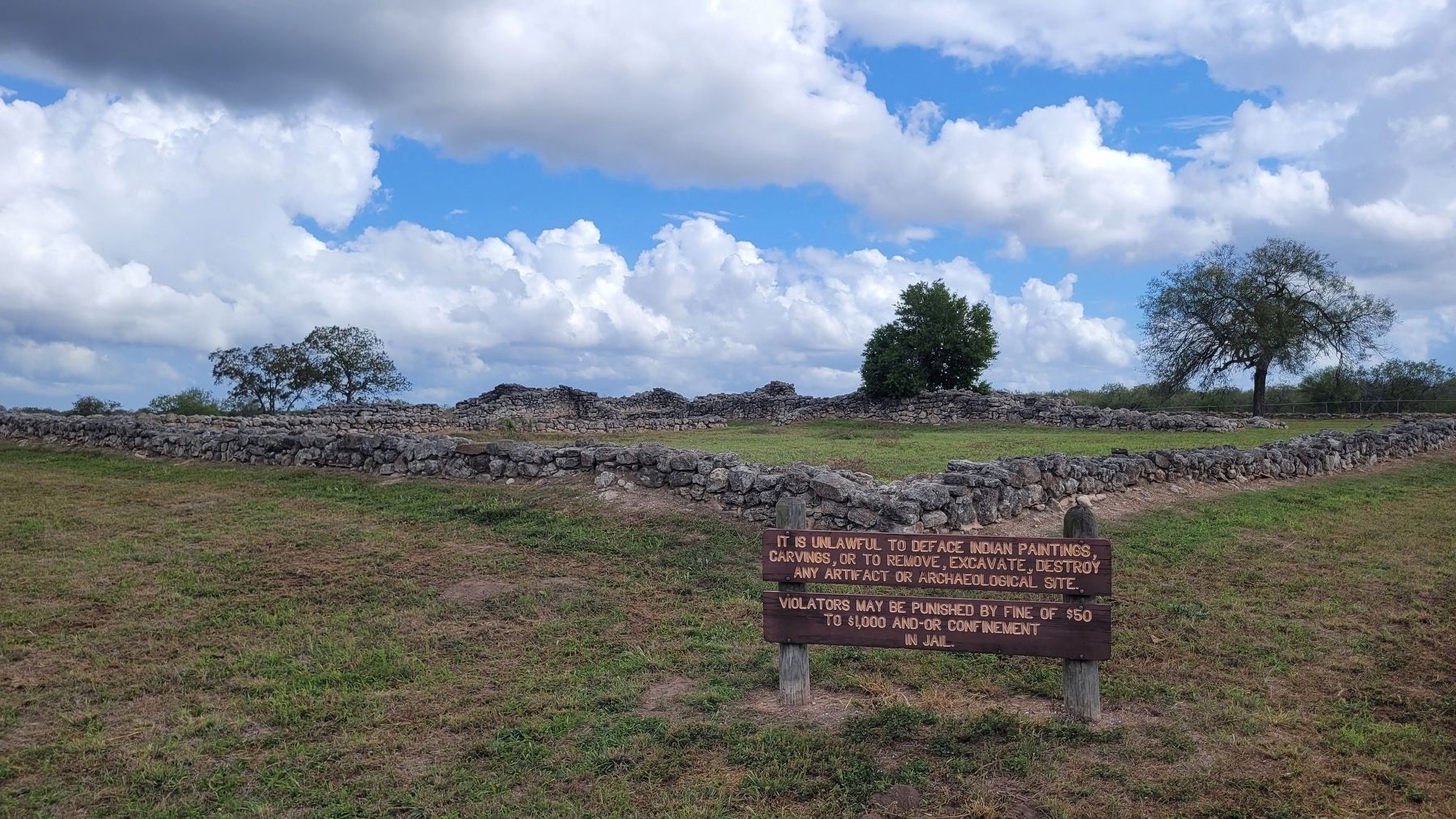
3. The view of the mission ruins through the fence from the pathway

Regionally, this marker is in South Texas. It is also in the American South. Globally, it is in North America, a Gulf of Mexico state, the Western Hemisphere, the Western World, and the Anglosphere. Historically, it finds itself in what was once New Spain, the Republic of Texas, and one of the Confederate States of America.
Other nearby markers. At least 8 other markers are within 3 miles of this marker, measured as the crow flies: Bird's Eye View / Vista Aérea (here, next to this marker); Mission Rosario State Historic Site / Sitio Histórico Estatal Misión Nuestra Señora del Rosario (within shouting distance of this marker); Site of Mission Nuestra Señora del Rosario (within shouting distance of this marker); Mission Nuestra Senora del Rosario (about 400 feet away, measured in a direct line); Goliad County (about 400 feet away); Lott Cemetery (approx. 2 miles away); Peck Cemetery (approx. 2.8 miles away); Fannin Street United Methodist Church (approx. 3 miles away). Touch for a list and map of all markers in Goliad.
Another marker is no longer nearby. Mission Rosario (was within shouting distance of this marker but has been confirmed missing).
More about this marker. The ruins of the Mission Rosario State Historic Site are fenced off and not open to the general public. However, there is a small parking lot at the site which allow the general public access to a viewing area of the mission ruins.
Also see . . . Nuestra Señora del Rosario Mission. Texas State Historical Association (TSHA)
Nuestra Señora del Rosario Mission, Goliad County, so named by Capt. Manuel Ramírez de la Piscina of nearby Presidio La Bahía for the church in his native town in Spain, was also known as Nuestra Señora del Rosario de los Cujanes, Misión del Santísimo Rosario, and Misión del Rosario. It was established in November 1754 by Father Juan de Dios Camberos of the College of Nuestra Señora de Guadalupe de Zacatecas in an attempt to make peace with the various Karankawan tribes-the Cujanes, Copanes, Guapites, and Karankawas proper-who did not get along with the other Indians at the already existing missions. The site on the San Antonio River four miles west of Goliad was given to the Goliad State Park Commission by W. J. O'Connor in 1935. It is not open to the public.(Submitted on November 3, 2023, by James Hulse of Medina, Texas.)
Credits. This page was last revised on September 23, 2025. It was originally submitted on November 2, 2023, by James Hulse of Medina, Texas. This page has been viewed 200 times since then and 27 times this year. Photos: 1, 2, 3. submitted on November 3, 2023, by James Hulse of Medina, Texas.
