Near Schuylerville in Saratoga County, New York — The American Northeast (Mid-Atlantic)
A Native Crossing
Hudson Crossing Park

Photographed by Steve Stoessel, May 4, 2024
1. A Native Crossing Marker
According to historians, the Mohicans occupied this strategic crossing for millennia, using the intersecting waterways for trade and sustenance. The Hudson-Champlain corridor forms a near-continuous water passage, extending from New York City to Quebec and to the inland rivers and lakes. Tributary rivers flowing east and west provide access to New England and the Mohawk Valley of western New York. This waterway later became a major corridor for intertribal and European trade and warfare.
Old Saratoga was originally occupied by the Mohicans. They took advantage of the vast fisheries, abundant wildlife, and the transportation corridor. There is archeological evidence that local tribes had a strong trade economy that extended back 1,500 years. They established extensive trade routes that brought copper, tropical shells, exotic chert (a type of rock often used in stone tools), and other materials here from across North America.
By the 1630s, the Mohicans had been driven from the Saratoga area by their long-standing enemies, the Mohawks. The Mohawks remained in their large defensive villages in the Mohawk Valley, but used
this page online
Iroquois expansion put the tribes in direct conflict with the Wabanaki Confederacy in present-day Canada and northern New England. The Beaver Wars, as the series of conflicts became known, escalated as war between Britain and France boiled over into the New World. By 1690, Saratoga was fortified by the British to guard this well-worn crossroads from French and Wabanaki raiders
[Captions:]
A map of Indian trails through Saratoga County from Saratoga County Communities: A Historical Perspective. Used with permission from the Saratoga County Historian
A Good Place to Set Up Camp by Greg Harin Courtesy of the National Park Service
Iroquois chief between 1760 and 1790. Reconstitution by G.A. Embleton. Used with permission of Parks Canada
Erected by Lakes to Locks Passages.
Topics. This historical marker is listed in these topic lists: Indigenous Peoples and Communities • Wars, Non-US • Waterways & Vessels. A significant historical year for this entry is 1690.
Location. 43° 6.891′ N,
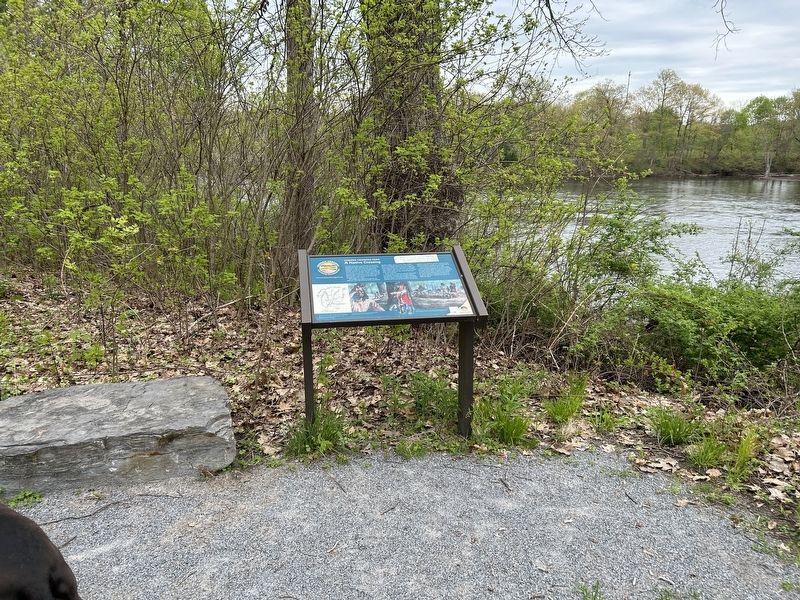
Photographed by Steve Stoessel, May 4, 2024
2. A Native Crossing Marker

Regionally, this marker is in Upstate New York, in the Capital District, and in the Albany Metropolitan Area. It is also in the American Northeast and in the Mid-Atlantic. Globally, it is in North America, the Great North Woods, the Western Hemisphere, the Western World, and the Anglosphere. Historically, it finds itself in what was once New Netherland and also one of the original Thirteen Colonies.
Other nearby markers. At least 8 other markers are within walking distance of this marker: Peter Kalm’s A Journey into North America (about 500 feet away, measured in a direct line); Dix Bridge (about 600 feet away); Bridge of Boats (approx. 0.2 miles away); The Canal System (approx. 0.2 miles away); Position of Burgoyne's Bridge (approx. 0.2 miles away); British Army Camp (approx. ¼ mile away); The Marshall House (approx. ¼ mile away); River Crossing (approx. 0.4 miles away). Touch for a list and map of all markers in Schuylerville.
Also see . . .
1. Virtual Wayside History A Native Crossing. Close ups of the marker, and a You Tube video available at this site. This the link listed on the marker. (Submitted on May 8, 2024, by Steve Stoessel of Niskayuna, New York.)
2. The Beaver Wars. Wikipedia entry (Submitted on May 8, 2024, by Steve Stoessel of Niskayuna, New York.)
3. Iroquois Wars. The Canadian Encyclopedia website entry:
The Iroquois Wars, also known as the Beaver Wars and the French and Iroquois Wars, were a series of 17th-century conflicts involving the Haudenosaunee Confederacy (also known as the Iroquois or Five Nations, then including the Mohawk, Oneida, Onondaga, Cayuga and Seneca), numerous other First Nations, and French colonial forces. The origins of the wars lay in the competitive fur trade. (Submitted on May 8, 2024, by Steve Stoessel of Niskayuna, New York.)
Credits. This page was last revised on August 12, 2026. It was originally submitted on May 8, 2024, by Steve Stoessel of Niskayuna, New York. This page has been viewed 270 times since then and 28 times this year. Photos: 1, 2. submitted on May 8, 2024, by Steve Stoessel of Niskayuna, New York.
