Boonville in Cooper County, Missouri — The American Midwest (Upper Plains)
Cobblestone Street Park
Missouri's Civil War

Photographed by Jason Voigt, May 15, 2024
1. Cobblestone Street Park Marker
Third Battle: October 11, 1863
The Third Battle of Boonville was fought from this wharf. Confederate General Joseph O. Shelby and his men approached Boonville from the south where they had burned a railroad bridge near Otterville. Local Boonville citizens who were known Union sympathizers fled across the Missouri River to temporary safety in Howard County as the town braced for Shelby's arrival.
Shelby marched into town and obtained much needed supplies. The Confederate troops did not molest any person during their stay; not one person was killed or wounded, but they did strip the stores of all their merchandise. Over $100,000 worth of goods were plundered by the troops in a single day. Shelby's men left receipts at a local jewelry store, Gmelich Jewelry, saying they had taken watches from the store. Gmelich had protested the loss of his merchandise, the not explained that the watches had been obtained under "force of arms." Of course, the watches were never returned; some stores lost as much as $4,000.00 in a world where an income of about $300 per year made a family a member of the middle class.
While Shelby's
this page online
At the same time, Union Colonel Thomas T. Crittenden (later Governor of Missouri) with about 100 men had been coming up the river in the steamboat Isabella, but when he learned what had just happened he got off the boat with his troops across the Missouri in Howard County and did not come to the Boonville wharf.
Shelby camped west of Boonville that night and then retreated westward the next day. One local farmer who lived at Dug Ford on the Lamine River recounted that "they made their camp fires out of our fence rails, used our corn and oats, and out of a fine crop of oats, only left us enough for seed, killed two fine Durham heifers and as many hogs as they wanted and then to
Photographed by Jason Voigt, May 15, 2024
2. Cobblestone Street Park Marker
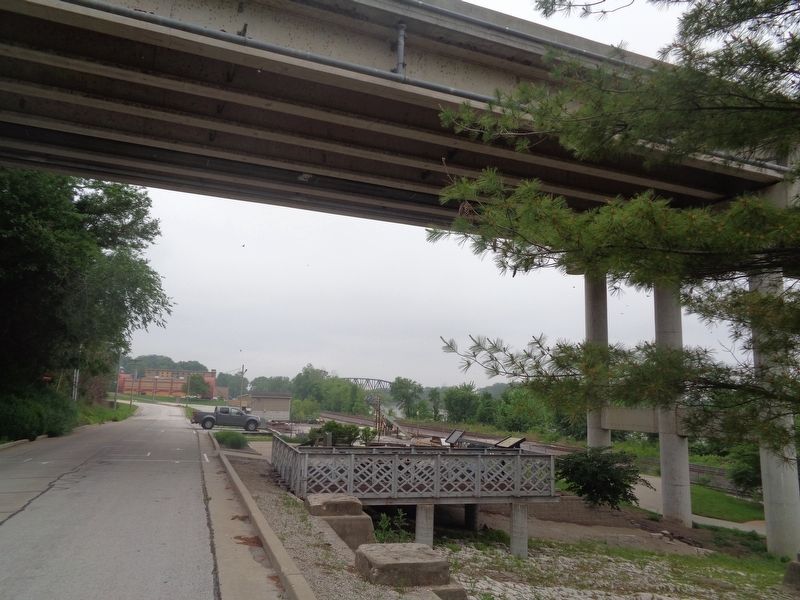
Marker is located at Cobblestone Street Park, under the Main Street overpass (which carries U.S. 40 and MO-87)
On October 12, Colonel Crittenden and Major Leonard both brought their troops into town after the Confederates had left and the citizens ended up feeding them too after feeding Shelby's men. Food intended for Cooper County use during the winter went into the stomachs of soldiers for both sides. Locals called this event "Shelby's Raid."
The Boonville Wharf & Cobblestone Street
Cobblestone Street Park is located at what was the Boonville wharf at the time of the Civil War. Merchandise and passengers from steamboats unloaded here and rode or walked up the cobblestone street to the stores and hotels. Because of the strategic location of this docking area, Confederates were stationed here at the beginning of the Civil War in June 1861. Union commander Nathaniel Lyon correctly guessed the wharf would be guarded so he unloaded his troops east of Boonville at the private wharf called Merna and marched into town via the back roads causing the First Battle of Boonville. Some Federal troops were left in Boonville throughout the Civil War to guard this wharf area. When railroads came through the town after the Civil War, the economic value of the wharf dropped as goods and people arrived by train rather than boats.
Sue Bryant and her Red and White Dress
In 1862 Sue M. Bryant was a pupil at the Female Seminary in Boonville. At the graduation ceremony held at Thespian Hall, a block east of the institute, the girls formed an American flag, wearing clothing of red, white, and blue with stars. They lined up next to each other to form the 34 star flag with all the stripes and stars marched according to the height of the student. Sue Bryant was five feet five inches tall so she was toward the end of the flag and her dress had only red and white stripes. It did not have any blue fabric or stars. On August 6, 1862 she visited friends in downtown Marshall, Missouri, where she donned the dress to show them since they had not attended the graduation ceremony. Her outfit was noticed by a person passing by on the street who looked through the open window and reported to Union troops in Marshall that Sue Bryant was in a local home with the Confederate flag (the main colors of that flag were red and white) wrapped about her.
The troops arrested her and she was sent to St. Louis. On her way under heavy guard the group detoured through Warrensburg where Sue Bryant met Colonel T.T. Crittenden who was involved in the Third Battle of Boonville. Sue Bryant asked Colonel Crittenden for something to eat; he locked her up in a two-room grocery store. She refused to steal food from the store as she had no money to pay so just before sundown Col. Crittenden brought her a quart bowl of pickled beets and half a loaf of stale bread. Eventually she reached St. Louis and was placed at Gratiot Street Prison only to discover that her father had followed her to St. Louis and was working to have her released and sent home. Sue Bryant was told she could go home but she had to sign the Oath of Allegiance first. She refused to do that. Eventually she did sign and her father was allowed to take her home in October.
Slaves Allowed to Fight at Last
Beginning about two months after this battle, male slaves were actively recruited to be soldiers throughout the country. Nancy Jones wrote (original spelling used - ed.), "A recruiting office was opened in Boonville of soldiers of "African descent" and Speed, Ike, and Willie, enlisted, Aaron would not go. Speed and Will cried like children when they left, I suppose Sally, Caroline and Ann will not leave before spring. Three hundred negroes have been sent from Boonville to St. Louis, and the office is still open and as Sally says the negroes keep "rolling." Ellis left home some time ago, and was employed as a teamster, he returned a few days since quite sick, minus the money he took with him, but wiser if not better than when he left home."
(photo caption:)
·One of the rare photographs of General Joseph O. Shelby taken during the Civil War. This picture was taken in Boonville by the photography company of Thomas Tureman and a Mr. Vandeventer in October 1864 after the Fourth and final battle in Boonville. Although the existence of this photograph was known to historians for many years because of references to it in the diaries of several of Shelby's men, it was only re-discovered about 1970 by Howard N. Monnett of the Westport Historical Society. One of the original copes is in Boonville.
Erected by Boonville Tourism Commission and Missouri's Civil War Heritage Foundation.
Topics and series. This historical marker is listed in these topic lists: Abolition & Underground RR • African Americans • War, US Civil • Women. In addition, it is included in the Missouri’s Civil War series list. A significant historical date for this entry is October 11, 1863.
Location. 38° 58.72′ N, 92° 44.695′ W. Marker is in Boonville, Missouri, in Cooper County. It is on East Water Street east of 4th Street, on the right when traveling west. Marker is located at Cobblestone Street Park, under the Main Street overpass (which carries U.S. 40 and MO-87. Touch for map. Marker is at or near this postal address: 509 E Water St, Boonville MO 65233, United States of America. Touch for directions.

Regionally, this marker is in the Missouri River Corridor. It is also in the American Midwest, in the Lewis & Clark Corridor, in the Corn Belt, and on the Santa Fe Trail Corridor. Globally, it is in North America, the Western Hemisphere, the Western World, and the Anglosphere. Historically, it finds itself in what was once the territory of the Mississippian Culture, the Louisiana Purchase, and the Antebellum South.
Other nearby markers. At least 8 other markers are within walking distance of this marker: Old Trails National Highway Bridge (a few steps from this marker); Missouri River Floods (within shouting distance of this marker); Boonville Veterans Memorial (about 300 feet away, measured in a direct line); High Street Office Building (about 400 feet away); Cooper County World War Memorial (about 500 feet away); Vietnam War Memorial Bench (about 500 feet away); World War II Memorial Bench (about 500 feet away); Replica of the Statue of Liberty (about 500 feet away). Touch for a list and map of all markers in Boonville.
Regarding Cobblestone Street Park. The website address (www.mocivilwar.org) on the marker for Missouri's Civil War Heritage Foundation, Inc. is inaccessible as of May 2024.
Credits. This page was last revised on May 25, 2024. It was originally submitted on May 25, 2024, by Jason Voigt of Glen Carbon, Illinois. This page has been viewed 350 times since then and 60 times this year. Photos: 1, 2. submitted on May 25, 2024, by Jason Voigt of Glen Carbon, Illinois.
