Crieve Hall in Nashville in Davidson County, Tennessee — The American South (East South Central)
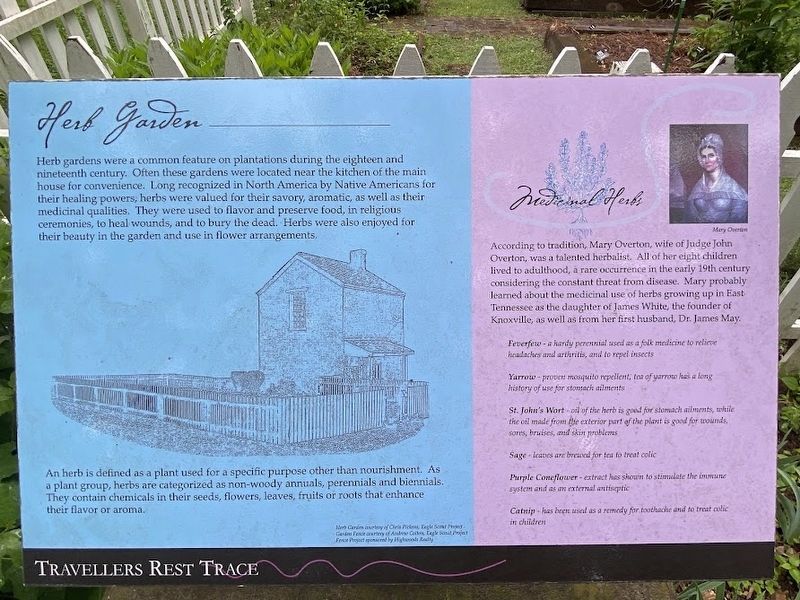
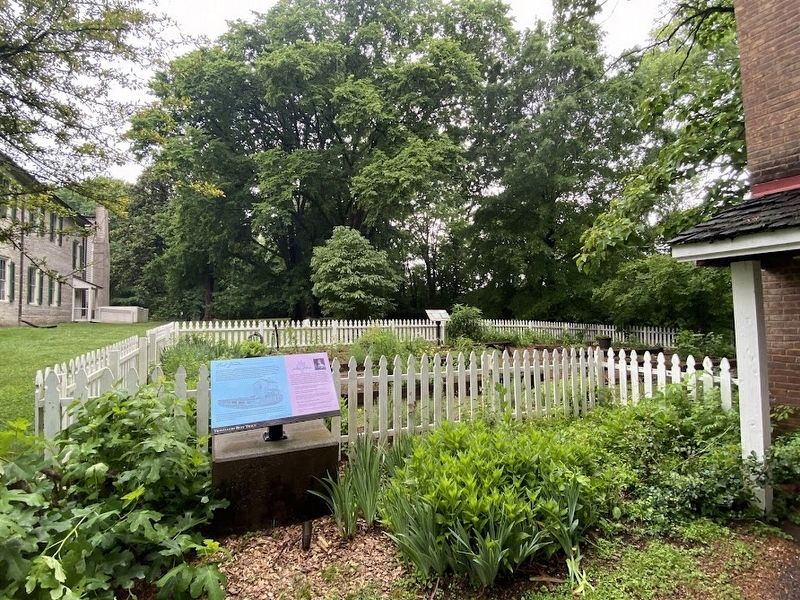
Herb Garden
Travellers Rest Trace
Photographed by Darren Jefferson Clay, June 1, 2024
1. Herb Garden Marker
An herb is defined as a plant used for a specific purpose other than nourishment. As a plant group, herbs are categorized as non-woody annuals, perennials and biennials. They contain chemicals in their seeds, flowers, leaves, fruits or roots that enhance their flavor or aroma.
According to tradition, Mary Overton, wife of Judge John Overton, was a talented herbalist. All of her eight children lived to adulthood, a rare occurrence in the early 19th century considering the constant threat from disease. Mary probably learned about the medicinal use of herbs growing up in East Tennessee as the
this page online
Feverfew - a hardy perennial used as a folk medicine to relieve headaches and arthritis, and to repel insects
Yarrow - proven mosquito repellent, tea of yarrow has a long history of use for stomach ailments
St. John's Wort - oil of the herb is good for stomach ailments, while the oil made from the exterior part of the plant is good for wounds, sores, bruises, and skin problems
Sage - leaves are brewed for tea to treat colic
Purple Coneflower - extract has shown to stimulate the immune system and as an external antiseptic
Catnip - has been used as a remedy for toothache and to treat colic in children
Topics. This historical marker is listed in these topic lists: Environment • Indigenous Peoples and Communities • Science & Medicine.
Location. 36° 4.632′ N, 86° 45.815′ W. Marker is in Nashville, Tennessee, in Davidson County. It is in Crieve Hall. It can be reached from Farrell Parkway west of Regent Drive. Touch for map. Marker is at or near this postal address: 636
Photographed by Darren Jefferson Clay, June 1, 2024
2. Herb Garden Marker

Regionally, this marker is in Middle Tennessee. It is also in the American South and specifically in the Upper South. Globally, it is in North America, the Western Hemisphere, the Western World, and the Anglosphere. Historically, it finds itself in what was once the territory of the Mississippian Culture, one of the Confederate States of America, and the Antebellum South.
Other nearby markers. At least 8 other markers are within walking distance of this marker: Historic Travellers Rest Herb Garden (a few steps from this marker); Smokehouse (within shouting distance of this marker); Arabian Horses (within shouting distance of this marker); Battle of Nashville / Peach Orchard Hill (about 400 feet away, measured in a direct line); Travellers Rest (about 500 feet away); From Enslavement to Freedom (about 500 feet away); Earliest Residents of Travellers Rest (about 500 feet away); a different marker also named Travellers' Rest (approx. ¼ mile away). Touch for a list and map of all markers in Nashville.
Another marker is no longer nearby. Travellers Rest (was about 500 feet away but has been replaced with another marker now near it).
Credits. This page was last revised on June 4, 2024. It was originally submitted on June 2, 2024, by Darren Jefferson Clay of Duluth, Georgia. This page has been viewed 151 times since then and 16 times this year. Photos: 1, 2. submitted on June 2, 2024, by Darren Jefferson Clay of Duluth, Georgia. • James Hulse was the editor who published this page.
