Crieve Hall in Nashville in Davidson County, Tennessee — The American South (East South Central)
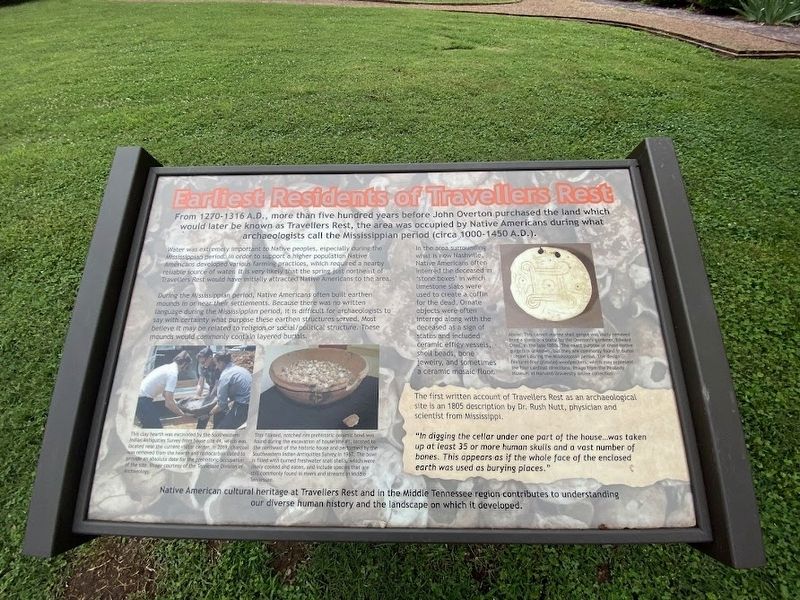
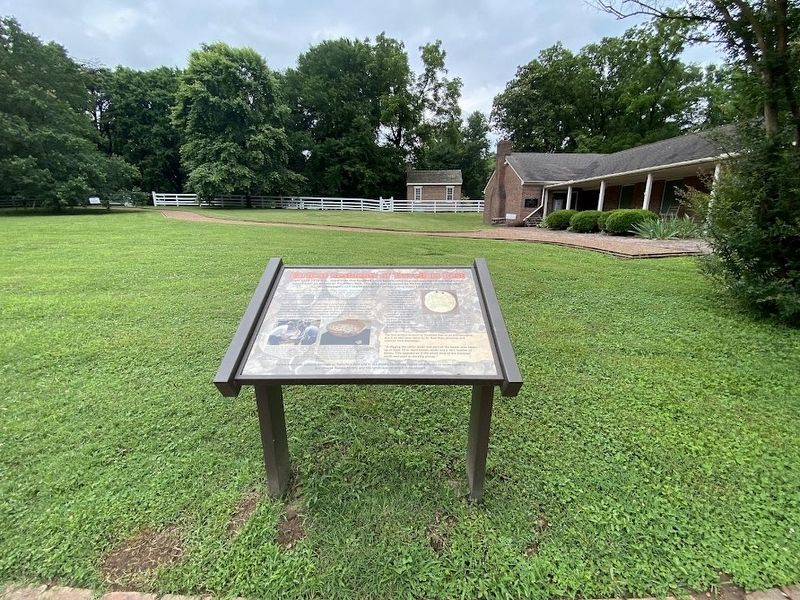
Earliest Residents of Travellers Rest
Photographed by Darren Jefferson Clay, June 1, 2024
1. Earliest Residents of Travellers Rest Marker
Water was extremely important to Native peoples, especially during the Mississippian period. In order to support a higher population Native Americans developed various farming practices, which required a nearby reliable source of water. It is very likely that the spring just northeast of Travellers Rest would have initially attracted Native Americans to the area.
During the Mississippian period, Native Americans often built earthen mounds in or near their settlements. Because there was no written language during the Mississippian period, it is difficult for archaeologists to say with certainty what purpose these earthen structures served. Most believe it may be related to religion or social/political structure. These mounds would commonly contain layered burials.
In the area surrounding what is now Nashville, Native Americans often interred the deceased in
this page online
The first written account of Travellers Rest as an archaeological site is an 1805 description by Dr. Rush Nutt, physician and scientist from Mississippi.
"In digging the cellar under one part of the house...was taken up at least 35 or more human skulls and a vast number of bones. This appears as if the whole face of the enclosed earth was used as burying places."
Native American cultural heritage at Travellers Rest and in the Middle Tennessee region contributes to understanding our diverse human history and the landscape on which it developed.
Captions
(left, left): This clay hearth was excavated by the Southeastern Indian Antiquities Survey from house site #4, which was located near the current visitor center. In 2019, charcoal was removed from the hearth and radiocarbon dated to provide an absolute date for the prehistoric occupation of the site. Image courtesy of the Tennessee Division of Archaeology.
(left, right): This filleted, notched rim prehistoric ceramic bowl was found during the excavation of house site #1, located to the northeast of the historic house and performed by the Southeastern Indian Antiquities Survey in 1967. The bowl is filled with burned freshwater snail shells, which were likely cooked and eaten, and include species that are still commonly found in rivers and streams in Middle Tennessee.
(right): Above: This carved marine shell gorget was likely removed from a stone box burial by the Overton's gardener, Edward Cross, in the late 1800s. The exact purpose of these Native gorgets is unknown, but they are commonly found in burial contexts during the Mississippian period. The design features four pileated woodpeckers, which may represent the four cardinal directions. Image from the Peabody Museum at Harvard University online collection.
Topics.
Photographed by Darren Jefferson Clay, June 1, 2024
2. Earliest Residents of Travellers Rest Marker
Location. 36° 4.567′ N, 86° 45.877′ W. Marker is in Nashville, Tennessee, in Davidson County. It is in Crieve Hall. It can be reached from Farrell Parkway west of Regent Drive. Touch for map. Marker is at or near this postal address: 636 Farrell Pkwy, Nashville TN 37220, United States of America. Touch for directions.

Regionally, this marker is in Middle Tennessee. It is also in the American South and specifically in the Upper South. Globally, it is in North America, the Western Hemisphere, the Western World, and the Anglosphere. Historically, it finds itself in what was once the territory of the Mississippian Culture, one of the Confederate States of America, and the Antebellum South.
Other nearby markers. At least 8 other markers are within walking distance of this marker: From Enslavement to Freedom (a few steps from this marker); a different marker also named Travellers Rest (within shouting distance of this marker); Battle of Nashville / Peach Orchard Hill (within shouting distance of this marker); Historic Travellers Rest Herb Garden (about 500 feet away, measured in a direct line); Herb Garden (about 500 feet away); Smokehouse (about 500 feet away); Arabian Horses (about 600 feet away); a different marker also named Travellers' Rest (approx. 0.2 miles away). Touch for a list and map of all markers in Nashville.
Another marker is no longer nearby. Travellers Rest (was a few steps from this marker but has been replaced with another marker now near it).
Credits. This page was last revised on June 4, 2024. It was originally submitted on June 2, 2024, by Darren Jefferson Clay of Duluth, Georgia. This page has been viewed 230 times since then and 29 times this year. Photos: 1, 2. submitted on June 2, 2024, by Darren Jefferson Clay of Duluth, Georgia. • James Hulse was the editor who published this page.
