Glen Rose in Somervell County, Texas — The American South (West South Central)
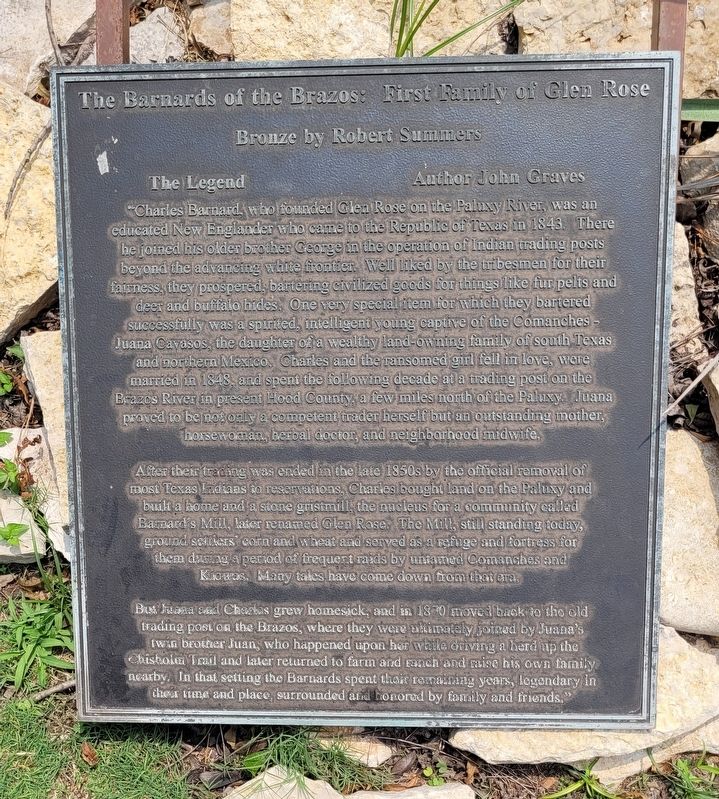
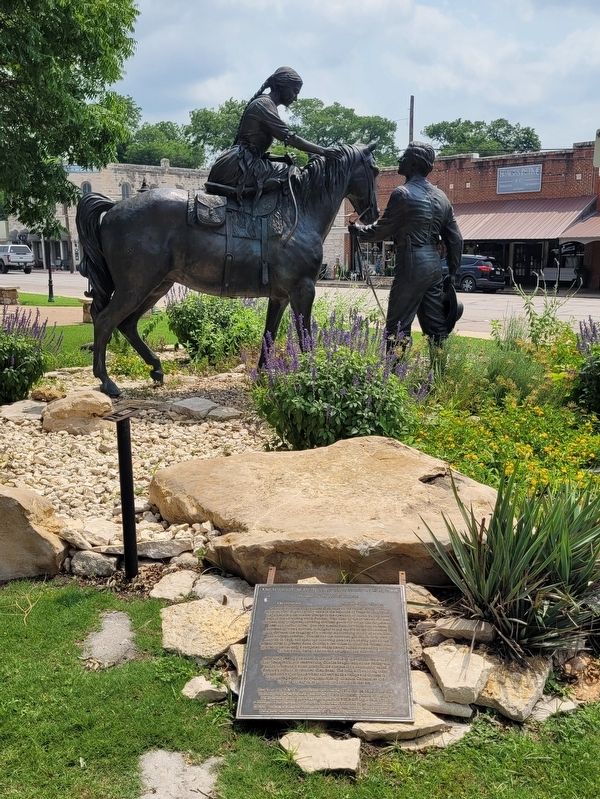
The Barnards of the Brazos
First Family of Glen Rose
| — | Bronze by Robert Summers | — |
Photographed by James Hulse, June 2, 2024
1. The Barnards of the Brazos Marker
Author John Graves
After their trading was ended in the late 1850s by the official removal of most Texas Indians to reservations, Charles bought land on the Paluxy and built a home
this page online
But Juana and Charles grew homesick, and in 1870 moved back to the old trading post on the Brazos, where they were ultimately joined by Juana's twin brother Juan, who happened upon her while driving a herd up the Chisholm Trail and later returned to farm and ranch and raise his own family nearby. In that setting the Barnards spent their remaining years, legendary in the time and place, surrounded and honored by family and friends."
Topics. This historical marker is listed in these topic lists: Hispanic Americans • Indigenous Peoples and Communities • Settlements & Settlers • Women. A significant historical year for this entry is 1843.
Location. 32° 14.096′ N, 97° 45.336′ W. Marker is in Glen Rose, Texas, in Somervell County. It is at the intersection of Northeast Barnard Street (State Road 144) and Elm Street,
Photographed by James Hulse, June 2, 2024
2. The Barnards of the Brazos statue and Marker

Regionally, this marker is in the Prairies & Lakes Region. Globally, it is in North America, a Gulf of Mexico state, the Western Hemisphere, the Western World, and the Anglosphere. Historically, it finds itself in what was once New Spain, the Republic of Texas, and one of the Confederate States of America.
Other nearby markers. At least 8 other markers are within walking distance of this marker: Somervell County (here, next to this marker); Somervell County Veterans (a few steps from this marker); Somervell County Courthouse (a few steps from this marker); Dinosaur Footprint (within shouting distance of this marker); First National Bank (within shouting distance of this marker); A Tribute to Senator Vernon Lemens (within shouting distance of this marker); Martin's Grocery Store (within shouting distance of this marker); Ice House (within

Photographed by James Hulse, June 2, 2024
3. The Barnards of the Brazos statue
Also see . . .
1. Barnard, Charles E. (1823–1900). Texas State Historical Association (TSHA)
Charles E. (Uncle Charley) Barnard, pioneer Indian trader, son of Henry B. Barnard, was born at Hartford, Connecticut, on August 10, 1823. At the age of twenty-one he joined his brother, George Barnard, at Tehuacana Trading Post near the site of present-day Waco and subsequently assisted him in operating it and other Indian trading posts along Central Texas rivers. In 1846 at Tehuacana Trading Post George Barnard ransomed a Comanche captive, Juana Cavasos, daughter of a prominent Spanish family of Matamoros, Mexico. In 1848 Charles married her.(Submitted on June 9, 2024, by James Hulse of Medina, Texas.)
2. Barnard, Juana Josefina Cavasos (1822–1906). Texas State Historical Association (TSHA)
On August 15, 1844, Comanche Indians raided South Texas near the Rio Grande and captured Juana, who was then eighteen. One account reports that she was held captive for seven months, while another reports three years, but Juana's own testimony suggests she may have been captive less than a month. The Comanches visited the Tehuacana Creek Trading House operated by George Barnard in north central Texas. Barnard traded $300 in horses and merchandise for Juana. Shortly afterwards she married George's brother Charles. Charles Barnard has been recognized as having cordial relations with various Indian tribes. Juana noted that she lived in the Somervell County area for many months without seeing a White woman.(Submitted on June 9, 2024, by James Hulse of Medina, Texas.)
Credits. This page was last revised on June 9, 2024. It was originally submitted on June 8, 2024, by James Hulse of Medina, Texas. This page has been viewed 740 times since then and 108 times this year. Photos: 1, 2, 3. submitted on June 9, 2024, by James Hulse of Medina, Texas.
