Cartersville in Bartow County, Georgia — The American South (South Atlantic)
Etowah’s Wattle and Daub House
| — | Etowah Indian Mounds State Historic Site | — |
Photographed by Brandon D Cross
1. Etowah’s Wattle and Daub House Marker
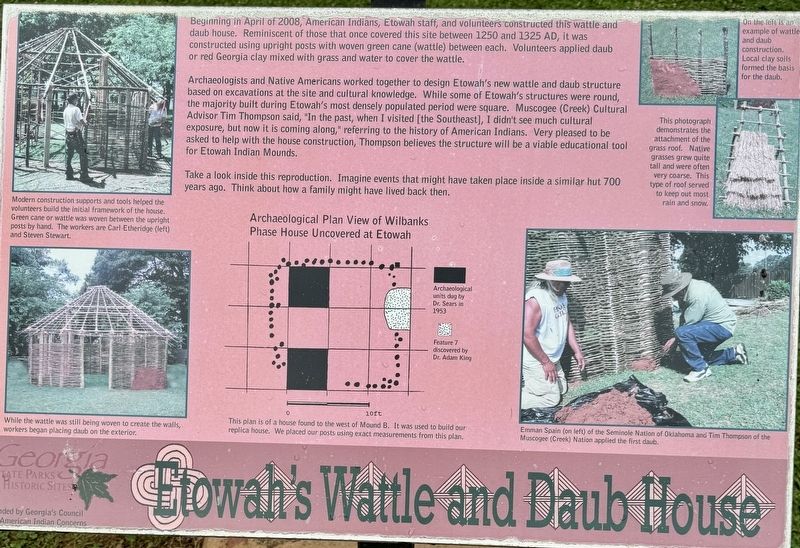
Archaeologists and Native Americans worked together to design Etowah's new wattle and daub structure based on excavations at the site and cultural knowledge. While some of Etowah's structures were round, the majority built during Etowah's most densely populated period were square. Muscogee (Creek) Cultural Advisor Tim Thompson said, "In the past, when I visited [the Southeast], I didn't see much cultural exposure, but now it is coming along," referring to the history of American Indians. Very pleased to be asked to help with the house construction, Thompson believes the structure will be a viable educational tool for Etowah Indian Mounds.
Take a look inside this reproduction. Imagine events that might have taken place inside a similar hut 700 years ago. Think
this page online
(captions)
Archaeological Plan View of Wilbanks Phase House Uncovered at Etowah
Archeological units dug by Dr. Sears in 1953
Feature 7 discovered by Dr. Adam King
This plan is of a house to the west of Mound B. It was used to build our replica house. We placed our posts using exact measurements from this plan.
Modern construction supports and tools helped the volunteers build the initial framework of the house. Green cane or wattle was woven between the upright posts by hand. The workers are Carl Etheridge (left) and Steven Stewart.
While the wattle was still being woven to create the walls, workers began placing daub on the exterior.
On the left is an example of wattle and daub construction. Local clay soils formed the basis for the daub.
This photograph demonstrates the attachment of the grass roof. Native grasses grew quite tall and were often very coarse. This type of roof served to keep out most rain and snow.
Emman Spain (on left) of the Seminole Nation of Oklahoma and Tim Thompson of the Muscogee (Creek) Nation applied the first daub.
Erected by Georgia

Photographed by Brandon D Cross
2. Etowah’s Wattle and Daub House Marker
Topics. This historical marker is listed in these topic lists: Anthropology & Archaeology • Cemeteries & Burial Sites • Indigenous Peoples and Communities • Notable Places. A significant historical month for this entry is April 2008.
Location. 34° 7.672′ N, 84° 48.444′ W. Marker is in Cartersville, Georgia, in Bartow County. It can be reached from Indian Mounds Road SE 0.2 miles south of Sequoyah Circle, on the left when traveling south. Located on the grounds of Etowah Indian Mounds State Historic Site. Touch for map. Marker is at or near this postal address: 813 Indian Mounds Road SE, Cartersville GA 30120, United States of America. Touch for directions.

Regionally, this marker is in the Mountains. It is also in the American South and specifically in the Deep South. Globally, it is in North America, the Western Hemisphere, the Western World, and the Anglosphere. Historically, it finds itself in what was once the original Cherokee Nation, the territory of the Mississippian Culture, one of the original Thirteen Colonies, one of the Confederate States of America, and the Antebellum South.
Other nearby markers. At least 8 other markers are within walking distance of this marker: The Defensive Ditch/Borrow Pit (a few steps from this marker); Remote Sensing at Etowah (a few steps from this marker); Etowah Mounds (within shouting distance of this marker); A Return to Native Grasses (within shouting distance of this marker); A Chiefly Village on the Etowah (about 500 feet away, measured in a direct line); Etowah (Tumlin) Mounds (about 600 feet away); Mound A - Symbol of a Chiefdom (approx. 0.2 miles away); Etowah’s Past, Present, and Future (approx. 0.2 miles away). Touch for a list and map of all markers in Cartersville.
Also see . . . Etowah Indian Mounds State Historic Site. (Submitted on June 30, 2024, by Brandon D Cross of Flagler Beach, Florida.)
Credits. This page was last revised on October 27, 2024. It was originally submitted on June 30, 2024, by Brandon D Cross of Flagler Beach, Florida. This page has been viewed 804 times since then and 102 times this year. Photos: 1, 2. submitted on June 30, 2024, by Brandon D Cross of Flagler Beach, Florida. • Bernard Fisher was the editor who published this page.
