Near Tucson in Pima County, Arizona — The American Mountains (Southwest)
Prehistoric People
Saguaro National Park
| — | National Park Service, U.S. Department of the Interior | — |
Photographed by James Hulse, June 17, 2024
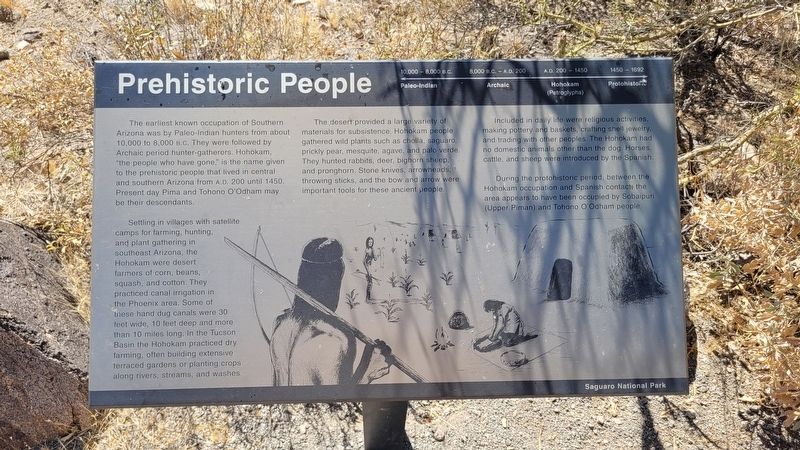
1. Prehistoric People Marker
The earliest known occupation of Southern Arizona was by Paleo-Indian hunters from about 10,000 to 8,000 B.C. They were followed by Archaic period hunter-gatherers. Hohokam, "the people who have gone," is the name given to the prehistoric people that lived in central and southern Arizona from A.D. 200 until 1450. Present day Pima and Tohono O'Odham may be their descendants.
Settling in villages with satellite camps for farming, hunting, and plant gathering in southeast Arizona, the Hohokam were desert farmers of corn, beans, squash, and cotton. They practiced canal irrigation in the Phoenix area. Some of these hand dug canals were 30 feet wide, 10 feet deep and more than 10 miles long. In the Tucson Basin the Hohokam practiced dry farming, often building extensive terraced gardens or planting crops along rivers, streams, and washes.
The desert provided a large variety of materials for subsistence. Hohokam people gathered wild plants such as cholla, saguaro, prickly pear, mesquite, agave, and palo verde. They hunted rabbits, deer, bighorn sheep and pronghorn. Stone knives, arrowheads, throwing sticks, and the bow
this page online
Included in daily life were religious activities, making pottery and baskets, crafting shell jewelry, and trading with other peoples. The Hohokam had no domestic animals other than the dog. Horses, cattle, and sheep were introduced by the Spanish.
During the protohistoric period, between the Hohokam occupation and Spanish contact, the area appears to have been occupied by Sobaipuri (Upper Piman) and Tohono O'Odham people.
Timeline
10,000-8,000 B.C. • Paleo-Indian
8,000 B.С.-A.D. 200 • Archaic
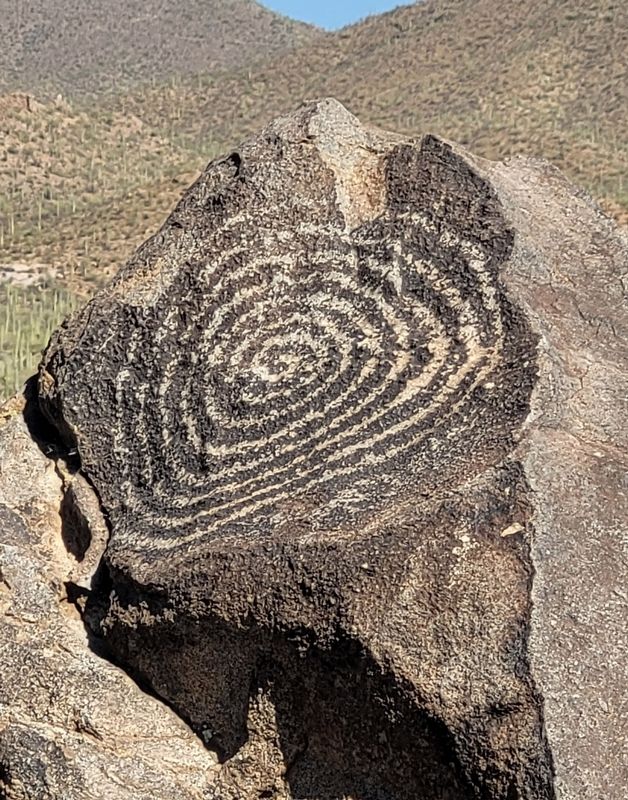
A.D. 200-1450 • Hohokam (Petroglyphs)
1450-1692 • Protohistoric
Erected by National Park Service, U.S. Department of the Interior.
Topics. This historical marker is listed in these topic lists: Anthropology & Archaeology • Indigenous Peoples and Communities • Parks & Recreational Areas • Settlements & Settlers. A significant historical year for this entry is 200 CE.
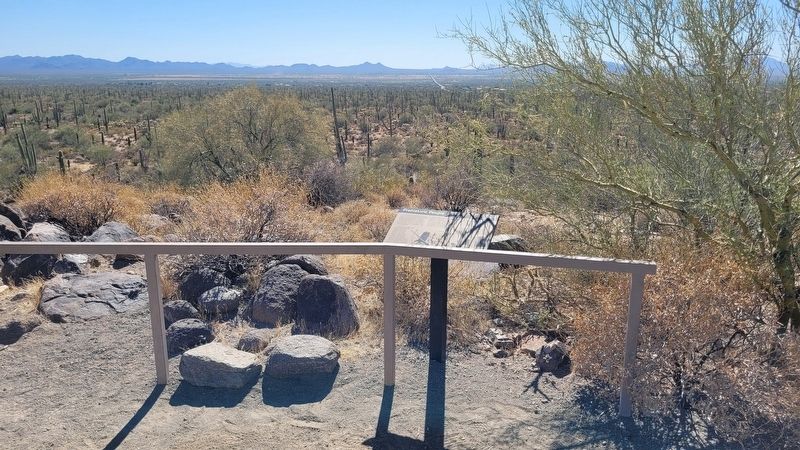
Location. 32° 17.466′ N, 111° 12.512′ W. Marker is near Tucson, Arizona, in Pima County. It is at the intersection of Signal Hill Road and Golden Gate Road on Signal Hill Road. The marker
Photographed by James Hulse, June 17, 2024
2. Prehistoric People Marker

Regionally, this marker is in the Sky Islands, in the Sonoran Desert, and in the Phoenix Metropolitan Area. It is also in the American Borderlands and in the Southwest. Globally, it is in North America, the Western Hemisphere, the Western World, and the Anglosphere. Historically, it finds itself in what was once New Spain and also the Gadsden Purchase.
Other nearby markers. At least 8 other markers are within 18 miles of this marker, measured as the crow flies: Historic Period (here, next to this marker); Prehistoric Rock Art (within shouting distance of this marker); Civilian Conservation Corps (The CCC) (about 300 feet away, measured in a direct line); World of the Wash (approx. 2.6 miles away); Desert Life (approx. 2.6 miles away); Seed to Sentinel (approx. 2.6 miles away); Mission San Xavier del Bac (approx. 17.3 miles away); a different marker also named Mission San Xavier del Bac (approx. 17.3 miles away). Touch for a list and map
Photographed by James Hulse, June 17, 2024
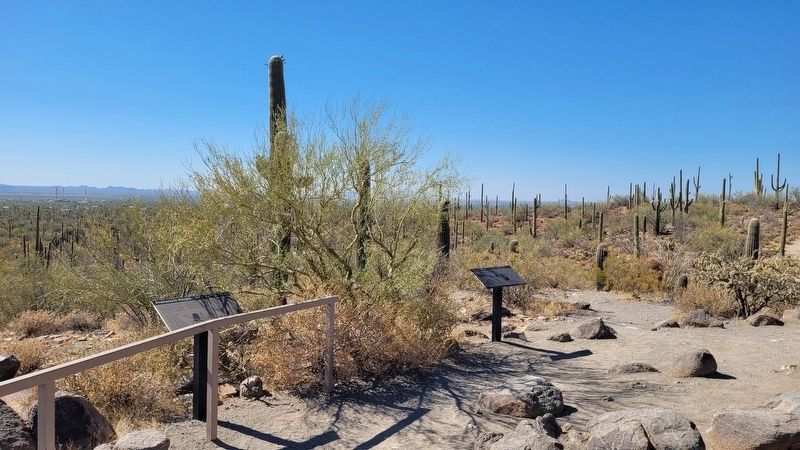
3. The Prehistoric People Marker is located on the left side of the two markers
Also see . . .
1. Signal Hill Petroglyphs. National Park Service
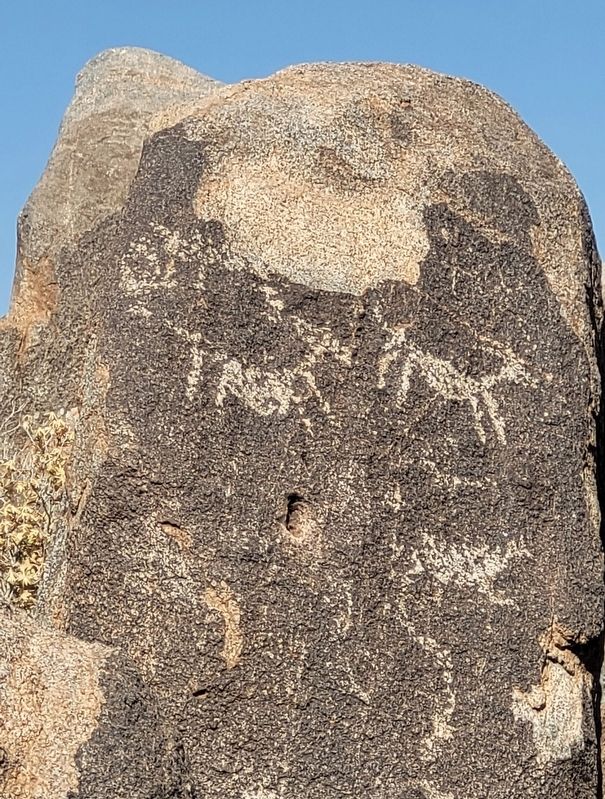
Just north of the Signal Hill picnic area is the largest petroglyph site in the Tucson Mountain District of Saguaro National Park (SNP). The Signal Hill Petroglyph Site occupies a small but very distinct rocky hill (Figure 1) that is about 200 feet in diameter at its base and 40 feet high.(Submitted on July 1, 2024, by James Hulse of Medina, Texas.)
The site consists of over 200 prehistoric Native American petroglyphs many of which can be viewed from the visitor trail that ascends the hill. These petroglyphs were created from between about 550 to 1550 years ago.
2. The Hohokam. Arizona Museum of Natural History
The Hohokam seemed to appear in Arizona quite suddenly with the ability to build sophisticated irrigation system to water their crops. Early archaeologists proposed that Hohokam culture developed in Mexico and moved into what is now Arizona.(Submitted on July 3, 2024, by James Hulse of Medina, Texas.)
Photographed by James Hulse, June 17, 2024
4. Petroglyphs on Signal Hill
Photographed by James Hulse, June 17, 2024
5. Spiral Petroglyph on Signal Hill
Credits. This page was last revised on June 28, 2025. It was originally submitted on July 1, 2024, by James Hulse of Medina, Texas. This page has been viewed 430 times since then and 47 times this year. Photos: 1, 2, 3, 4, 5. submitted on July 3, 2024, by James Hulse of Medina, Texas.
