Cartersville in Bartow County, Georgia — The American South (South Atlantic)
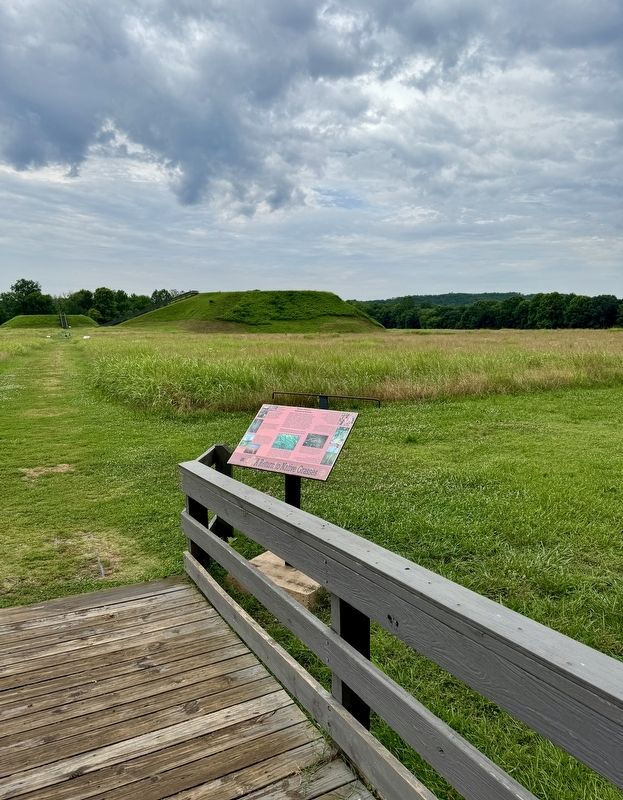
A Return to Native Grasses
| — | Etowah Indian Mounds State Historic Site | — |

Photographed by Brandon D Cross
1. A Return to Native Grasses Marker
Native grasses and forbs (non-grass herbs) are identified in each garden plot by small markers.
Bushy Bluestem (Andropogon glomeratus) typically grows in low-lying wet areas. It provides screening and nesting cover for some species of wildlife, is a poor quality forage for cattle, and is often used as an ornamental grass in landscapes. It grows 1 to 2 feet tall and has an attractive seed head in fall.
Little Bluestem (Schizachyrium scoparium) is a true blue grass that loves heat and humidity. Its blue foliage of summer turns burgundy red in fall with tall seedheads. It is a great native grass for mass planting in full sun.
Big Bluestem (Andropogon gerardi) is a clump forming warm season perennial grass which grows 3 to 6 feet tall. The lower stems are a bluish color. The flowers form in three dense elongate clusters giving it the common name "turkey-foot grass." It grows best in moist well-drained soil in full sun. In fall, it turns a brilliant bronze color.
Eastern gamagrass (Tripsacum dactyloides) is a warm-season bunch grass native to the eastern United States. This highly productive grass is best adapted to wet habitats. Remnant colonies are commonly found in flood plains and along stream banks. Individual grass clumps can reach a diameter of 4 feet with seed heads growing 3 to 9 feet tall.
River Oats or Northern Sea Oats (Chasmanthium latifolium) is a drought-resistant grass that grows up to 3 feet high. Its eight inch leaves turn from green to brown throughout the seasons. Growing best in partial shade, it flowers in June. The seed heads, or spikelets turn a beautiful bronze in the fall, and by October, the one-inch spikelets are a natural brown color.
Poverty oatgrass (Danthonia Spicata) is a shortleaved, light green tufted perennial found on dry and poor sandy or gravelly soils. It is typically 1-2 feet tall. It bears seed heads that are rarely more than 2 inches long, with the seed borne on spikelets carried off the main stem on short, stiff branches.
Switchgrass (Panicum virgatum) is a slow-spreading red-tinged perennial grass that grows to a height of 3 to 6 feet. Preferring full sun, it produces airy flowers from August to September. Its seed heads look like pillowy clouds.
Indian Grass (Sorghastrum nutans) is a perennial bunchgrass with upright showy stalks. As a warm season grass, it begins growing in May and seeds from July to August. It turns from green to tan in winter.
(caption) Photo of Bluestem grass in fall by Steve Mulligan
Erected by Georgia
this page online
Topics. This historical marker is listed in these topic lists: Environment • Indigenous Peoples and Communities • Parks & Recreational Areas.
Location. 34° 7.644′ N, 84° 48.434′ W. Marker is in Cartersville, Georgia, in Bartow County. It can be reached from Indian Mounds Road SE 0.2 miles south of Sequoyah Circle, on the left when traveling south. Located on the grounds of Etowah Indian Mounds State Historic Site. Touch for map. Marker is at or near this postal address: 813 Indian Mounds Road SE, Cartersville GA 30120, United States of America. Touch for directions.

Regionally, this marker is in the Mountains. It is also in the American South and specifically in the Deep South. Globally, it is in North America, the Western Hemisphere, the Western World, and the Anglosphere. Historically, it finds itself in what was once the original Cherokee Nation, the territory of the Mississippian Culture, one of the original Thirteen Colonies, one of the Confederate States of America, and the Antebellum South.
Other nearby markers. At
Photographed by Brandon D Cross
2. A Return to Native Grasses Marker
Credits. This page was last revised on July 4, 2024. It was originally submitted on July 2, 2024, by Brandon D Cross of Flagler Beach, Florida. This page has been viewed 225 times since then and 30 times this year. Photos: 1, 2. submitted on July 2, 2024, by Brandon D Cross of Flagler Beach, Florida. • Bernard Fisher was the editor who published this page.
