Lower Macungie Township in Wescosville in Lehigh County, Pennsylvania — The American Northeast (Mid-Atlantic)
A Farming Community
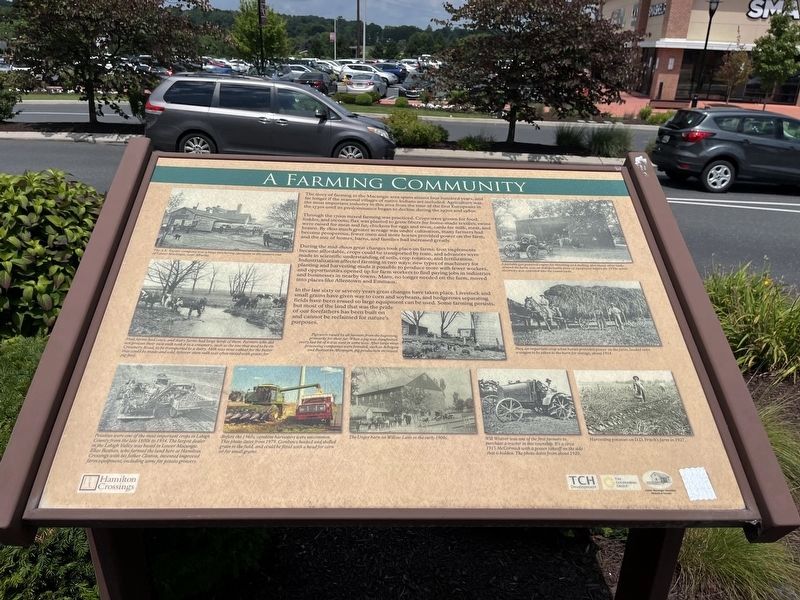
The story of farming in the Macungie area spans almost four hundred years, and far longer if the seasonal villages of native Indians are included. Agriculture was the most important industry in this area from the time of the first Europeans in the 1730s until its predominance began to decline during the 1970s and 1980s.
Through the 1700s mixed farming was practiced. Crops were grown for food, fodder, and income; flax was planted to grow fibers for home-made textiles; swine were raised for meat and fat; chickens for eggs and meat; cattle for milk, meat, and brawn. By 1800 much greater acreage was under cultivation, many farmers had become prosperous, fewer oxen and more horses provided power on the farm, and the size of homes, barns, and families had increased greatly.
During the mid-1800s great changes took place on farms. Iron implements became affordable, crops could be transported by train, and advances were made in scientific understanding of soils, crop rotation, and fertilization. Industrialization affected farming in two ways: new types of machinery for planting and harvesting made it possible to produce
this page online
In the last sixty or seventy years great changes have taken place. Livestock and small grains have given way to corn and soybeans, and hedgerows separating fields have been erased so large equipment can be used. Some farming persists, but most of the land that was the pride of our forefathers have been built on and cannot be reclaimed for nature's purposes.
[Captions:]
The A.K. Snyder company was a large butchering operation in the western end of Lower Macungie, near Alburtis.
Most farms had cows, and dairy farms had large herds of them. Farmers who did not process their own milk took it to a creamery, such as the one that used to be on the Creamery Road, to be transported to a dairy. Milk was most valued for the butter that could be made and sold; leftover skim milk was often mixed with grains for pig feed.
A portable gas-powered engine for threshing and shelling, plus many other tasks around the farm, was an indispensable piece of equipment before the 1930s, when electricity was extended into the countryside.
Hay, an important crop when horses provided power on the farm, loaded into a wagon to be taken to the barn for storage, about 1914.
Pigs were raised by all farmers from the beginning, primarily for their fat. When a pig was slaughtered, every last bit of it was used in some way. After large meat processing companies were founded, such as Arbogast and Bastian in Allentown, pig production increased.
Potatoes were one of the most important crops in Lehigh County from the late 1800s to 1954. The largest dealer in the Lehigh Valley was based in Lower Macungie. Elias Bastian, who farmed the land here at Hamilton Crossings with his father Clinton, invented improved farm equipment, including some for potato growers.
Before the 1960s, combined harvesters were uncommon. This photo dates from 1979. Combines husked and shelled grain in the field, and could be fitted with a head for corn or for small grains.
The Unger barn on Willow Lane in the early 1900s.
Will Weaver was one of the first farmers to purchase a tractor in this township. It's a circa 1915 McCormick with a power takeoff on the side that is hidden. The photo dates from about 1920.
Harvesting potatoes on D.D. Fritch's farm in 1927.
Erected by TCH
Topics and series. This historical marker is listed in these topic lists: Agriculture • Animals • Colonial Era • Science & Medicine. In addition, it is included in the Pennsylvania, Lower Macungie Township Historic Walking Trail series list. A significant historical year for this entry is 1800.
Location. 40° 33.908′ N, 75° 33.729′ W. Marker is in Wescosville, Pennsylvania, in Lehigh County. It is in Lower Macungie Township. It is on North Krocks Road south of Fred Jaindl Memorial Highway (U.S. 222), on the left when traveling south. Touch for map. Marker is at or near this postal address: 833 N Krocks Rd, Allentown PA 18106, United States of America. Touch for directions.

Regionally, this marker is in Southeast Pennsylvania and in Lehigh Valley. It is also in the American Northeast and in the Mid-Atlantic. Globally, it is in North America, the Western Hemisphere, the Western World, and the Anglosphere. Historically, it finds itself in what was once the Haudenosaunee (Iroquois) Confederacy and also one of the original Thirteen Colonies.
Other nearby markers. At least 8 other markers are within walking distance of this marker: The Mining Industry (within shouting distance of this marker); Barns, Decorative Art & Music (within shouting distance of this marker); Business & Industry (about 300 feet away, measured in a direct line); Early Roads & Highways (about 400 feet away); Churches and Schools (about 500 feet away); Trains and Trolleys (about 600 feet away); Early Settlers (approx. 0.2 miles away); Villages (approx. ¼ mile away). Touch for a list and map of all markers in Wescosville.
Credits. This page was last revised on July 24, 2024. It was originally submitted on July 24, 2024, by Devry Becker Jones of Washington, District of Columbia. This page has been viewed 202 times since then and 19 times this year. Photos: 1, 2. submitted on July 24, 2024, by Devry Becker Jones of Washington, District of Columbia.
