Guayanilla in Municipio de Guayanilla, Puerto Rico — The Caribbean (The West Indies)
Villa de Santa María de Guadianilla
[Village of Santa Maria de Guadianilla]
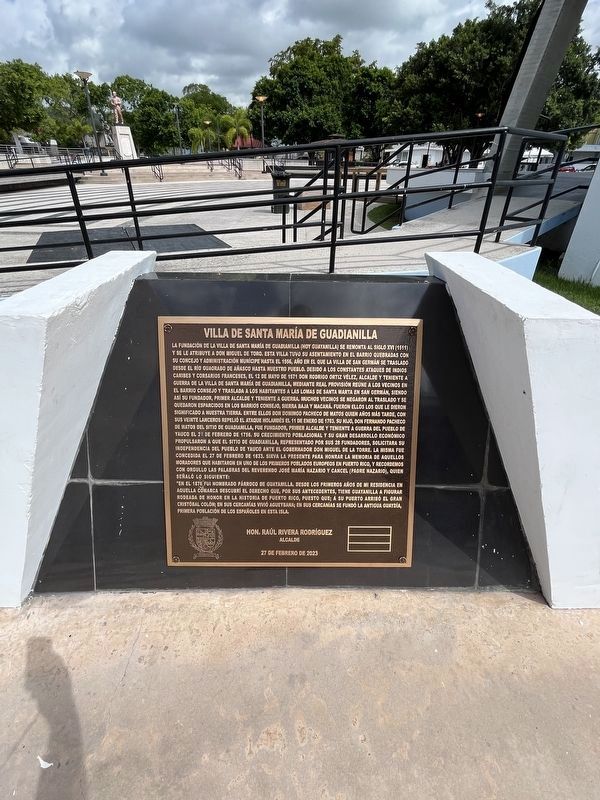
Photographed by Devry Becker Jones (CC0), June 7, 2023
1. Villa de Santa María de Guadianilla Marker

La fundación de la Villa de Santa María de Guadianilla (hoy Guayanilla) se remonta al Siglo XVI (1511) y se le atribuye a Don Miguel de Toro. Esta villa tuvo su asentamiento en el Barrio Quebradas con su concejo y administrición munícipe hasta el 1556, año el que la Villa de San Germán se traslado desde el Río Guaorabo de Añasco hasta nuestro pueblo, debido a los constantes ataques de Indios Caribes y Corsarios Franceses, el 12 de mayo de 1571 Don Rodrigo Ortiz Vélez, Alcalde y teniente de Guerra de la Villa de Santa María de Guadianilla, mediante real provisión reúne a los vecinos en el barrio Consejo y traslada a los habitantes a las lomas de Santa Marta en San Germán, siendo así su fundador, primer alcalde y teniente de guerra. Muchos vecinos se negaron al traslado y se quedaron esparcidos en los barrios Consejo, Sierra Baja y Macaná. Fueron ellos los que le dieron significado a nuestra tierra. Entre ellos Don Domingo Pacheco de Matos quien años más tarde, con sus veinte lanceros repelió el ataque holandés el 11 de enero de 1703. Su hijo Don Fernando Pacheco de Matos del Sitio de Guadianilla, fue fundador, primer
this page online
"En el 1876 fui nombrado párroco de Guayanilla. Dede los primeros años de mi residencia en aquella comarca descubrí el derecho que, por sus antecedentes, tiene Guayanilla a figurar rodeada de honor en la historia de Puerto Rico, puesto que; a su puerto arribó el gran Cristóbal Colón; en sus cercanías vivió Aguebana; en sus cercanías se fundó la Antigua Guaydía, primera población de los Españoles en esta isla.
The Village of Santa María de Guadianilla (today Guayanilla) dates back to the 16th century (1511)
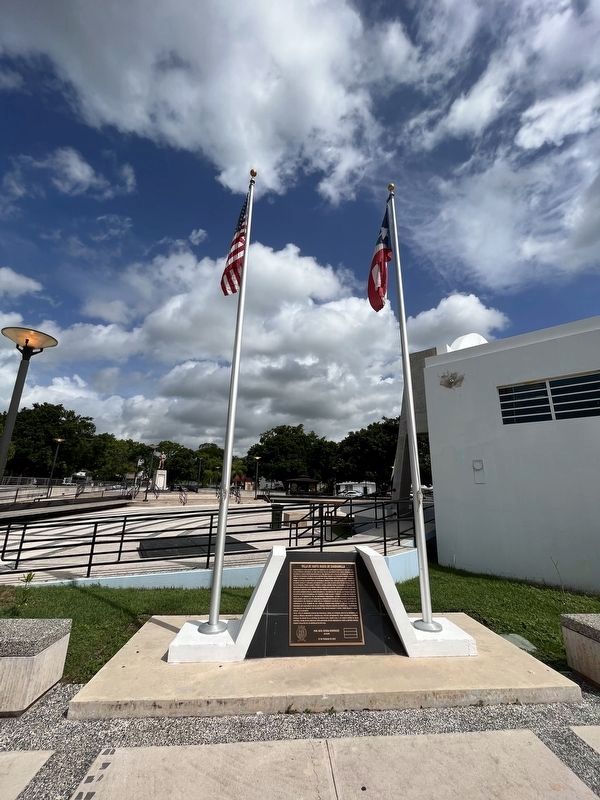
Photographed by Devry Becker Jones (CC0), June 7, 2023
2. Villa de Santa María de Guadianilla Marker
"In 1876 I was appointed parish priest of Guayanilla. From the first years of my residence in that region I discovered that Guayanilla has to appear surrounded by honor in the history of Puerto Rico. In its port, the great Christopher Colombus arrived; Aguebana lived nearby; Antigua Guaydía was founded nearby, the first Spanish town on this island.
Erected 2023 by Municipio de Guayanilla, Hon. Raúl Rivera Rodríguez, Alquede.
Topics. This historical marker is listed in these topic lists: Colonial Era • Settlements & Settlers • Wars, Non-US • Waterways & Vessels. A significant historical date for this entry is January 11, 1703.
Location. 18° 1.057′ N, 66° 47.389′ W. Marker is in Guayanilla in Municipio de Guayanilla, Puerto Rico. It is on Calle Luis Munoz Rivera (Puerto Rico Route 127) south of Calle Concepcion, on the right when traveling south. Touch for map. Marker is at or near this postal address: Calle Luis Munoz Rivera 6, Guayanilla PR 00656, United States of America. Touch for directions.

Regionally, this marker is on the Southern Coastal Zone. Globally, it is one of the Greater Antilles on the Caribbean Sea, on in the Atlantic Ocean, in North America, in the Western Hemisphere, in the Western World, and in the Anglosphere. Historically, it finds itself in what was once a Spanish colony.
Other nearby markers. At least 8 other markers are within walking distance of this marker: Luis Muñoz Marin (within shouting distance of this marker); Veteranos Guayanillenses (within shouting distance of this marker); En Memoria de Todos los Veteranos de la I Guerra Mundial (within shouting distance of this marker); En Memoria de Todos los Veteranos de la II Guerra Mundial (within shouting distance of this marker); En Memoria de Todos los Veteranos de la Guerra de Corea (within shouting distance of this marker); En Memoria de Todos los Veteranos de Vietnam (within shouting distance of this marker); En Memoria de Todos los Veteranos de la Guerra del Golfo Persico (within shouting distance of this marker); Edificio Neoclásico (approx. 0.3 kilometers away). Touch for a list and map of all markers in Guayanilla.
Credits. This page was last revised on August 2, 2024. It was originally submitted on June 14, 2023, by Devry Becker Jones of Washington, District of Columbia. This page has been viewed 984 times since then and 108 times this year. Last updated on August 1, 2024, by Rafael Escobar of Jacksonville, Florida. Photos: 1, 2. submitted on June 14, 2023, by Devry Becker Jones of Washington, District of Columbia. • J. Makali Bruton was the editor who published this page.
