Pekin in Tazewell County, Illinois — The American Midwest (Great Lakes)
Nance Legins-Costley
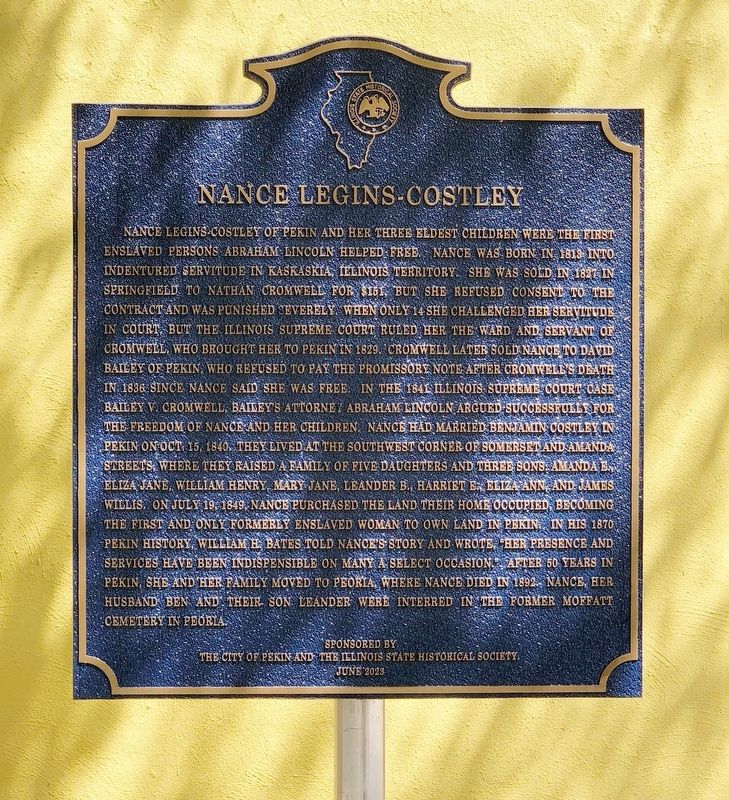
Photographed by Duane and Tracy Marsteller, July 6, 2024
1. Nance Legins-Costley Marker
this page online
Erected 2023 by The City of Pekin • The Illinois State Historical Society.
Topics and series. This historical marker is listed in these topic lists: Abolition & Underground RR • African Americans • Law Enforcement • Women. In addition, it is included in the Former U.S. Presidents: #16 Abraham Lincoln, and the Illinois State Historical Society series lists. A significant historical year for this entry is 1841.
Location. 40° 34.152′ N, 89° 38.775′ W. Marker is in Pekin, Illinois, in Tazewell County. It can be reached from Court Street east of North 4th Street, on the left when traveling east. Marker is in Legins-Costley Park, located between 411 and 417 Court Street. Touch for map.
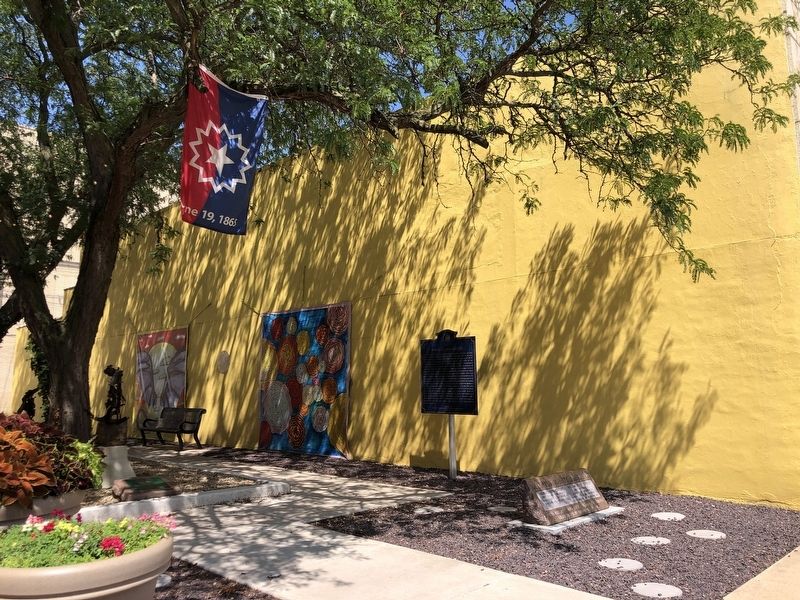
Photographed by Duane and Tracy Marsteller, July 6, 2024
2. Nance Legins-Costley Marker

Regionally, this marker is in the Illinois River Valley and in Greater Peoria. It is also in the American Midwest and in the Corn Belt. Globally, it is in North America, the Western Hemisphere, the Western World, and the Anglosphere. Historically, it finds itself in what was once the territory of the Mississippian Culture and also the Northwest Territory.
Other nearby markers. At least 8 other markers are within 6 miles of this marker, measured as the crow flies: Tazewell County Remembers (here, next to this marker); Pvt. William Henry Costley (here, next to this marker); Abraham Lincoln - Eighth Judicial District (about 400 feet away, measured in a direct line); 29th United States Colored Infantry (about 500 feet away); Union League of America (about 700 feet away); Hinners Organ Company (approx. 0.3 miles away); The Steamboat Columbia Disaster (approx. 0.4 miles away); Fort Crevecœur (approx. 5.9 miles away). Touch for a list and map of all markers in Pekin.
Also see . . . Nance Legins Costley. Born into a culture that persistently denied African Americans their right to freedom, Nance Legins Costley proved herself to be a woman of singular bravery and resilience when she took an important public stand for her own legal emancipation, setting a precedent that helped numerous others secure their own freedom. (The Randolph Society) (Submitted on August 2, 2024, by Duane and Tracy Marsteller of Murfreesboro, Tennessee.)
Credits. This page was last revised on August 2, 2024. It was originally submitted on August 2, 2024, by Duane and Tracy Marsteller of Murfreesboro, Tennessee. This page has been viewed 308 times since then and 47 times this year. Photos: 1, 2. submitted on August 2, 2024, by Duane and Tracy Marsteller of Murfreesboro, Tennessee.
