Susquehanna Township near Harrisburg in Dauphin County, Pennsylvania — The American Northeast (Mid-Atlantic)
Native Americans

Erected by Dauphin County Parks & Recreation.
Topics. This historical marker is listed in these topic lists: Anthropology & Archaeology • Indigenous Peoples and Communities • Parks & Recreational Areas.
Location. 40° 20.463′ N, 76° 54.542′ W. Marker is near Harrisburg, Pennsylvania, in Dauphin County. It is in Susquehanna Township. It is on North Front Street south of Fort Hunter Road, on the right when traveling south. Touch for map. Marker is at or near this postal address: 35 N Front St, Harrisburg PA 17110, United States of America. Touch for directions.

Regionally, this marker is in South-Central Pennsylvania, specifically in Pennsylvania Dutch Country, and in the Susquehanna
this page online
Other nearby markers. At least 8 other markers are within walking distance of this marker: Fort Hunter (about 300 feet away, measured in a direct line); Simon Girty (1741–1818) (about 300 feet away); United States Slavery (about 300 feet away); Pennsylvania Slavery (about 300 feet away); Slavery at Fort Hunter (about 300 feet away); a different marker also named Fort Hunter (about 400 feet away); a different marker also named Fort Hunter (about 400 feet away); a different marker also named United States Slavery (about 500 feet away). Touch for a list and map of all markers in Harrisburg.
Another marker is no longer nearby. Fort Hunter (was about 400 feet away but has been replaced with another marker now near it).


By Devry Becker Jones (CC0), August 3, 2024
3. Fish and Birds of the Susquehanna (nearby nature marker)
This stretch of river is popular for its smallmouth bass fishing. Muskies, walleye, panfish, catfish, and carp are also prevalent. Smallmouth bass fishing is "catch and immediate release" only. Over twenty species of ducks, geese, and loons use the river to rest and feed during late winter and early spring migration. Common merganser, hooded merganser, and mallard are common sightings. In the spring herons and egrets appear in shallow backwaters and use the protected islands as safe nesting sites. Rich, tree-lined river edges and islands provide important greenspace for flycatchers, thrushes, vireos, warblers, orioles, and tanagers. During the summer kingfishers, cormorants, ring-billed gulls, Canada geese, and tree swallows are widespread.
By Devry Becker Jones (CC0), August 3, 2024
4. The Susquehanna River (additional nearby nature marker)
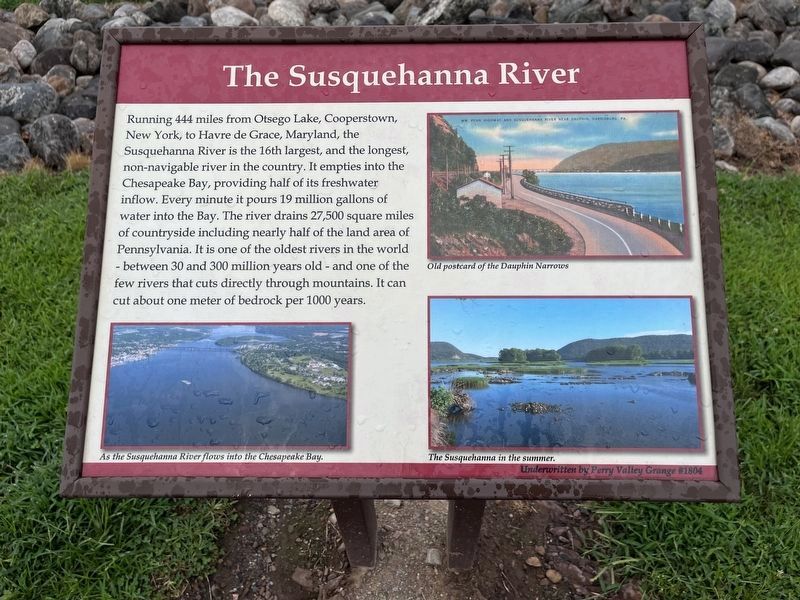
Running 444 miles from Otsego Lake, Cooperstown, New York, to Havre de Grace, Maryland, the Susquehanna River is the 16th largest, and the longest, non-navigable river in the country. It empties into the Chesapeake Bay, providing half of its freshwater inflow. Every minute it pours 19 million gallons of water into the Bay. The river drains 27,500 square miles of countryside including nearly half of the land area of Pennsylvania. It is one of the oldest rivers in the world - between 30 and 300 million years old - and one of the few rivers that cuts directly through the mountains. It can cut about one meter of bedrock per 1000 years.
Credits. This page was last revised on August 4, 2024. It was originally submitted on August 4, 2024, by Devry Becker Jones of Washington, District of Columbia. This page has been viewed 144 times since then and 15 times this year. Photos: 1, 2, 3, 4. submitted on August 4, 2024, by Devry Becker Jones of Washington, District of Columbia.
