Memphis in Shelby County, Tennessee — The American South (East South Central)
Mississippian Mounds
Photographed by Jason Voigt, August 1, 2024
1. Mississippian Mounds Marker
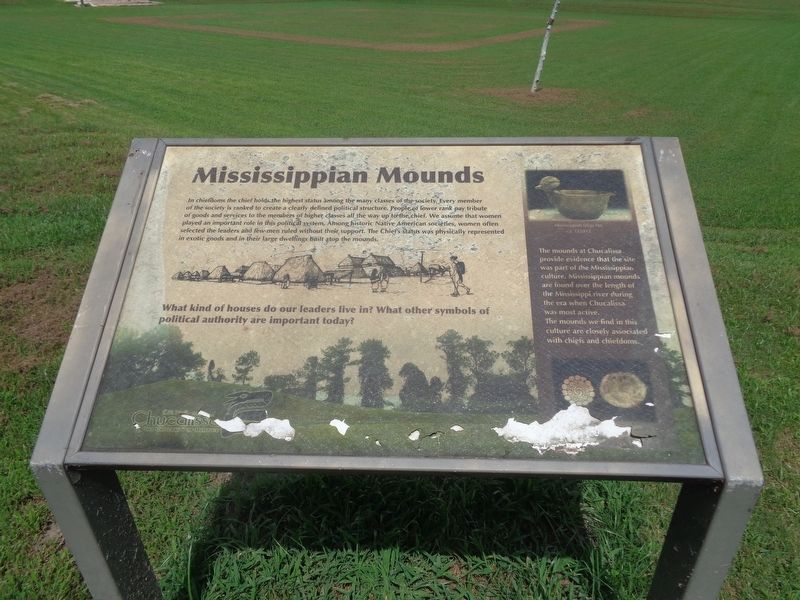
In chiefdoms the chief holds the highest status among the many classes of the society. Every member of the society is ranked to create a clearly defined political structure. People of lower rank pay tribute of goods and services to the members of higher classes all the way up to the chief. We assume that women played an important role in this political system. Among historic Native American societies, women often selected the leaders and few men ruled without their support. The Chief's status was physically represented in exotic goods and in their large dwellings built atop the mounds.
Sidebar
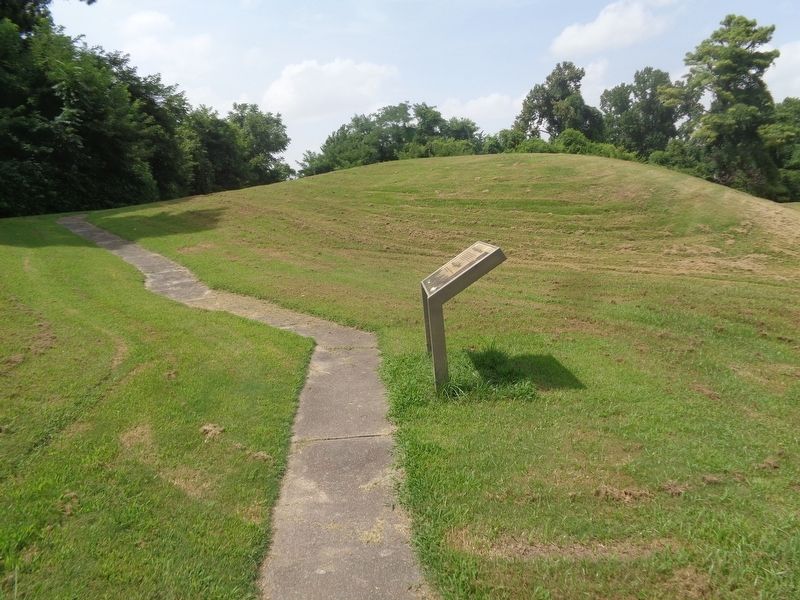
The mounds at Chucalissa provide evidence that the site was part of the Mississippian culture. Mississippian mounds are found over the length of the Mississippi river during the era when Chucalissa was most active. The mounds we find in this culture are closely associated with chiefs and chiefdoms.
Erected by C.H. Nash Museum, Chucalissa, the University of Memphis.
Topics. This historical marker is listed in these topic lists: Anthropology & Archaeology • Indigenous Peoples and Communities • Women.
Location. 35° 3.769′ N,
this page online

Regionally, this marker is in West Tennessee. It is also in the American South, specifically in the Deep South, in the Upper South, in the Mississippi Delta, and in the Great River Road Region. Globally, it is in North America, the Western Hemisphere, the Western World, and the Anglosphere. Historically, it finds itself in what was once the territory of the Mississippian Culture, one of the Confederate States of America, and the Antebellum South.
Other nearby markers. At least 8 other markers are within walking distance of this marker: The Central Plaza (within shouting distance of this marker); Chucalissa in Historic Times (within shouting distance of this marker); Platform Mound (within shouting distance of this marker); Plant Use in the Southeast (within
Photographed by Jason Voigt, August 1, 2024
2. Mississippian Mounds Marker
Also see . . . C.H. Nash Museum Chucalissa (University of Memphis). (Submitted on August 14, 2024, by Jason Voigt of Glen Carbon, Illinois.)
Additional commentary.
1. The true reasons for the Mississippi River Mounds
I was born and raised in the Mississippi River valley. For years people have been taught about the mounds. My grandmother taught me why the mounds were created. Clear and simple, they were not a religious building.
The mounds were built as a temporary refuge and escape—they were islands to escape the annual floods of the Mississippi River. The religious use theory was generated later by white people when they discovered them. The mounds were totally for practical and not religious reasons. Instead of running and finding higher ground they created the mounds as islands. Note To Editor only visible by Contributor and editor
— Submitted July 16, 2025, by William Powell of Dyersburg, Tennessee.
Credits. This page was last revised on July 23, 2025. It was originally submitted on August 14, 2024, by Jason Voigt of Glen Carbon, Illinois. This page has been viewed 286 times since then and 51 times this year. Photos: 1, 2. submitted on August 14, 2024, by Jason Voigt of Glen Carbon, Illinois.
