
North Chattanooga in Hamilton County, Tennessee — The American South (East South Central)
Chattanooga's Changing Riverfront
Photographed by Joel Seewald, April 29, 2024
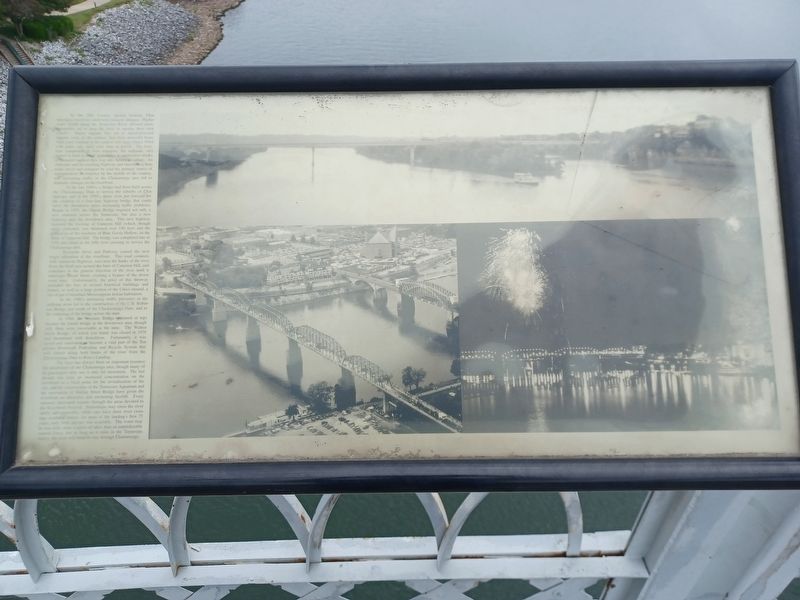
1. Chattanooga's Changing Riverfront Marker
As the 20th Century moved forward, Chattanooga's riverfront underwent massive changes. Higher water levels along the Tennessee River allowed many companies on or near the river to operate their own wharfs. Steam engines lost out to diesel-powered engines early in the century, and these powerful boats were (and continue to be) used to tow large barges filled with grain, salt, sand, coal, lime or gravel. The long-time competitor of river transport, the railroads, also ceased to hold as much importance as automotive modes of transport worked their way into American culture. An elaborate and far-reaching highway and interstate system made travel and transport by road the primary source of transportation in America by the middle of the century, and increasing traffic in the Chattanooga area led to dramatic changes on the riverfront.
In the late 1940's, a bridge had been built across the Chickamauga Dam to service the suburbs of Chattanooga, and in the 1950's, plans were put forward for the creation of a four-lane highway bridge that could serve the downtown area's increasing traffic problems. Begun in 1955, the Olgiati
this page online
Riverside Drive and Parkway caused the next major alteration of the riverfront. This road connects with Amnicola Highway, runs near the banks of the river from the bluff area around the base of Cameron Hill, and continues in the general direction of the river until it intercepts Broad Street, creating a bypass of the downtown area. Unfortunately, the price of this thruway included the loss of several historical buildings and homes, as well as a large portion of the Citico mound, a site of pre-Columbian Mississippian Indian habitation.
In the 1980's increasing traffic pressures in the outlying areas led to the construction of the C.B. Robinson Bridge just south of the Chickamauga Dam, and to the widening of the bridge
Photographed by Joel Seewald, April 29, 2024
2. Chattanooga's Changing Riverfront Marker
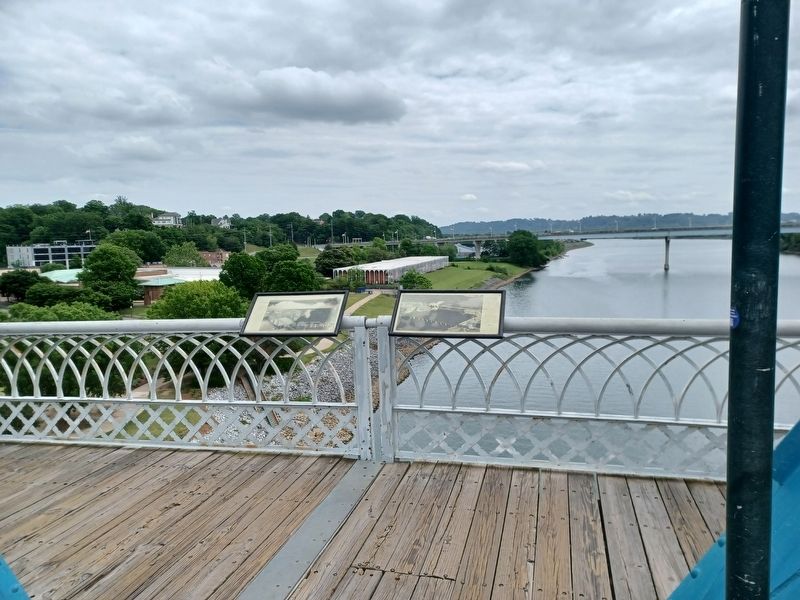
View of the marker (on the left).
In 1984, the Veterans Bridge (pictured at top) became the fourth bridge in the downtown area, though only three were traversable at the time. The Walnut Street Bridge, on which you stand, was closed in 1978 and threatened with demolition. Fortunately, it was saved and renovated to become a vital part of the Tennessee Riverwalk Pedestrian and Bicycle System that will stretch along both banks of the river from the Chickamauga Dam to Ross's Landing.
The river has always been an important resource for inhabitants of the Chattanooga area, though many of its passengers now use it only for recreation. The last decade has seen an increased concentration on the riverfront as a focal point for the revitalization of the city, and the construction of the Tennessee Aquarium and the renovation of Walnut Street Bridge have given the riverfront an attractive and interesting facelift. Every summer, thousands wander through the areas devoted to the Riverbend Festival. Pedestrians may cross the river safely and enjoyably, while cars have three river crossing available where, for most of the landing's first 75 years, only ferry service was available. The water may be less wild, more a series of lakes than an unpredictable natural force, but as long as it rains in the Tennessee Valley, the river will bend its way through Chattanooga.
Topics. This historical marker is listed in these topic lists: Bridges & Viaducts • Roads & Vehicles • Waterways & Vessels. A significant historical year for this entry is 1955.
Location. 35° 3.577′ N, 85° 18.425′ W. Marker is in Chattanooga, Tennessee, in Hamilton County. It is in North Chattanooga. It can be reached from River Street. Marker can be reached from Walnut Street at the south and Forest Street at the north. Marker is on the east side of the Walnut Street Bridge, between the fifth and sixth truss spans from the south. Touch for map. Marker is in this post office area: Chattanooga TN 37405, United States of America. Touch for directions.

Regionally, this marker is in the American South, specifically in the Upper South, in Appalachia, and specifically in Southern Appalachia. Globally, it is in North America, the Western Hemisphere, the Western World, and the Anglosphere. Historically, it finds itself in what was once the original Cherokee Nation, the territory of the Mississippian Culture, one of the Confederate States of America, and the Antebellum South.
Other nearby markers. At least 8 other markers are within walking distance of this marker: Electrical Power and the TVA (here, next to this marker); Late 1800s and Early 1900s Industry in Chattanooga (about 300 feet away, measured in a direct line); Market Street Bridge (about 300 feet away); Early Improvements to Tennessee River Navigation (about 300 feet away); 1838 Cherokee Removal & Trail of Tears (about 600 feet away); Tennesee River Flooding and the First Chattanooga Bridges (about 600 feet away); Occupied Chattanooga (about 700 feet away); Coolidge Riverside Park / Charles H. Coolidge Medal of Honor Citation (about 700 feet away). Touch for a list and map of all markers in Chattanooga.
Credits. This page was last revised on August 26, 2024. It was originally submitted on August 17, 2024, by Joel Seewald of Madison Heights, Michigan. This page has been viewed 355 times since then and 40 times this year. Photos: 1, 2. submitted on August 17, 2024, by Joel Seewald of Madison Heights, Michigan.
