Rockville in Montgomery County, Maryland — The American Northeast (Mid-Atlantic)
The Human Sundial
Discover Rockville in Your Own Backyard
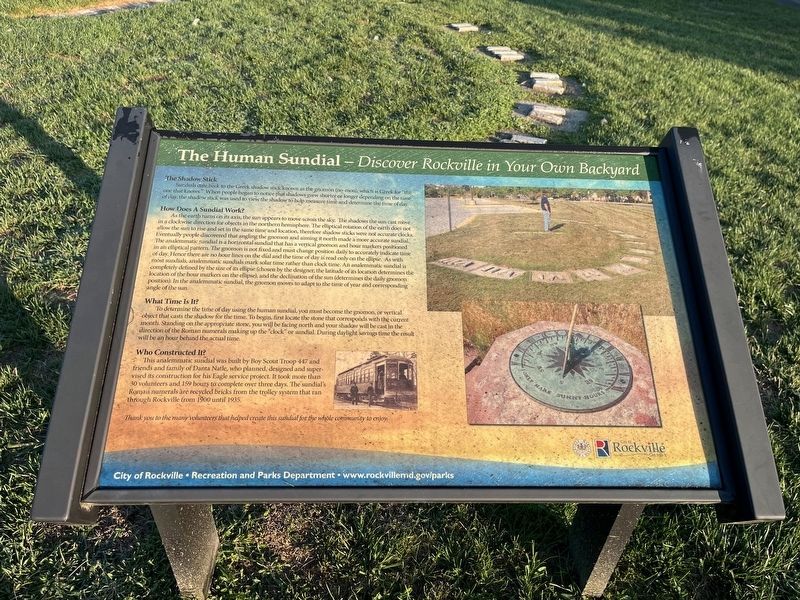
The Shadow Stick
Sundials date back to the Greek shadow stick known as the gnomon (no-mon), which is Greek for "the one that knows." When people began to notice that shadows grew shorter or longer depending on the time of day, the shadow was used to view the shadow to help measure time and determine the time of day.
How Does A Sundial Work
As the earth turns on its axis, the sun appears to move across the sky. The shadows the sun cast move in a clockwise direction for objects in the northern hemisphere. The elliptical rotation of the early does not allow the sun to rise and set in the same time and location, therefore shadow sticks were not accurate clocks. Eventually people discovered that angling the gnomon and aiming it north made a more accurate sundial. The analemmatic sundial is a horizontal sundial that has a vertical gnomon and hour markers positioned in an elliptical pattern. The gnomon is not fixed and must change position daily to accurately indicate time of day. Hence there are no hour lines on the dial and the time of day is read only on the ellipse. As with most sundials, analemmatic sundials marker
this page online
What Time Is It?
To determine the time of day using the human sundial, you must become the gnomon, or vertical object that casts the shadow for the time. To begin, first locate the stone that corresponds with the current month. Standing on the appropriate stone, you will be facing north and your shadow will be cast in the direction of the Roman numerals making up the "clock" or sundial. During daylight savings time the result will be an hour behind the actual time.
Who Constructed It?
This analemmatic sundial was built by Boy Scout Troop 447 and friends and family of Danta Natle, who planned, designed and supervised its construction for his Eagle service project. It took more than 30 volunteers and 159 hours to complete over three
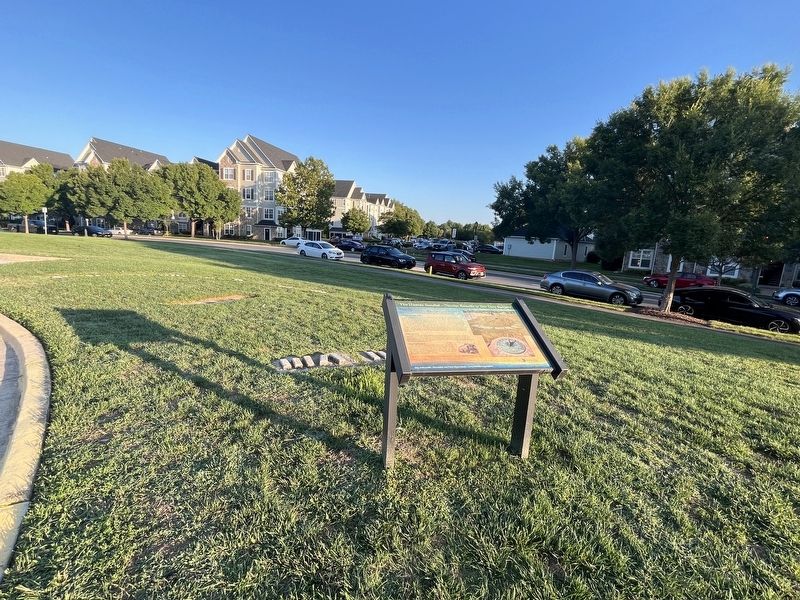
Photographed by Devry Becker Jones (CC0), August 23, 2024
2. The Human Sundial Marker
The sundial lies directly behind the marker.
Thank you to the many volunteers that helped create this sundial for the whole community to enjoy.
Erected by Recreation and Parks Department, City of Rockville, Maryland.
Topics. This historical marker is listed in these topic lists: Anthropology & Archaeology • Communications • Parks & Recreational Areas • Railroads & Streetcars. A significant historical year for this entry is 1900.
Location. 39° 5.982′ N, 77° 11.195′ W. Marker is in Rockville, Maryland, in Montgomery County. It is on Fallsgrove Drive 0.2 miles west of West Montgomery Avenue (Maryland Route 28), on the left when traveling west. The marker stands on the grounds of Fallsgrove Stream Valley Park. Touch for map. Marker is at or near this postal address: 735 Fallsgrove Dr, Rockville MD 20850, United States of America. Touch for directions.

Regionally, this marker is in the Washington Metropolitan Area. It is also in the American Mid-Atlantic. Globally, it is in North America, the Western Hemisphere, the Western World, and the Anglosphere. Historically, it finds itself in what was once one of the original Thirteen Colonies and also the Antebellum South.
Other nearby markers. At least 8 other markers are within 2 miles of this marker, measured as the crow flies: Sister City Friendship Bridge (approx. 0.9 miles away); Bechtel (approx. 1.2 miles away); Mattie J.T. Stepanek Peace Garden (approx. 1.3 miles away); Wootton's Mill (approx. 1.3 miles away); Rockville - Pinneberg (approx. 1.4 miles away); The Hay Drying Shed (approx. 1.4 miles away); Jeremiah Crabbe (approx. 1.6 miles away); George Washington Carver Junior College (approx. 1.6 miles away). Touch for a list and map of all markers in Rockville.
Credits. This page was last revised on July 8, 2025. It was originally submitted on August 23, 2024, by Devry Becker Jones of Washington, District of Columbia. This page has been viewed 442 times since then and 93 times this year. Photos: 1, 2. submitted on August 23, 2024, by Devry Becker Jones of Washington, District of Columbia.
