Nipigon in Thunder Bay District, Ontario — Central Canada (North America)
Nipigon Canoe Route
⎯⎯⎯
La route de canoë Népigon
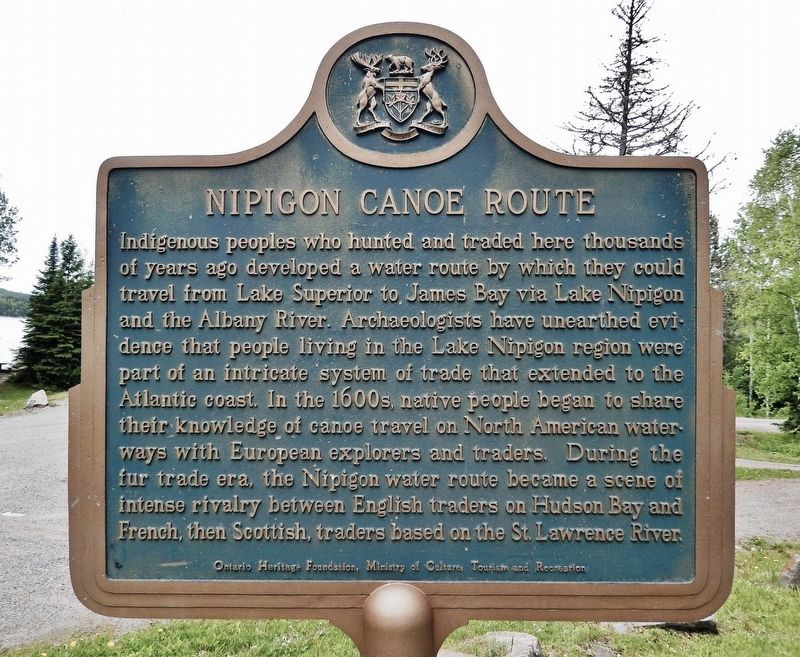
Photographed by Cosmos Mariner, June 14, 2024
1. Nipigon Canoe Route (marker south side)

this page online
Erected by Ontario Heritage Foundation, Ministry of Culture, Tourism and Recreation/Fondation du patrimoine ontarien, Ministère de la Culture, du Tourisme et des Loisirs.
Topics and series. This historical marker is listed in these topic lists: Anthropology & Archaeology • Indigenous Peoples and Communities • Industry & Commerce • Waterways & Vessels. In addition, it is included in the Canada, Ontario Heritage Trust series list.
Location. 49° 4.879′ N, 88° 16.389′ W. Marker is in Nipigon, Ontario, in Thunder Bay District. It can be reached from Trans-Canada Highway (Provincial Highway 11) 7.7 kilometers north of Trans-Canada Highway (Provincial Highway 17), on the left when traveling north. The marker is located in the Lake Helen wayside
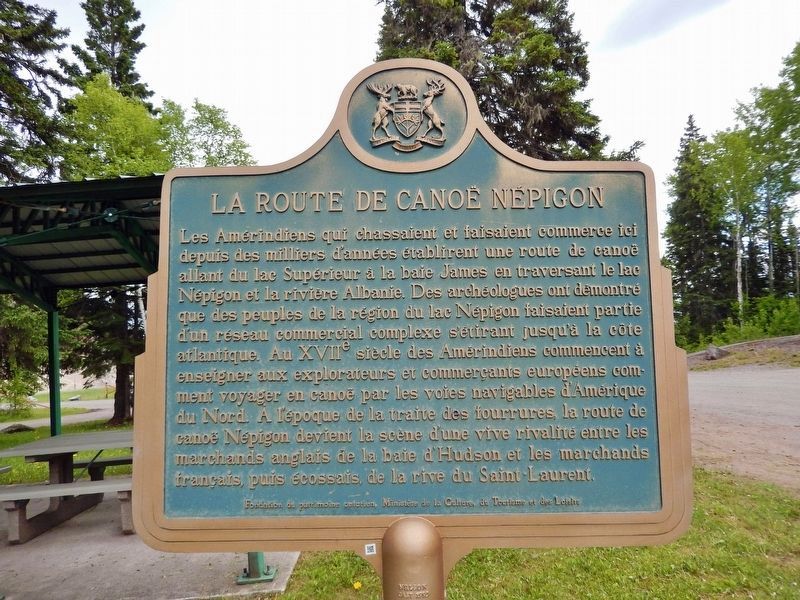
Photographed by Cosmos Mariner, June 14, 2024
2. La route de canoë Népigon (marker north side)

Regionally, this marker is in Northern Ontario and specifically in Northwest Ontario. It is also in Central Canada. Globally, it is in North America, in the Great North Woods, on the Great Lakes, on Lake Superior’s North Shore, in the Western Hemisphere, in the Western World, and in the Anglosphere. Historically, it finds itself in what was once a British colony, the Viceroyalty of New France, the Haudenosaunee (Iroquois) Confederacy, and Rupert’s Land.
Other nearby markers. At least 8 other markers are within 8 kilometers of this marker, measured as the crow flies: St. Sylvester's Mission Church (approx. 5.2 kilometers away); A solitary path / Un chemin solitaire (approx. 7.3 kilometers away); Consolidated School (approx. 7.3 kilometers away); The Old Nipigon CP Railway Station (approx. 7.4 kilometers away); In Tribute to John Salo (approx. 7.4 kilometers away); Nipigon Service Garage / Palace Theatre (approx. 7.4 kilometers away); Lest We Forget
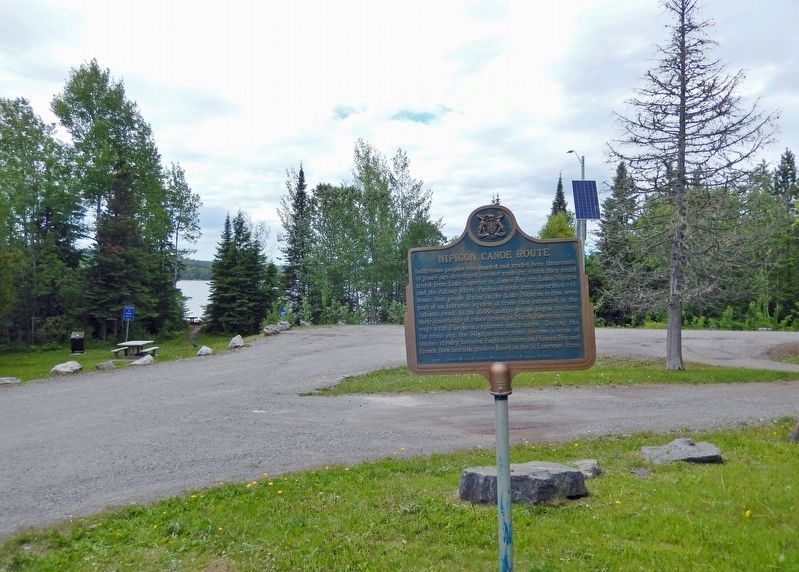
Photographed by Cosmos Mariner, June 14, 2024
3. Nipigon Canoe Route (marker south side)
Lake Helen wayside in background.
Also see . . .
1. Canadian Canoe Routes (Wikipedia).
Excerpt: European exploration of the Canadian interior was principally by river. The land has many navigable rivers with short portages between them. There are no serious barriers to water-borne travel east of the Rockies. The fur trade, principally in beaver, drove and financed exploration and initial settlement. Traders obtained furs from the natives and exported them to Europe.(Submitted on August 27, 2024, by Cosmos Mariner of Cape Canaveral, Florida.)
2. Fur Trade Route Networks. The Canadian Encyclopedia website entry:
Excerpt: Throughout the period of the historical fur trade (early 17th to the mid-19th century), water routes were the natural “highways” of First Nations trappers and European fur traders. Water trading networks connected Indigenous societies from the Atlantic Ocean, along the St. Lawrence River to the Great Lakes, and then on towards the Hudson Bay watershed. North America’s waterborne geography(Submitted on August 27, 2024, by Cosmos Mariner of Cape Canaveral, Florida.)facilitated intracontinental travel, enabled European expansion and settlement into Indigenous North America, and shaped the contours of Euro-Indigenous relations in the context of the fur trade. These extensive and interconnected systems of rivers, lakes and overland trails criss-crossed Indigenous territories and had been used for generations.Photographed by Cosmos Mariner, June 14, 20244. La route de canoë Népigon (marker north side)Lake Helen picnic area shelter in background.
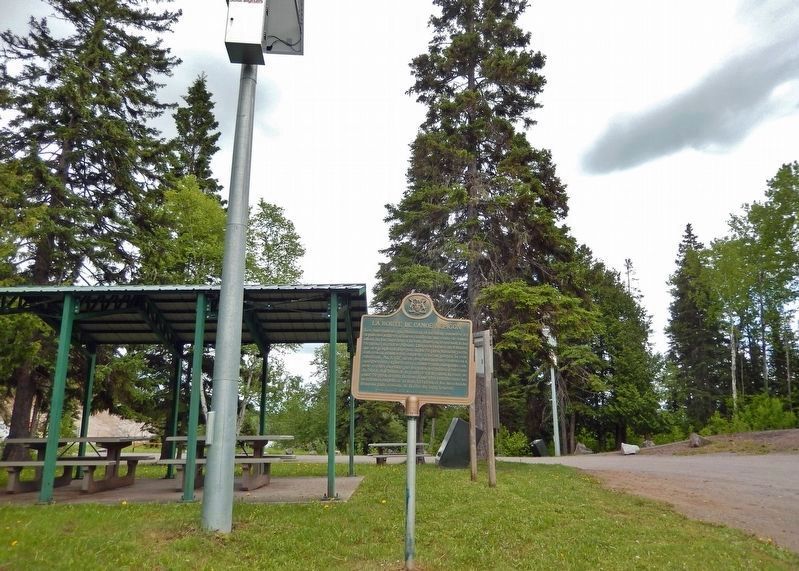
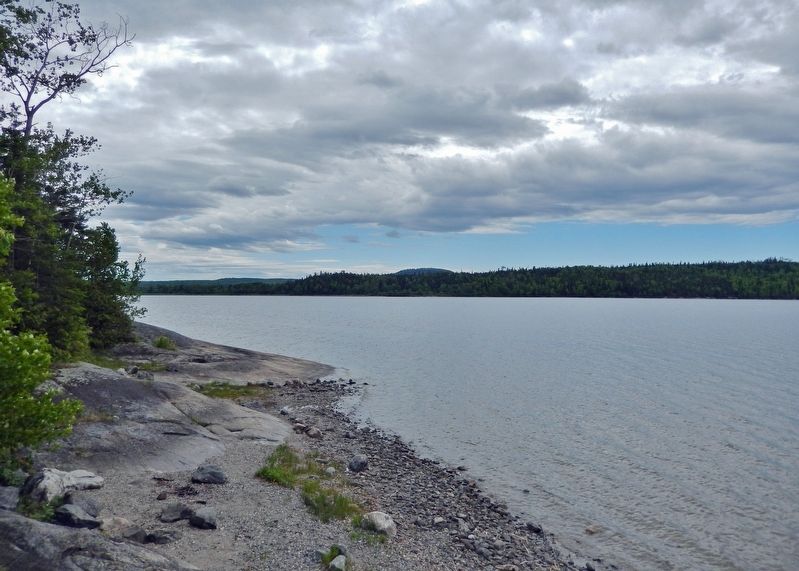
Photographed by Cosmos Mariner, June 14, 2024
5. Lake Helen (looking south from wayside)
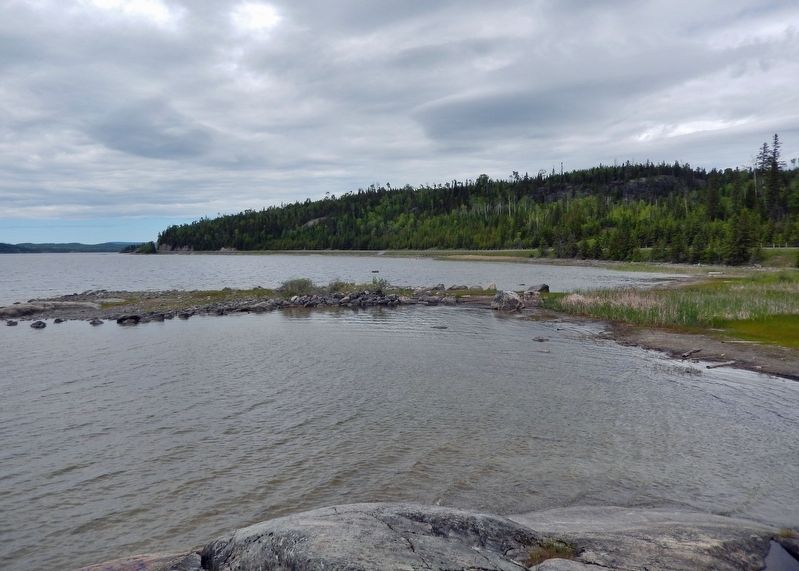
Photographed by Cosmos Mariner, June 14, 2024
6. Lake Helen (looking north from wayside)
Credits. This page was last revised on August 7, 2026. It was originally submitted on August 25, 2024, by Cosmos Mariner of Cape Canaveral, Florida. This page has been viewed 327 times since then and 97 times this year. Photos: 1, 2, 3, 4, 5, 6. submitted on August 27, 2024, by Cosmos Mariner of Cape Canaveral, Florida.
