Ballantyne in Charlotte in Mecklenburg County, North Carolina — The American South (South Atlantic)
Human Spirit
Photographed by Mark Parker, September 3, 2024
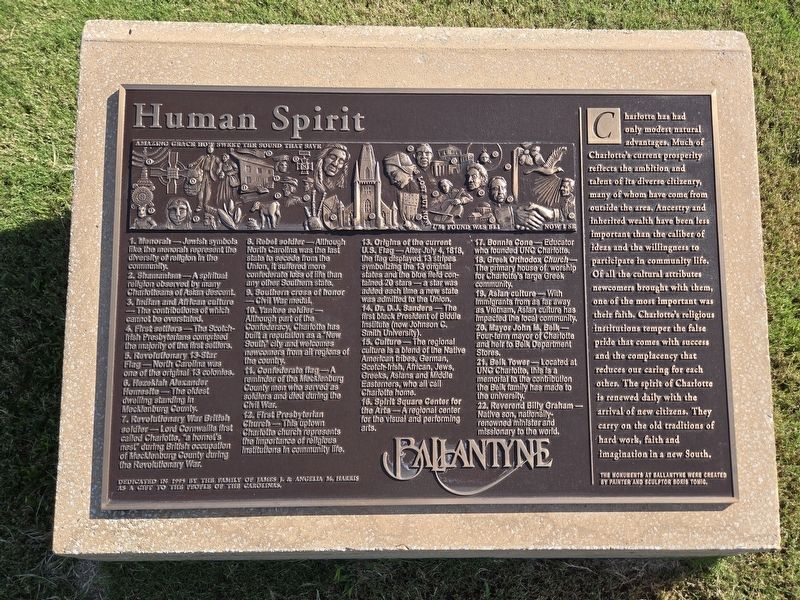
1. Human Spirit Marker
(Main panel with the key to the mural on the plaque and accompanying sculpture)
1. Menorah - Jewish symbols like the the menorah represent the diversity of religion in the community.
2. Shamanism - A spiritual religion observed by many Charlotteans of Asian descent.
3. Indian and African culture - The contributions of which cannot be overstated.
4. First settlers - The Scotch-Irish Presbyterians comprised the majority of the first settlers.
5. Revolutionary 13-Star Flag - North Carolina was one of the original 13 colonies.
6. Hezekiah Alexander Homesite - The oldest dwelling standing in Mecklenburg County.
7. Revolutionary War British soldier - Lord Cornwallis first called Charlotte, "a hornet's nest during British occupation of Mecklenburg County during the Revolutionary War.
8. Rebel soldier - Although North Carolina was the last state to secede from the Union, it suffered more confederate loss of life than any other Southern state.
9 Southern cross of honor - Civil War medal.
10. Yankee soldier - Although part of the Confederacy, Charlotte has built a reputation as a "New South" city
this page online
11. Confederate flag - A reminder of the Mecklenburg County men who served as soldiers and died during the Civil War.
12. First Presbyterian Church - This uptown Charlotte church represents the importance of religious institutions in community life.
13. Origins of the current U.S. Flag - After July 4, 1818, the flag displayed 13 stripes symbolizing the 13 original states and the blue field contained 20 stars - a star was added each time a new state was admitted to the Union.
14. Dr. D.J. Sanders - The first black President of Biddle Institute (now Johnson C. Smith University).
15. Culture - The regional culture is a blend of the Native American tribes, German, Scotch-Irish, African, Jews, Greeks, Asians and Middle Easterners, who all call Charlotte home.
16. Spirit Square Center for the Arts - A regional center for the visual and performing arts.
17. Bonnie Cone - Educator who founded UNC Charlotte.
18. Greek Orthodox Church - The primary house of worship for Charlotte's large Greek community.
19, Asian culture - With immigrants from as far away as
Photographed by Mark Parker, September 3, 2024
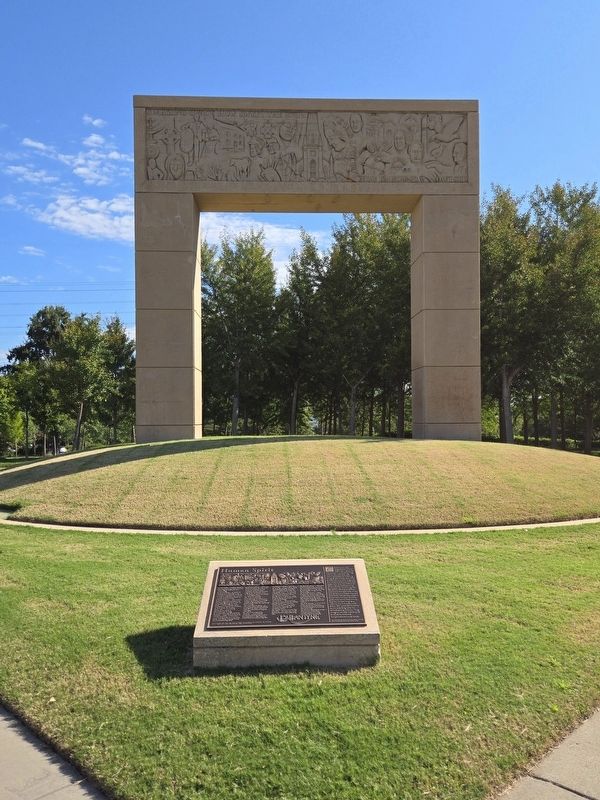
2. Human Spirit Marker and archway.
Closest available parking is at The Ballantyne Hotel, located beyond the trees in the background.
20. Mayor John M. Belk - Four-term mayor of Charlotte and heir to Belk Department Stores.
21. Belk Tower - Located at UNC Charlotte, this is a memorial to the contribution the Belk family has made to the university.
22. Reverend Billy Graham - Native son, nationally renowned minister and missionary to the world.
(right panel)
Charlotte has had only modest natural advantages. Much of Charlotte's current prosperity reflects the ambition and talent of its diverse citizenry, many of whom have come from outside the area. Ancestry and inherited wealth have been less important than the caliber of ideas and the willingness to participate in community life. Of all the cultural attributes newcomers brought with them, one of the most important was their faith. Charlotte's religious institutions temper the false pride that comes with success and the complacency that reduces our caring for each other. The spirit of Charlotte is renewed daily with the arrival of new citizens. They carry on the old traditions of hard work, faith and imagination in a new South.
The monuments at
Photographed by Mark Parker, September 3, 2024
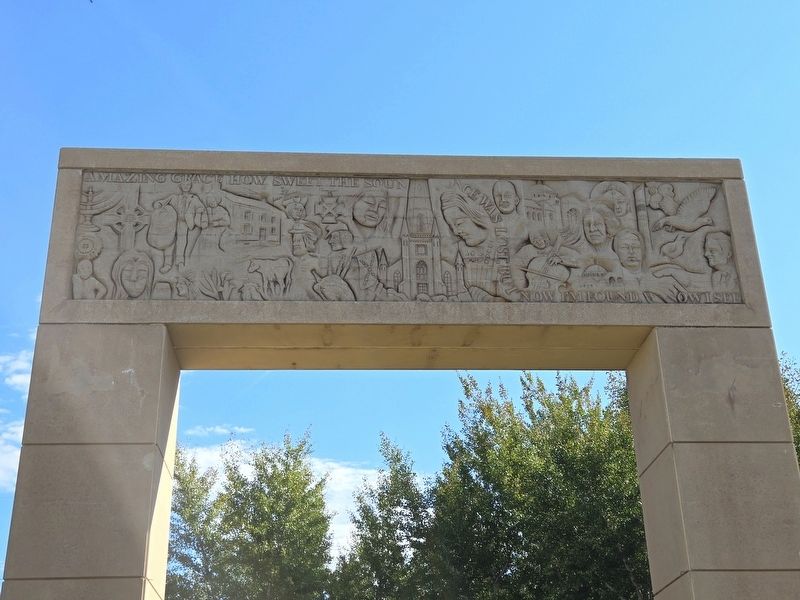
3. Human Spirit sculpture
Erected 1995 by The family of James J. & Angela M. Harris.
Topics. This historical marker is listed in these topic lists: African Americans • Arts, Letters, Music • Asian Americans • Immigration • Indigenous Peoples and Communities • Religion & Religious Structures • Settlements & Settlers • War, US Civil • War, US Revolutionary. A significant historical date for this entry is July 4, 1818.
Location. 35° 3.298′ N, 80° 50.993′ W. Marker is in Charlotte, North Carolina, in Mecklenburg County. It is in Ballantyne. It can be reached from the intersection of Ballantyne Commons Parkway and Johnston Road (U.S. 521), on the right when traveling west. The marker is at ground level in front of the large arch. Closest available parking is at The Ballantyne Hotel. Touch for map. Marker is at or near this postal address: 10250 Ballantyne Commons Pkwy, Charlotte NC 28277, United States of America. Touch for directions.

Regionally, this marker is in North Carolina’s Piedmont. It is also in the American South and specifically in the Upper South. Globally, it is in North America, the Western Hemisphere, the Western World, and the Anglosphere. Historically, it finds itself in what was once the territory of the Mississippian Culture, one of the original Thirteen Colonies, one of the Confederate States of America, and the Antebellum South.
Other nearby markers. At least 8 other markers are within 3 miles of this marker, measured as the crow flies: Technology (within shouting distance of this marker); Finance (within shouting distance of this marker); Transportation (about 300 feet away, measured in a direct line); The Revolution in the Back Country / Sumpter's Camp at Clems Branch (approx. 2 miles away in South Carolina); The Revolution in the Backcountry / Sumter's Camp at Clems Branch (approx. 2.3 miles away in South Carolina); Trading Path (approx. 2.3 miles away); Polk Family Cemetery (approx. 2.4 miles away); President James K. Polk S.H.S. (approx. 2.4 miles away). Touch for a list and map of all markers in Charlotte.
Credits. This page was last revised on September 4, 2024. It was originally submitted on September 4, 2024, by Mark Parker of Hickory, North Carolina. This page has been viewed 263 times since then and 40 times this year. Photos: 1, 2, 3. submitted on September 4, 2024, by Mark Parker of Hickory, North Carolina. • Bernard Fisher was the editor who published this page.
