
Historic District in St. Augustine in St. Johns County, Florida — The American South (South Atlantic)
Fountain of Youth Archaeological Park
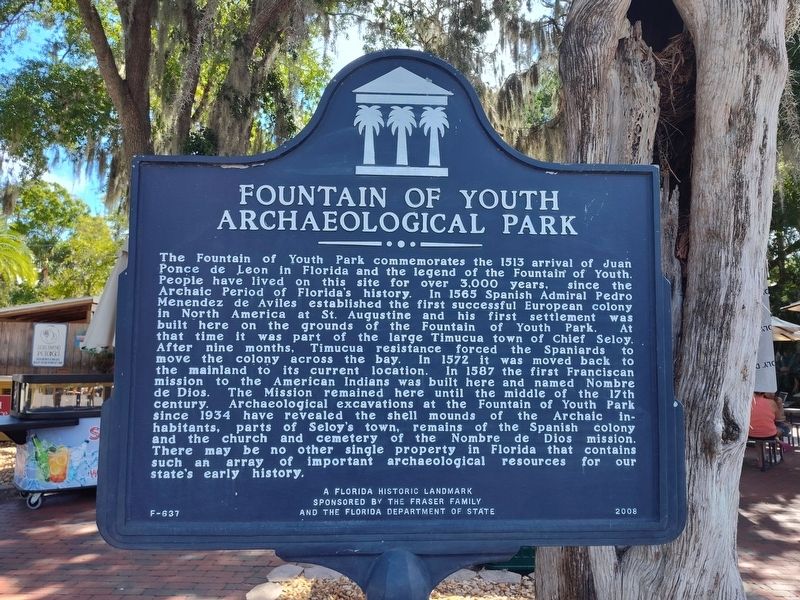
Photographed by Craig Doda, September 1, 2024
1. Fountain of Youth Archaeological Park Marker
this page online
Erected 2008 by The Fraser Family and The Florida Department of State. (Marker Number F-637.)
Topics. This historical marker is listed in these topic lists: Anthropology & Archaeology • Colonial Era • Exploration • Indigenous Peoples and Communities • Religion & Religious Structures. A significant historical year for this entry is 1513.
Location. 29° 54.452′ N, 81° 18.947′ W. Marker is in St. Augustine, Florida, in St. Johns County. It is in the Historic District. It can be reached from the intersection of Magnolia Avenue and Williams Street, on the right when traveling north. Touch for map. Marker is at or near this postal address: 11 Magnolia Ave, Saint Augustine FL 32084, United States of America. Touch for directions.

Regionally, this marker is in First Coast and in Greater Jacksonville. It is also in the American South and on the Eastern Seaboard. Globally, it is in the North Atlantic Region, North America, a Gulf of Mexico state, the Western Hemisphere, the Western World, and the Anglosphere. Historically,
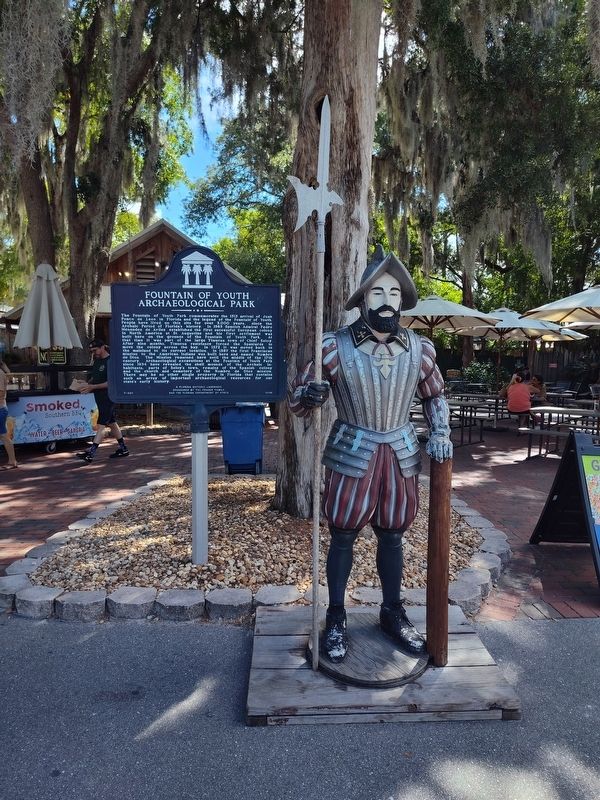
Photographed by Craig Doda, September 1, 2024
2. Fountain of Youth Archaeological Park Marker
Other nearby markers. At least 8 other markers are within walking distance of this marker: Ponce de Leon's Fountain of Youth Archaeological Park (a few steps from this marker); a different marker also named Ponce de Leon's Fountain of Youth Archaeological Park (a few steps from this marker); a different marker also named Ponce de Leon's Fountain of Youth Archaeological Park (within shouting distance of this marker); Pedro Menéndez de Aviles (within shouting distance of this marker); a different marker also named Ponce de Leon's Fountain of Youth Archaeological Park (within shouting distance of this marker); a different marker also named Fountain of Youth Archaeological Park (within shouting distance of this marker); First Spanish Muster Site in Florida (within shouting distance of this marker); Common Anchor (within shouting distance of this marker). Touch for a list and map of all markers in St. Augustine.

Photographed by Craig Doda, September 1, 2024
3. Fountain of Youth Archaeological Park Marker
Credits. This page was last revised on September 9, 2024. It was originally submitted on September 6, 2024, by Craig Doda of Napoleon, Ohio. This page has been viewed 299 times since then and 34 times this year. Photos: 1, 2, 3. submitted on September 6, 2024, by Craig Doda of Napoleon, Ohio. • Bernard Fisher was the editor who published this page.
