Modoc in Randolph County, Illinois — The American Midwest (Great Lakes)
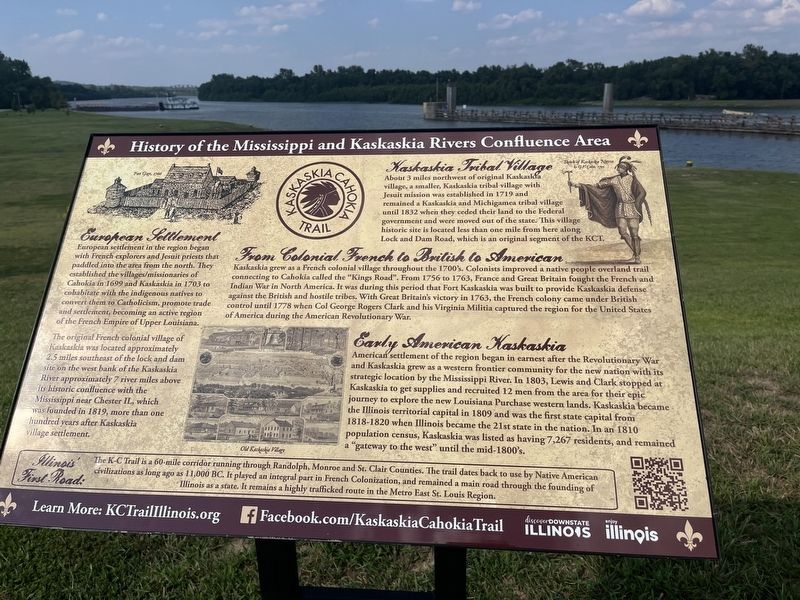
History of the Mississippi and Kaskaskia Rivers Confluence Area
| — | Kaskaskia / Cahokia Trail | — |
Photographed by Thomas Smith, September 6, 2024
1. History of the Mississippi and Kaskaskia Rivers Confluence Area Marker
European Settlement
European settlement in the region began with French explorers and Jesuit priests that paddled into the area from the north. They established the villages/missionaries of Cahokia in 1699 and Kaskaskia in 1703 to cohabitate with the indigenous natives to convert them to Catholicism, promote trade and settlement, becoming an active region of the French Empire of Upper Louisiana.
The original French colonial village of Kaskaskia was located approximately 2.5 miles southeast of the lock and dam site on the west bank of the Kaskaskia River approximately 7 river miles above its historic confluence with the Mississippi near Chester II, which was founded in 1819, more than one hundred years after Kaskaskia village settlement.
Kaskaskia Tribal Village
About 3 miles northwest of original Kaskaskia village, a smaller, Kaskaskia tribal village with Jesuit mission was established in 1719 and remained a Kaskaskia and Michigames tribal village until 1832 when they ceded their land to the Federal government and were moved out of the state. This village historic site is located less than one mile from here
this page online
From Colonial French to British to American
Kaskaskia grew as a French colonial village throughout the 1700's. Colonists improved a native people overland trail connecting to Cahokia called the "Kings Road". From 1756 to 1763, France and Great Britain fought the French and Indian War in North America. It was during this period that Fort Kaskaskia was built to provide Kaskaskia defense against the British and hostile tribes. With Great Britain's victory in 1763, the French colony came under British control until 1778 when Col George Rogers Clark and his Virginia Militia captured the region for the United States of America during the American Revolutionary War.
Early American Kaskaskia
American settlement of the region began in earnest after the Revolutionary War and Kaskaskia grew as a western frontier community for the new nation with its strategic location by the Mississippi River. In 1803, Lewis and Clark stopped at Kaskaskia to get supplies and recruited 12 men from the area for their epic journey to explore the new Louisiana Purchase western lands. Kaskaskia
Photographed by Thomas Smith, September 6, 2024
2. History of the Mississippi and Kaskaskia Rivers Confluence Area Marker
The K-C Trail is a 60-mile corridor running through Randolph, Monroe and St. Clair Counties. The trail dates back to use by Native American civilizations as long ago as 11,000 BC. It played an integral part in French Colonization, and remained a main road through the founding of Illinois as a state. It remains a highly trafficked route in the Metro East St. Louis Region.
Erected by Kaskaskia - Cahokia Trail.
Topics. This historical marker is listed in these topic lists: Colonial Era • Exploration • Indigenous Peoples and Communities • Waterways & Vessels. A significant historical year for this entry is 1699.
Location. 37° 59.055′ N, 89° 56.823′ W. Marker is in Modoc, Illinois, in Randolph County. It is on Lock and Dam Road half a mile south of Levee Road, on the right when traveling north. Touch for map. Marker is at or near this postal address: 4800 Lock and Dam Rd, Modoc IL 62261, United States of America. Touch for directions.

Regionally, this marker is in Southern Illinois — Little Egypt. It is also in the American Midwest, in the Corn Belt, and in the Great River Road Region. Globally, it is in North America, the Western Hemisphere, the Western World, and the Anglosphere. Historically, it finds itself in what was once the Viceroyalty of New France, the territory of the Mississippian Culture, and the Northwest Territory.
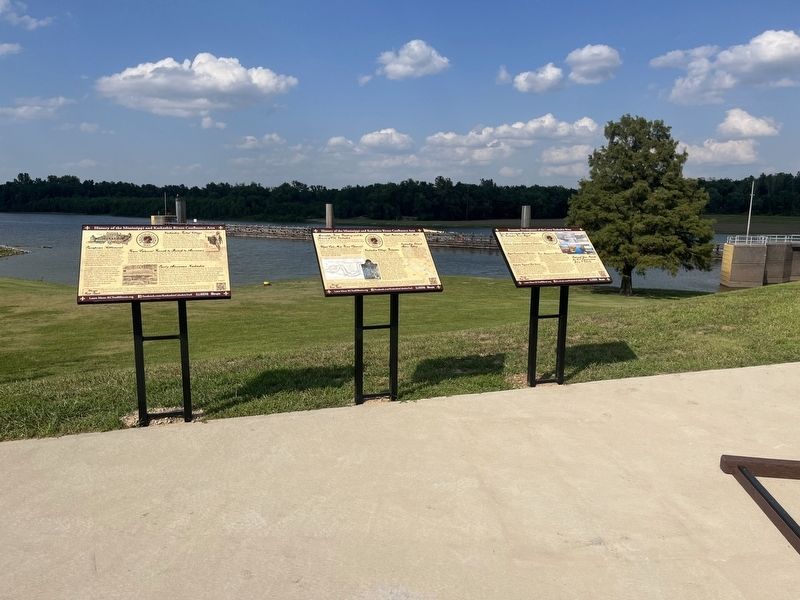
Other nearby markers. At least 8 other markers are within 3 miles of this marker, measured as the crow flies: A different marker also named History of the Mississippi and Kaskaskia Rivers Confluence Area (here, next to this marker); Economic Development of the Lower Kaskaskia River (here, next to this marker); Kaskaskia Confluence Area (approx. ¼ mile away); Reily Lake (approx. 1.8 miles away); Lewis and Clark in Illinois (approx. 2.2 miles away); Kaskaskia Island (approx. 2.3 miles away); Dedicated in Memory of George Rogers Clark (approx. 2.3 miles away); Kaskaskia Village (approx. 2.3 miles away). Touch for a list and map of all markers in Modoc.
Another marker is no longer nearby. Beaver Island (was approx. 2.3 miles away but has been confirmed missing).
Credits. This page was last revised on October 15, 2024. It was originally submitted on September 21, 2024, by Thomas Smith of Waterloo, Ill. This page has been viewed 244 times since then and 29 times this year. Photos: 1, 2. submitted on September 21, 2024, by Thomas Smith of Waterloo, Ill. • J. Makali Bruton was the editor who published this page.
