
Near Henrico in Henrico County, Virginia — The American South (Mid-Atlantic)
Henrico History
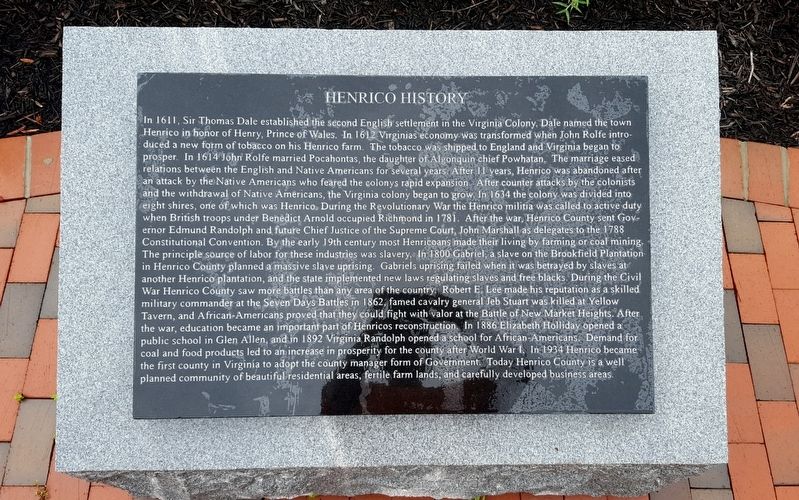
Photographed by Bernard Fisher, July 16, 2016
1. Henrico History Marker
In 1611, Sir Thomas Dale established the second English settlement in the Virginia Colony. Dale named the town Henrico in honor of Henry, Prince of Wales. In 1612, Virginia’s economy was transformed when John Rolfe introduced a new form of tobacco on his Henrico farm. The tobacco was shipped to England and Virginia began to prosper. In 1614 John Rolfe married Pocahontas, the daughter of Algonquin chief Powhatan. The marriage eased relations between the English and Native Americans for several years. After 11 years Henrico was abandoned after an attack by the Native Americans who feared the colony’s rapid expansion. After counter attacks by the colonists and the withdrawal of Native Americans, the Virginia Colony began to to grow. In 1634 the colony was divided into eight shires, one of which was Henrico. During the Revolutionary War the Henrico militia was called to active duty when British troops under Benedict Arnold occupied Richmond in 1781. After the war, Henrico sent Governor Edmund Randolph and future Chief Justice of the Supreme Court, John Marshall to the 1788 Constitutional Convention. By the early 19th century
this page online
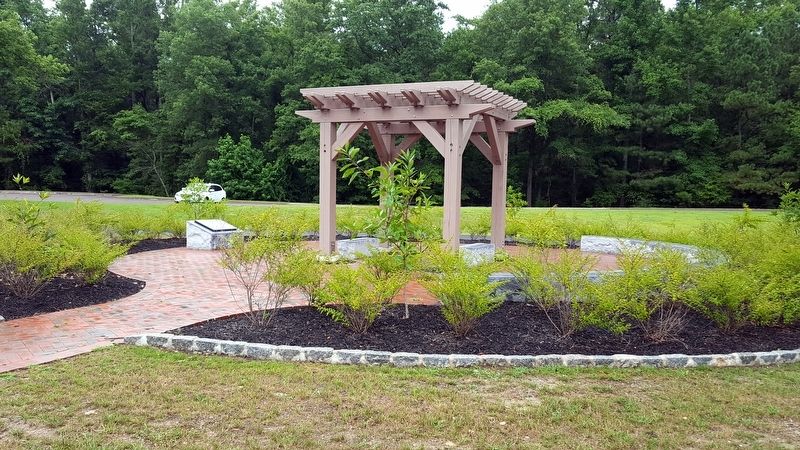
Photographed by Bernard Fisher, July 16, 2016
2. Henrico History Marker
Topics. This historical marker is listed in these topic lists: Colonial Era • Indigenous Peoples and Communities • Settlements & Settlers • War, US Civil. A significant historical year for this entry is 1611.
Location. This marker has been replaced by another marker nearby. It was located near 37° 26.121′ N, 77° 19.744′ W. Marker was near Henrico, Virginia, in Henrico County. It could be reached from the intersection of New Market Road (Virginia Route 5) and Interstate 295, on the left when traveling east. Located in the Four Mile Creek parking lot of the Virginia Capital Trail. Touch for map. Marker was at or near this postal address: 3256 New Market Rd, Henrico VA 23231, United States of America. Touch for directions.

Regionally, this marker was in Virginia’s Piedmont, in Central Virginia, and in the Richmond Metropolitan Area. It was also in the American South, specifically in the Upper South, and on the Eastern Seaboard. Globally, it was in the North Atlantic Region, North America, the Western Hemisphere, the Western World, and the Anglosphere. Historically, it found itself in what was once the territory of the Mississippian Culture, one of the original Thirteen Colonies, one of the Confederate States of America, and the Antebellum South.
Other nearby markers. At least 8 other markers are within walking distance of this location: Historic Route 5 Corridor (here, next to this marker); Pocahontas (here, next to this marker); Henrico Town (here, next to this marker); Action at Osborne's (a few steps from this marker); Varina (a few steps from this marker); Proposed First University in English America (a few steps from this marker); New Market Heights (within shouting distance of this marker); George Thorpe (within shouting distance of this marker). Touch for a list and map of all markers in Henrico.
Another marker is no longer nearby. New Market Heights (was within shouting distance of this marker but has been replaced with another marker now near it).
Additional commentary.
1. Error on the marker's text
This marker has a lexical error (wrong word) in the phrase "principle source of labor." The correct word for this meaning is "principal".
— Submitted September 26, 2024, by Carl Gordon Moore Jr. of North East, Maryland.
Credits. This page was last revised on June 3, 2026. It was originally submitted on July 16, 2016, by Bernard Fisher of Richmond, Virginia. This page has been viewed 1,351 times since then and 71 times this year. Last updated on September 28, 2024, by Carl Gordon Moore Jr. of North East, Maryland. Photos: 1, 2. submitted on July 16, 2016, by Bernard Fisher of Richmond, Virginia. • J. J. Prats was the editor who published this page.
