Bainbridge in Decatur County, Georgia — The American South (South Atlantic)
Historic Fort Hughes

Photographed by Cosmos Mariner, September 21, 2024
1. Historic Fort Hughes Marker
Chason Park sits on the site of historic Fort Hughes, where the Battle of Fowltown was fought in 1817, marking the beginning of the Seminole War. Archaeological and historical research on the fort continues to uncover details about how the site was designed and used during that time.
Location
Fort Hughes once stood where you stand today. The entire southern wall of the fort and the southwestern blockhouse are within the current extent of Chason Park, with the remaining fort features located on adjacent property. The fort comprised of an approximately 90' x 90' stockade wall, and two blockhouses at opposite corners.
Construction
The fort consisted of a stockade fence and two blockhouse buildings The stockade was built by digging a trench about 3 feet deep, placing timber logs in, and then filling in around them. They used small trees for the logs that were just thick enough to stop a metal musket ball, which were the common ammunition for the flintlock muskets being used by both US and Native American forces at the time.
Research Process
Historian Dale Cox and archaeologists Rhonda Kimbrough, Brian Mabelitini, and Tray Earnest conducted extensive research between 2017 and 2023 to confirm the location of Fort Hughes.
1 Metal Detector Survey
Metal detector survey found scattered artifacts around Fort Hughes.
2 Archival Research
Evaluation of historic military reports and surveys provided information on the size, design, and placement of the fort wall and structures.
3 Exploratory Trench Dig
Excavation of a series of short slot trenches revealed intact remains of a stockade footing trench, post molds, and charred post remains from the logs within the original wall of the fort matching descriptions of reports.
4 Excavations
Excavation of the line of the stockade wall determined exact dimensions and footprint of the fortwithin Chason Park.
Click or scan to see
this page online
5 Additional Testing • Excavations
Additional testing and excavations of the blockhouse and stockade sites revealed 200-year-old artifacts, including deer bones from a soldier's meal (with teeth marks included!), lead bullets, and a ramrod used for loading a gun.
Visit the Decatur County Historical and Genealogical Society Museum to see these artifacts and learn more about Bainbridge history!
Topics. This historical marker is listed in these topic lists: Anthropology & Archaeology • Forts and Castles • Indigenous Peoples and Communities • Wars, US Indian. A significant historical year for this entry is 1817.
Location. 30° 54.495′ N, 84° 34.76′ W. Marker is in Bainbridge, Georgia, in Decatur County. It can be reached from the intersection of West Jackson Street and North Florida Street, on the right when traveling west. This marker is located in the overlook at the northwest corner of Chason Park. Touch for map. Marker is at or near this postal address: 233 Donalson Street, Bainbridge GA 39817, United States of America. Touch for directions.

Regionally, this marker is on the Coastal Plain. It is also
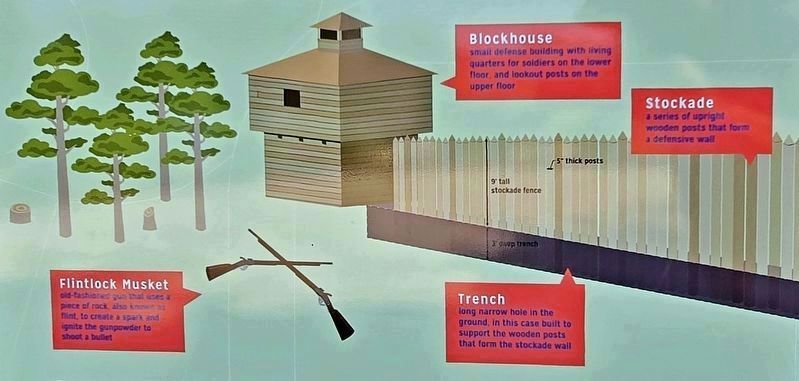
2. Marker detail: Fort Illustration
Blockhouse
Small defense building with living quarters for soldiers on the lower floor, and lookout posts on the upper floor
Small defense building with living quarters for soldiers on the lower floor, and lookout posts on the upper floor
Stockade
A series of upright wooden posts that form a defensive wall
Flintlock Musket
Old-fashioned gun that uses a piece of rock, also known as flint, to create a spark and ignite the gunpowder to shoot a bullet.
Trench
Long narrow hole in the ground, in this case built to support the wooden posts that form the stockade wall.
Other nearby markers. At least 8 other markers are within walking distance of this marker: Stepping Back in Time (here, next to this marker); The First Seminole War in Decatur County (here, next to this marker); Decatur County During the Creek and Seminole Wars Era (here, next to this marker); Bainbridge Beginnings (here, next to this marker); Fort Hughes (here, next to this marker); The Battle of Fowltown (here, next to this marker); The Second Creek War and Removal in the Decatur County Area (here, next to this marker); General Andrew Jackson Trail (a few steps from this marker). Touch for a list and map of all markers in Bainbridge.
Related markers. Click here for a list of markers that are related to this marker.
Also see . . . Fort Hughes — Seminole War Fort in Georgia.

Photographed by Cosmos Mariner, September 21, 2024
3. Historic Fort Hughes Marker
Looking east from the Chason Park overlook through the north side of Chason Park.
Excerpt: Fort Hughes was a small temporary log fort built by U.S. troops during the First Seminole War of 1817-1818. Here they held off a fierce attack by force of Red Stick Creek, Seminole and African American warriors. The military occupation of Fort Hughes came to an end after only three weeks. So far as is known, soldiers never again garrisoned Fort Hughes, but the little log fort was still standing when the first settlers arrived in the area a few years later. The outline of the fort was shown on the original land surveys of the area and the new village founded there was known as Fort Hughes until its name was changed to Bainbridge by the Georgia Legislature in 1824.(Submitted on October 8, 2024, by Cosmos Mariner of Cape Canaveral, Florida.)

Photographed by Cosmos Mariner, September 21, 2024
4. Historic Fort Hughes Marker
This marker is the rightmost of three markers located in the overlook at the northwest corner of Chason Park.
Credits. This page was last revised on October 8, 2024. It was originally submitted on October 7, 2024, by Cosmos Mariner of Cape Canaveral, Florida. This page has been viewed 222 times since then and 44 times this year. Photos: 1. submitted on October 7, 2024, by Cosmos Mariner of Cape Canaveral, Florida. 2. submitted on October 8, 2024, by Cosmos Mariner of Cape Canaveral, Florida. 3, 4. submitted on October 7, 2024, by Cosmos Mariner of Cape Canaveral, Florida.
