McKinley Park in Chicago in Cook County, Illinois — The American Midwest (Great Lakes)
McKinley Park
Photographed by Sean P. Flynn, October 10, 2024
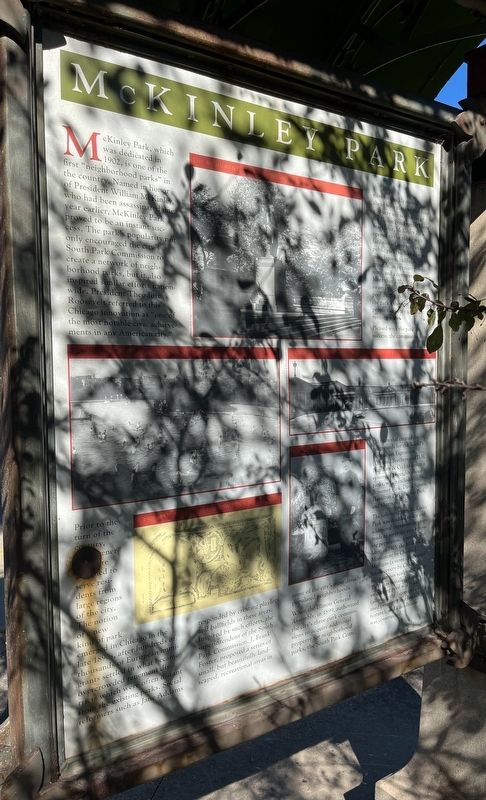
1. McKinley Park Marker
Prior to the turn of the century, [two or three words are unreadable, the last word is possibly "designed"] to serve residents from large regions of the city. The notion of a new kind of park emerged in Chicago in the late 1890s, after hundreds of thousands of European immigrants settled in what became overcrowded tenement districts which were often distant from the existing parks. Social reformers such as Jane Addams responded by creating playlots and ballfields in these areas. Inspired by such efforts, the superintendent of the South Park Commission, J. Frank Foster, proposed a series of small, but beautifully landscaped, recreational areas in some of the city's most densely populated neighborhoods.
When the Illinois General Assembly, in 1899, authorized the city's three park commissions to acquire additional property for neighborhood parks, the South Park Commission quickly moved ahead with plans to purchase a 34-acre site northwest of the Union Stockyards. Three years later, McKinley Park opened to the public with facilities seldom seen in a public park, such as a swimming lagoon, ballfields, playgrounds, an open-air gymnasium, and a community center. More than 100,000 people swam in the park's lagoon pool during its first year, and the park's showers gave many people
this page online
Pleased with the park's success, the commission hired the team that created the fairgrounds for the World's Columbian Exposition (Olmsted Brothers and D.H. Burnham & Co.) to design a system of 14 neighborhood parks, which includes Bessemer Park, Davis Square, Hamilton Park, Palmer Park, and Sherman Park.
The following year, McKinley Park was doubled in size and additional improvements were made to serve the area's growing population. Another year later, the McKinley Monument by Charles J. Mulligan (a stone cutter until his discovery by Chicago's most famous sculptor, Lorado Taft) was installed; a modern swimming pool was built (allowing the lagoon to be used primarily as a landscape feature); and a fieldhouse was constructed.
Erected 1995 by City of Chicago.
Topics and series. This historical marker is listed in these topic lists: Charity & Public Work • Environment • Immigration • Parks & Recreational Areas. In addition, it is included in the Former U.S. Presidents: #25 William McKinley, and the Former U.S. Presidents: #26 Theodore Roosevelt series lists. A significant historical year for this entry is 1899.
Location. 41° 49.555′ N,
Photographed by Sean P. Flynn, October 10, 2024
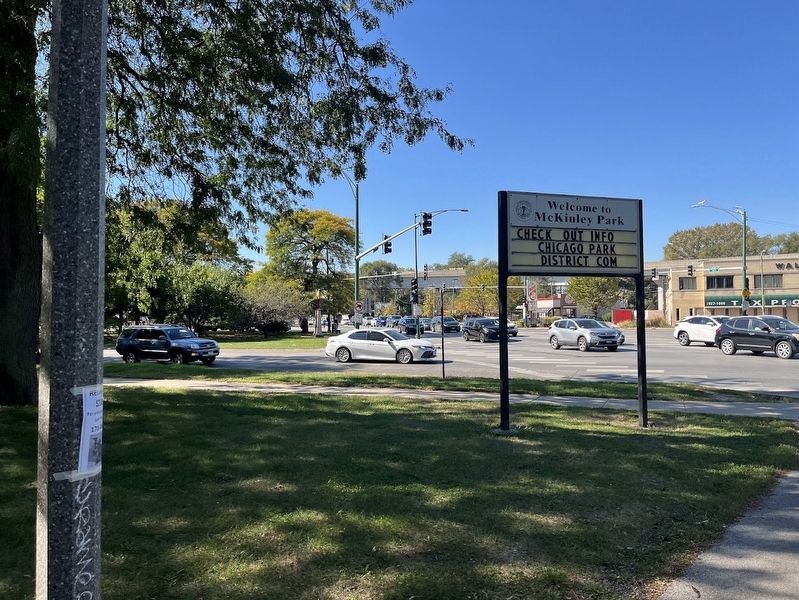
2. McKinley Park
The marker is across Western Avenue in the background of this photo.

Regionally, this marker is on Chicago’s South Side. It is also in the American Midwest. Globally, it is in North America, on the Great Lakes, in the Western Hemisphere, in the Western World, and in the Anglosphere. Historically, it finds itself in what was once the Viceroyalty of New France, the territory of the Mississippian Culture, and the Northwest Territory.
Other nearby markers. At least 8 other markers are within walking distance of this marker: The Boulevard System (here, next to this marker); Marquette and Jolliet Memorial (approx. 0.3 miles away); (Former) Schlitz Brewery-Tied House at 3456 S. Western Ave. (approx. 0.3 miles away); World War II Memorial (approx. 0.3 miles away); a
Photographed by Sean P. Flynn, October 10, 2024
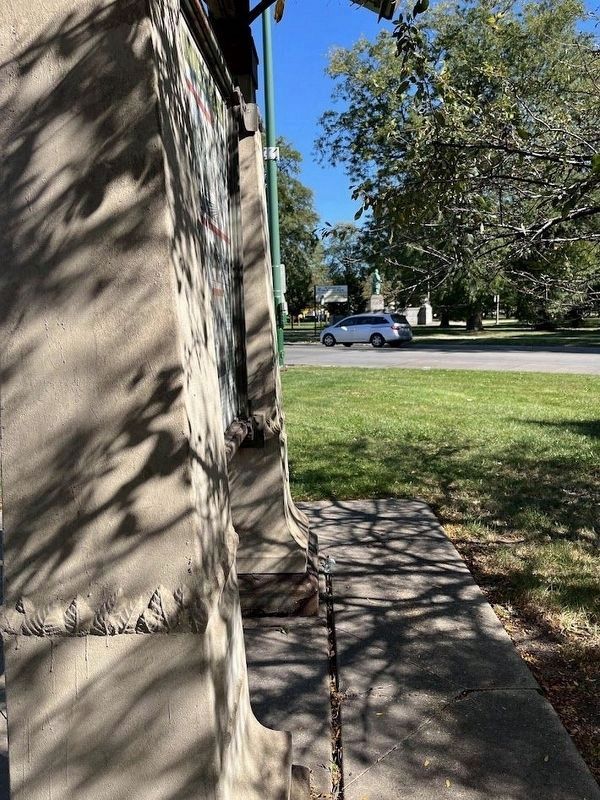
3. The McKinley Park marker and a view of the McKinley statue
More about this marker. The front (Archer Avenue-facing) side of the canopy has a marker about Chicago's Boulevard System. There is erosion and other damage to the sign, which made one portion hard to read. It is also close to a large bush, which makes it hard to read.
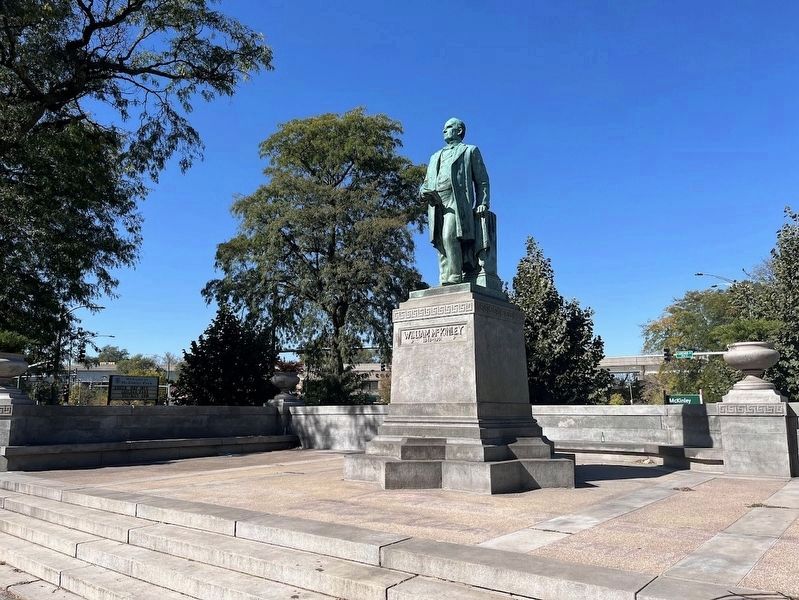
Regarding McKinley Park. The McKinley statue, across the street from here, was erected in 1904 but has faced some increased scrutiny in recent years. In 2021, it was among 41 monuments that faced extra scrutiny by the 2021 Chicago Monuments Project, which sought to reexamine Chicago's historic monuments in the context of historic racism and oppression. The project cited McKinley's support of the annexation of Hawaii and the U.S.'s territorial expansion after the Spanish-American War as reasons to possibly change or remove the statue. Interestingly, the statue's background is linked to that of another
Photographed by Sean P. Flynn, October 10, 2024
4. William McKinley Statue
The statue is across the street from the marker. Erected in 1905, it has faced recent scrutiny about whether it should remain on public display.
Mulligan's other well-known works include Lincoln the Rail Splitter in Chicago's Garfield Park and the Henry Clay monument in Lexington, Kentucky.
Also see . . .
1. McKinley (William) Park. From the Chicago Park District official site (Submitted on October 11, 2024, by Sean P. Flynn of Oak Park, Illinois.)
2. Charles James Mulligan bio. From the This Old Palette blog (Submitted on October 11, 2024, by Sean P. Flynn of Oak Park, Illinois.)
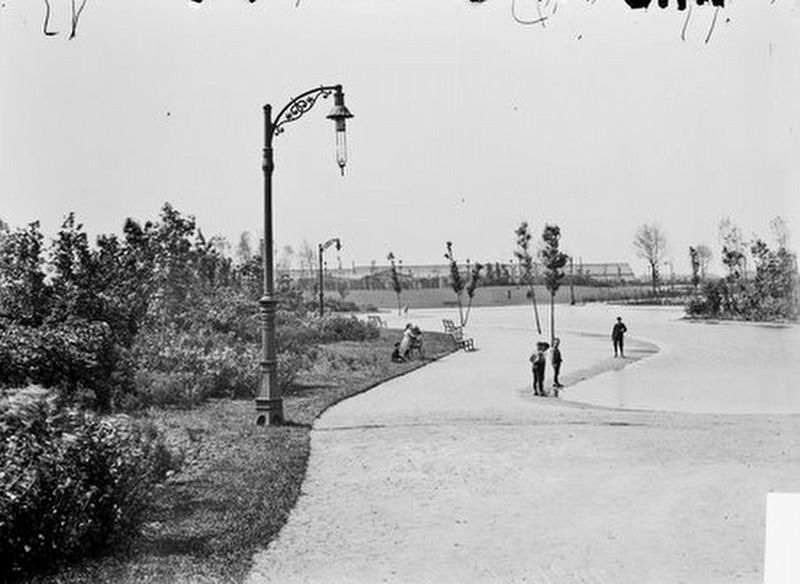
Chicago Daily News Collection, Chicago History Museum, June 13, 1903
5. McKinley Park
This early photo of the park shows the McKinley Park lagoon. The caption from the Chicago History Museum states: "View of children standing on the bank of a lagoon in McKinley Park located in the McKinley Park community area of Chicago, Illinois, June 13, 1903."
Credits. This page was last revised on October 11, 2024. It was originally submitted on October 11, 2024, by Sean P. Flynn of Oak Park, Illinois. This page has been viewed 554 times since then and 81 times this year. Photos: 1, 2, 3, 4, 5. submitted on October 11, 2024, by Sean P. Flynn of Oak Park, Illinois.
