Chicago Lawn in Cook County, Illinois — The American Midwest (Great Lakes)
Marquette and Jolliet Memorial
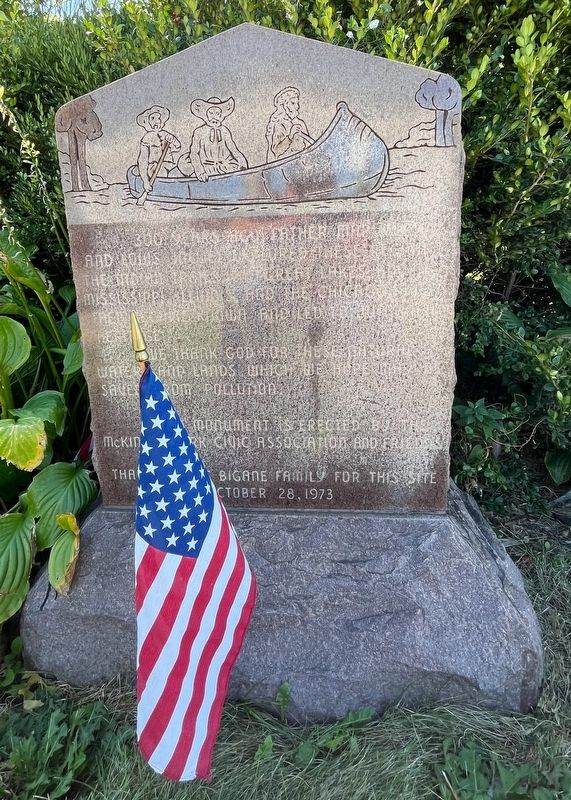
Photographed by Sean P. Flynn, October 10, 2024
1. Marquette and Jolliet Memorial Marker
We thank God for these natural waters and lands which we hope may be saved from pollution.
This monument is erected by the McKinley Park Civic Association and friends.
Thanks to the Bigane family for this site.
Erected 1973 by McKinley Park Civic Association.
Topics. This historical marker and memorial is listed in these topic lists: Environment • Exploration • Indigenous Peoples and Communities • Waterways & Vessels. A significant historical year for this entry is 1673.
Location. 41° 49.717′ N, 87° 40.816′ W. Marker is in Chicago, Illinois, in Cook County. It is in Chicago Lawn. It is at the intersection of Archer Avenue and Leavitt Street, on the right when traveling east on Archer Avenue. The marker is at the southwest corner of the triangular intersection, across the street from the 35th/Archer CTA Orange Line train station. Touch for map. Marker is in this post office area: Chicago
this page online

Regionally, this marker and memorial is on Chicago’s South Side. It is also in the American Midwest. Globally, it is in North America, on the Great Lakes, in the Western Hemisphere, in the Western World, and in the Anglosphere. Historically, it finds itself in what was once the Viceroyalty of New France, the territory of the Mississippian Culture, and the Northwest Territory.
Other nearby markers. At least 8 other markers are within walking distance of this marker: World War II Memorial (approx. ¼ mile away); (Former) Schlitz Brewery-Tied House at 3456 S. Western Ave. (approx. 0.3 miles away); McKinley Park (approx. 0.3 miles away); The Boulevard System (approx. 0.3 miles away); Our Hero War Dead (approx. 0.3 miles away); Veterans Memorial (approx. 0.3 miles away); a different marker also named Veterans Memorial (approx. 0.7 miles away); World War I Memorial (approx. 0.7 miles away). Touch for a list and map of all markers in Chicago.
More about this marker. The Marquette and Jolliet marker was dedicated in 1973, the 300th anniversary of Jolliet and Marquette's
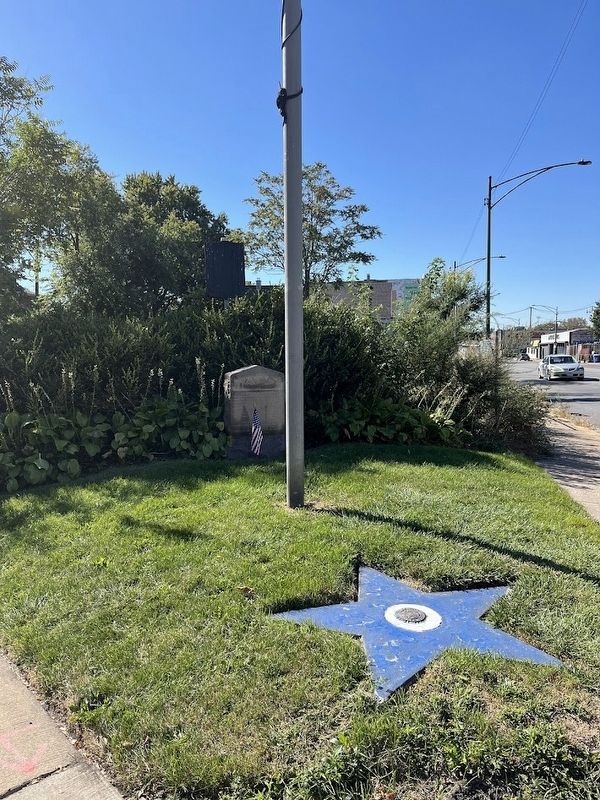
Photographed by Sean P. Flynn, October 10, 2024
2. Marquette and Jolliet Memorial
A concrete star is embedded into the ground in front of the marker with a small medal for the American Legion on it; behind the memorial is a black sign on a post. There is a World War II memorial nearby at American Legion Post 231, about a ¼ mile east on 35th Street, which says "Archer Leavitt Honor Roll" at the bottom. The corner housing this Marquette-Jolliet memorial is at the intersection of Archer and Leavitt, so it's possible that war memorial was originally placed here before being moved east to the post's headquarters.
Regarding Marquette and Jolliet Memorial. Archer Avenue follows the original trail of the Chicago Portage, which connected the Chicago River, which originally emptied into the St. Lawrence River basin, with the Des Plaines River, which empties into the Mississippi. Archer Avenue parallels numerous other transportation routes, including the Illinois and Michigan Canal, which opened in 1848 and connected the two basins for
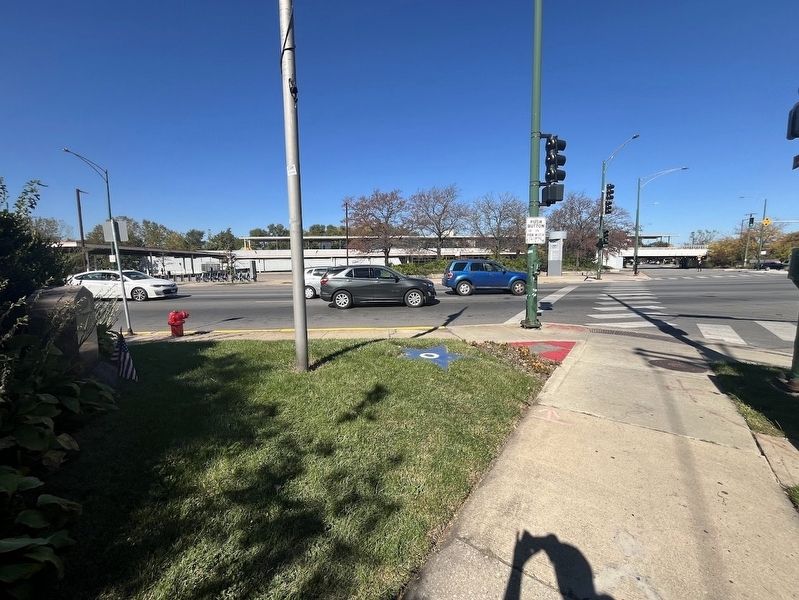
Photographed by Sean P. Flynn, October 10, 2024
3. Marquette and Jolliet Memorial
A rear view with Archer Avenue in the background, and behind it the CTA Orange Line train's 35th/Archer stop.
Jacques Marquette, a Jesuit priest, and Louis Jolliet, a fur trader, trekked along this passage at the completion of their four-month exploration of the Mississippi River basin in 1673—the first by white settlers. Starting in the upper reaches of Wisconsin in May 1673, the duo traveled through that state to the Wisconsin River, eventually reaching with the Mississippi River and following that to the Arkansas River, meeting various Native American tribes and viewing the region's previously unknown plants and animals. On their return, they traveled up the Illinois River and returned to Lake Michigan by portage—meaning that they carried their canoes over land—along what is today's Archer Avenue. The eastern terminus of the trail between the two basins, the South Branch of the Chicago River, is not far from this spot.
About 18 months after that first voyage, Marquette returned to this general
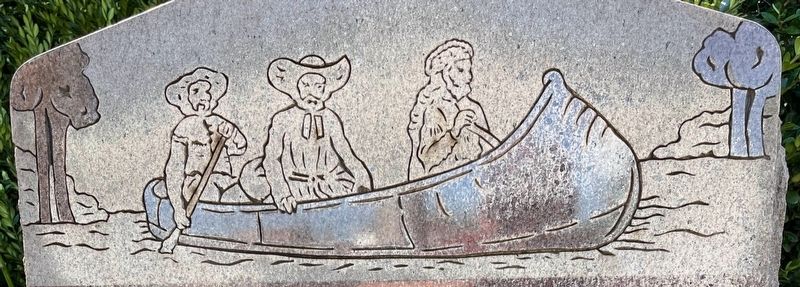
Photographed by Sean P. Flynn, October 10, 2024
4. Marquette and Jolliet Memorial engraving
A close-up of the scene etched into the memorial. It was dedicated in 1973, in honor of the 300th anniversary of Jolliet and Marquette's Mississippi River voyage, which ended through what would later become Chicago.
Related markers. Click here for a list of markers that are related to this marker. Chicagoland memorials to Fr. Jacques Marquette
Also see . . .
1. American Journeys: The Mississippi Voyage of Jolliet and Marquette.
Excerpt: "Once on the Mississippi, Marquette describes “a monster with the head of a tiger, the nose of a wildcat, and whisker”—a large species of catfish. On the riverbank, Marquette described the presence of large cattle, the bison. They met with bands of the Illinois tribes living in the region, who shared calumet pipes of tobacco with the French explorers. Here, Marquette describes the woven rush homes of the Illinois tribe and large gardens filled with melons, squash, beans, and tobacco. They continued downriver past the Missouri and the Ohio Rivers until stopping at the Arkansas River in July 1763. They guessed that the Mississippi emptied into the Gulf of Mexico, and that traveling further south might mean capture by the Spaniards and so returned to the north by way of the Illinois River and Lake Michigan."(Submitted on October 11, 2024, by Sean P. Flynn of Oak Park, Illinois.)
2. Encyclopedia of Chicago: Jolliet and La Salle's Canal Plans.
Excerpt from the Chicago Historical Society: "With Father Jacques Marquette, Louis Jolliet traveled by canoe during the spring of 1673, first on the Wisconsin, then on to find the Mississippi River for Nouvelle France. They returned north on the Illinois River to the mouth of the Chicago River.(Submitted on October 11, 2024, by Sean P. Flynn of Oak Park, Illinois.)
Jolliet made a careful notation of the physiography of the area, leading us to believe that he and his companions spent several days there. The Chicago Portage fascinated Jolliet. He recognized the potential of a direct maritime link between the St. Lawrence estuary on the Atlantic Ocean and the Gulf of Mexico, writing to another Jesuit priest: ' ...it should be easy to go as far as Florida in a bark.... A canal would need to be cut across in only half a league of a prairie in order to enter from the lake in the River St. Louis (Illinois River) which discharges into the Mississippi.'”
Credits. This page was last revised on July 2, 2026. It was originally submitted on October 11, 2024, by Sean P. Flynn of Oak Park, Illinois. This page has been viewed 305 times since then and 55 times this year. Photos: 1, 2, 3, 4. submitted on October 11, 2024, by Sean P. Flynn of Oak Park, Illinois.
