Near Wells in York County, Maine — The American Northeast (New England)
Rachel Carson National Wildlife Refuge
Where Wildlife Comes First

Photographed by Steve Stoessel, October 13, 2024
1. Rachel Carson National Wildlife Refuge Marker
[right front panel]
Rachel Carson National Wildlife Refuge was created in 1966, to preserve the migrating bird hubitat and waterfowl migration routes along the southern coast of Maine. Originally called Coastal Maine National Wildlife Refuge, it was renamed in 1969 to honor the scientist, author, and ecologist Rachel Carson.
Growing in acreage as new land is acquired, the refuge has 10 divisions spanning over 50 miles of coastline from Kimery to Cape Elizabeth Our story is one of conservation, protection and enhancement. We conserve wildlife and natural resources with landscape level projects, protect threatened or endangered species and enhance disappearing or degraded habitats while managing refuge lands to benefit wildlife and perpetuate the biological integrity and diversity of our coastal, freshwater and upland habitats
Rachel Carson National Wildlife Refuge is a part of the National Wildlife Refuge System, a network of habitats that benefits wildlife, provides positive outdoor experiences for at all visitors, and protects the environment. Administered by the US Fish and Wildlife Service, with 545
this page online
[rear left panel]
Rachel Louise Carson
1907-1964
Writer, Scientist, Ecologist… Courageous Visionary
Born in Pennsylvania in 1907, Rachel Carson had a great love and appreciation for the natural world that inspired a course of study and ultimately a career which led her to play a pivotal role in the course of history.
After studying marine biology as an undergraduate and zoology as a graduate student, Ms. Carson began a career intimately tied to the natural world. She studied, researched, wrote, and edited for the U.S. Bureau of Fisheries, the precursor of the U.S. Fish and Wildlife Service. Outside of work, she continued to express her passion for nature by writing magazine pieces and the, books: Under the Sea Wind and The Sea Around Us. She completed the trilogy in 1955 with The Edge of the Sea.
"The history of life on earth has been a history of interaction between living things and their surroundings."
Repeated evidence of the devastating effects of excessive and

Photographed by Steve Stoessel, October 13, 2024
2. Rachel Carson National Wildlife Refuge Marker
Despite government and industry pressures, her research, knowledge, and observations compelled her to write a meticulously researched, brilliantly written argument that profoundly impacted the course of history. Silent Spring was published in 1962. As a result of her effort, the insecticide DDT was banned, the concept of modern environmentalism was born, and the important concept of an interrelated world was established.
A simple, private woman, Rachel Carson is a testament to the power of one person making a difference. She lived her life committed to the things she felt deeply about — her family and the natural world. Rachel Carson died of breast cancer in 1964, two years after Silent Spring was published.
"In every outthrust headland, in every curving beach, in every grain of sand there is the story of the earth."
[photo caption:] Rachel Carson and Robert Hines in the field.
[right rear panel:]
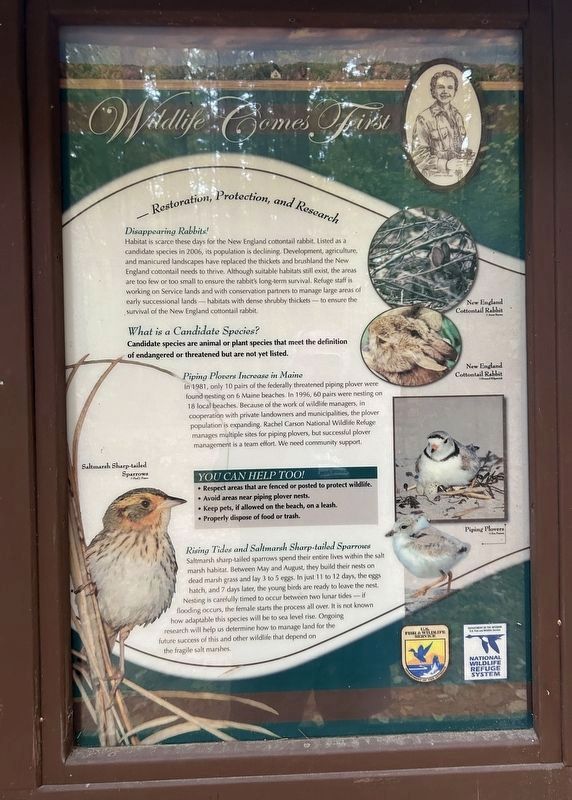
Restoration, Protection, and Rescarch Disappearing Rabbits!
Habitat
Photographed by Steve Stoessel, October 13, 2024
3. Rachel Carson National Wildlife Refuge Marker
What is a Candidate Species?
Candidate species are animal or plant species that meet the definition of endangered or threatened but are not yet listed.
Piping Plovers Increase in Maine In 1981, only 10 pairs of the federally threatened piping plover were found nesting on 6 Maine beaches. In 1996, 60 pairs were nesting on 18 local beaches. Because of the work of wildlife managers, in cooperation with private landowners and municipalities, the plover population is expanding. Rachel Carson National Wildlife Refuge manages multiple sites for
Photographed by Steve Stoessel, October 13, 2024
4. Left Front Panel
YOU CAN HELP TOO!
• Respect areas that are fenced or posted to protect wildlife.
• Avoid areas near piping plover nests.
• Keep pets, if allowed on the beach, on a leash.
• Properly dispose of food or trash.
Rising Tides and Saltmarsh Sharp-tailed Sparrows
Saltmarsh sharp-tailed sparrows spend their entire lives within the salt marsh habitat. Between May and August, they build their nests on dead marsh grass and lay 3 to 5 eggs. In just 11 to 12 days, the eggs hatch, and 7 days later, the young birds are ready to leave the nest. Nesting is carefully timed to occur between two lunar tides — if flooding occurs, the female starts the process all over. It is not known how adaptable this species will be to sea level rise. Ongoing research will help us determine how to manage land for the future success of this and other wildlife that depend on the fragile salt marshes.
Erected by National Wildlife Refuge System.
Topics. This historical marker is listed in these topic lists: Arts, Letters, Music • Environment • Parks & Recreational Areas

Photographed by Steve Stoessel, October 13, 2024
5. Rachel Carson National Wildlife Refuge Marker
Location. 43° 20.831′ N, 70° 32.897′ W. Marker is near Wells, Maine, in York County. It can be reached from Port Road (Maine Route 9). Marker is at trailhead near the parking area. Touch for map. Marker is at or near this postal address: 321 Port Road, Wells ME 04090, United States of America. Touch for directions.

Regionally, this marker is on Southern Maine Coast. It is also in the American Northeast, in New England, and on the Eastern Seaboard. Globally, it is in the North Atlantic Region, North America, the Western Hemisphere, the Western World, and the Anglosphere.
Other nearby markers. At least 8 other markers are within walking distance of this marker: Welcome to the 'Sense of Wonder' Rain Garden… (a few steps from this marker); Rachel Carson (within shouting distance of this marker); The 2005 Landslide (within shouting distance of this marker); Laudholm Farm: The foundation of the Wells Reserve (approx. 0.6 miles away); Hay and Horse Barn (approx. 0.7 miles away); Cow Barn (approx. 0.7 miles away); Ice House (approx. 0.7 miles away); Creamery (approx. 0.7 miles

Photographed by Steve Stoessel, October 13, 2024
6. Rachel Carson National Wildlife Refuge Marker
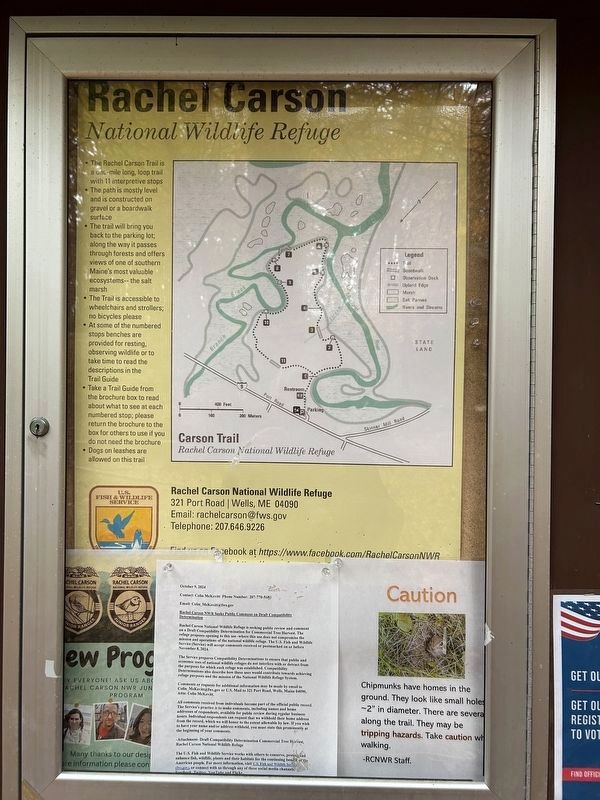
More about this marker. The marker is a two-sided marker with two panels on each side.
Also see . . . Rachel Carson (Wikipedia). (Submitted on October 13, 2024, by Steve Stoessel of Niskayuna, New York.)

Photographed by Steve Stoessel, October 13, 2024
7. Rachel Carson National Wildlife Refuge Marker
Photographed by Steve Stoessel, October 13, 2024
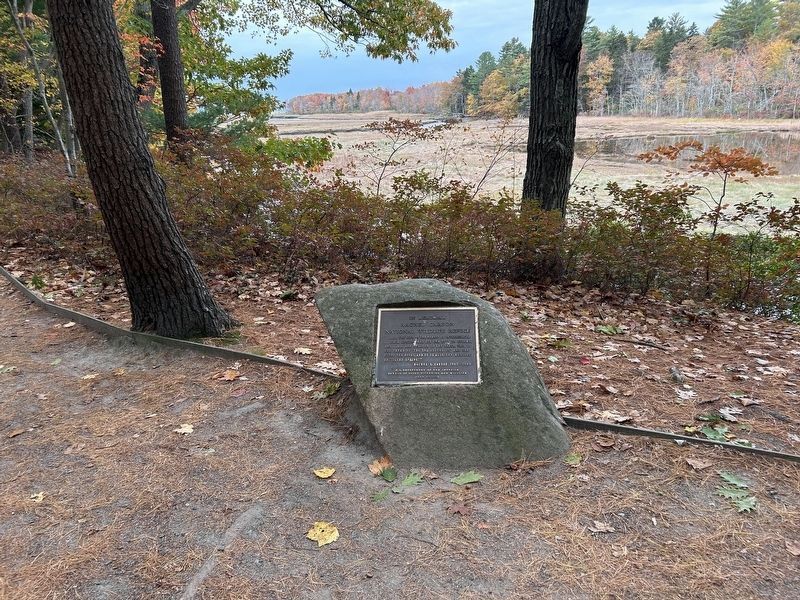
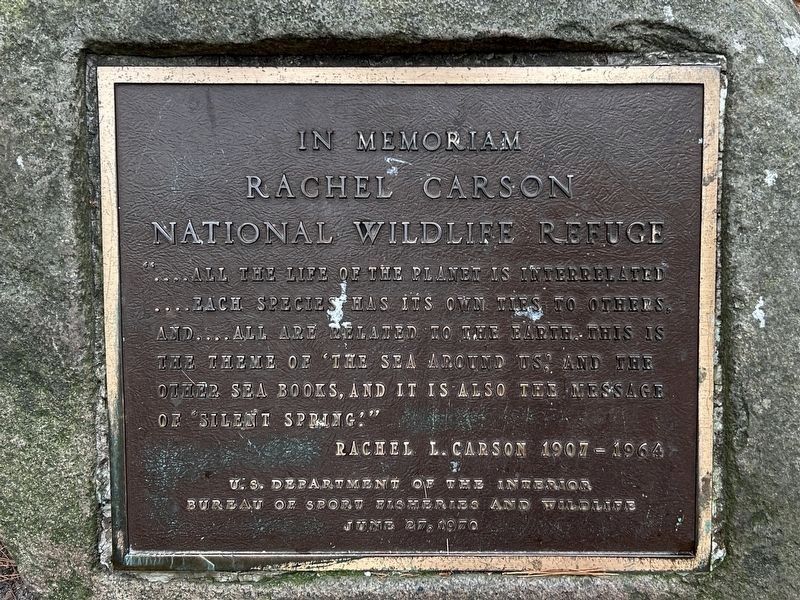
8. Rachel Carson Memorial
The memorial is on the trail.
Photographed by Steve Stoessel, October 13, 2024
9. Rachel Carson Memorial
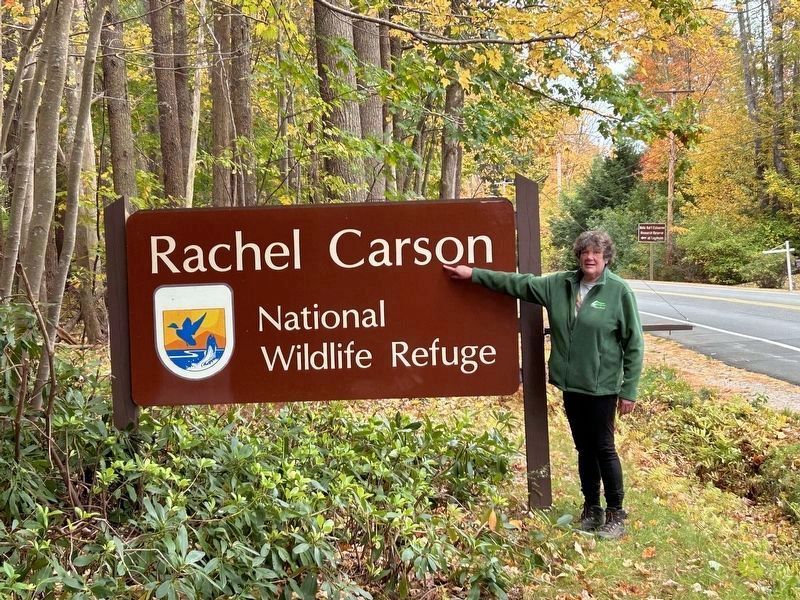
Photographed by Steve Stoessel, October 13, 2024
10. Rachel Carson National Wildlife Refuge Entrance
Credits. This page was last revised on October 15, 2024. It was originally submitted on October 13, 2024, by Steve Stoessel of Niskayuna, New York. This page has been viewed 203 times since then and 19 times this year. Photos: 1, 2, 3. submitted on October 13, 2024, by Steve Stoessel of Niskayuna, New York. 4. submitted on October 14, 2024, by Steve Stoessel of Niskayuna, New York. 5, 6, 7. submitted on October 13, 2024, by Steve Stoessel of Niskayuna, New York. 8, 9, 10. submitted on October 14, 2024, by Steve Stoessel of Niskayuna, New York.
