Port Credit in Mississauga in Peel Region, Ontario — Central Canada (North America)
At the Mouth of the Credit
Photographed by Tim Boyd, September 26, 2024
1. At the Mouth of the Credit Marker
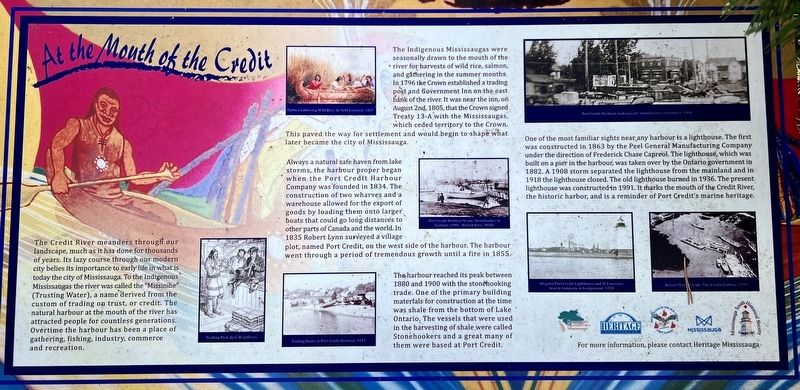
The Credit River meanders through our landscape, much as it has done for thousands of years. Its lazy course through our modern city belies its importance to early life in what is today the city of Mississauga. To the Indigenous Mississaugas the river was called the "Missinihe" (Trusting Water), a name derived from the custom of trading on trust, or credit. The natural harbour at the mouth of the river has attracted people for countless generations. Overtime the harbour has been a place of gathering, fishing, industry, commerce and recreation.
The Indigenous Mississaugas were seasonally drawn to the mouth of the river for harvests of wild rice, salmon, and gathering in the summer months. In 1796 the Crown established a trading post and Government Inn on the east bank of the river. It was near the inn, on August 2nd, 1805, that the Crown signed Treaty 13-A with the Mississaugas, which ceded territory to the Crown. This paved the way for settlement and would begin to shape what later became the city of Mississauga.
Always a natural safe haven from lake storms, the harbour proper began when the Port Credit Harbour
this page online
The harbour reached its peak between 1880 and 1900 with the stonehooking trade. One of the primary building materials for construction at the time was shale from the bottom of Lake Ontario. The vessels that were used in the harvesting of shale were called Stonehookers and a great many of them were based at Port Credit.
One of the most familiar sights near any harbour is a lighthouse. The first was constructed in 1863 by the Peel General Manufacturing Company under the direction of Frederick Chase Capreol. The lighthouse, which was built on a pier in the harbour, was taken over by the Ontario government in 1882. A 1908 storm separated the lighthouse from the mainland and in 1918 the lighthouse closed. The old lighthouse burned in 1936. The present
Photographed by Tim Boyd, September 26, 2024
2. At the Mouth of the Credit Marker
Topics and series. This historical marker is listed in these topic lists: Colonial Era • Indigenous Peoples and Communities • Settlements & Settlers • Waterways & Vessels. In addition, it is included in the Lighthouses series list. A significant historical date for this entry is August 2, 1805.
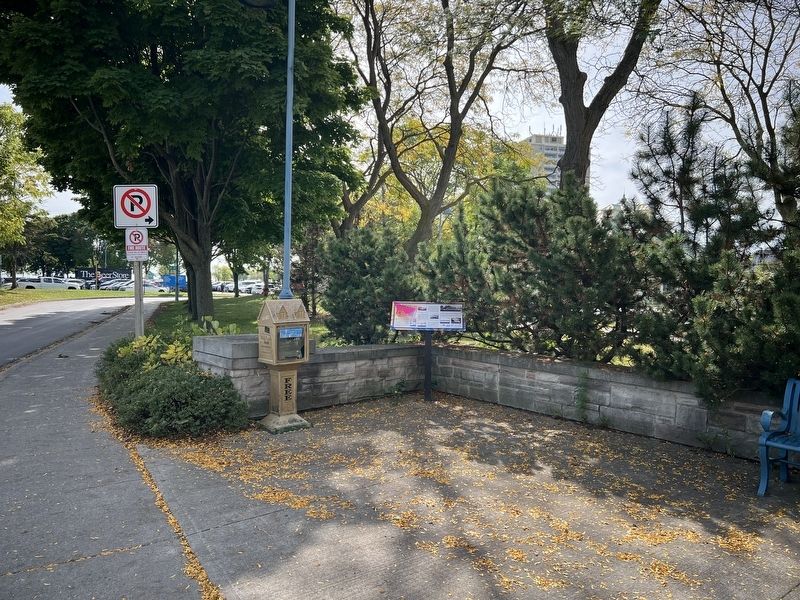
Location. 43° 33.062′ N, 79° 35.052′ W. Marker is in Mississauga, Ontario, in Peel Region. It is in Port Credit. It is on Stavebank Road South near Port Street East, on the right when traveling south. Touch for map. Marker is at or near this postal address: 8 Stavebank Road S, Mississauga ON L5G L5G, Canada. Touch for directions.

Regionally, this marker is in Greater Toronto, specifically on the Golden Horseshoe, and in the Toronto Metropolitan Area. It is also in Central Canada. Globally, it is in North America, on the Great Lakes, in the Western Hemisphere, in the Western World, and in the Anglosphere. Historically, it finds itself in what was once a British colony, the Viceroyalty
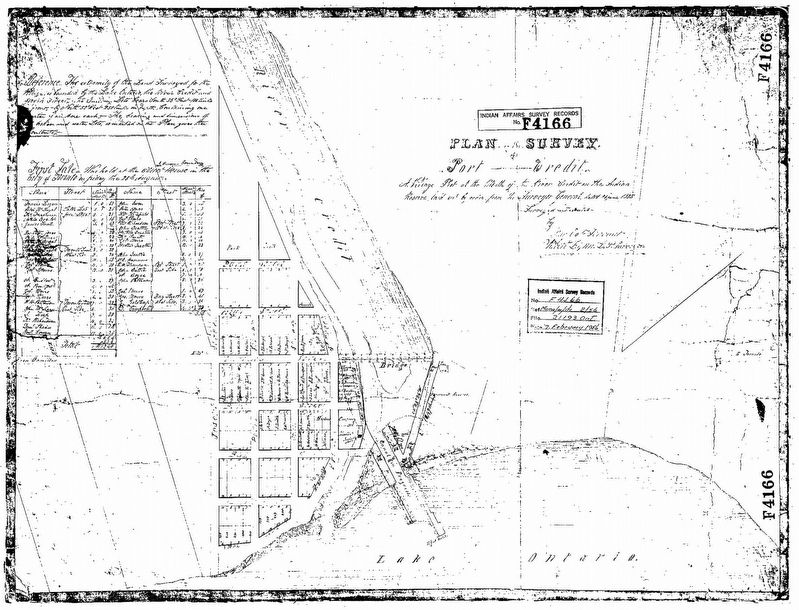
3. Plan of Port Credit, 1835
Other nearby markers. At least 8 other markers are within walking distance of this marker: The Mississauga Tract, 1805 (within shouting distance of this marker); Mrs. Mailman (about 120 meters away, measured in a direct line); Crossing the River (about 150 meters away); The Harbour (about 150 meters away); The Mills of the Credit River (about 210 meters away); Memorial Park (about 240 meters away); a different marker also named Memorial Park (about 240 meters away); a different marker also named Memorial Park (approx. 0.2 kilometers away). Touch for a list and map of all markers in Mississauga.
Credits. This page was last revised on October 17, 2024. It was originally submitted on October 14, 2024, by Tim Boyd of Hamilton, Ontario. This page has been viewed 252 times since then and 29 times this year. Photos: 1, 2, 3. submitted on October 14, 2024, by Tim Boyd of Hamilton, Ontario. • Andrew Ruppenstein was the editor who published this page.
