Medicine Lodge in Barber County, Kansas — The American Midwest (Upper Plains)
The Story of Prohibition
The temperance movement in Kansas

Photographed by Cosmos Mariner, September 8, 2024
1. The Story of Prohibition Marker
Teetotalers fought against the selling and consumption of alcohol in the mid-19th century, and nowhere was the temperance movement stronger than in Kansas. As a territory, local option laws for taverns were passed. These, along with other prohibition efforts, were supported by groups like the Kansas State Temperance Union and the Woman's Christian Temperance Union. Together, temperance groups and like-minded individuals pushed Kansas to be a leader in prohibition.
By the 1870s, Kansas Republicans supported prohibition and in 1878, a prohibitionist governor was voted into office. Two years later, Kansas became the first state to add prohibition to its constitution through an amendment forbidding manufacturing or selling “intoxicating liquors.” Voters ratified the amendment, and Kansas Prohibition went into effect.
State Prohibition
Prohibition in Kansas was at first unsuccessful. Many taverns flouted the law, including the Senate Saloon in Topeka. They operated by paying monthly fines, using loopholes, or taking advantage of lax enforcement. However, the temperance movement gained momentum again at the turn-of-the-century
this page online
The Rest of the Story
In 1919, the U.S. Constitution's 18th Amendment passed, resulting in national prohibition. Law enforcement struggled to make the country dry for 14 years. While it had some success reducing alcohol consumption, it also led to lawlessness, a skepticism about government overreach, and large public expenditures. By 1933, most saw prohibition as a failure, and in that year the amendment was repealed.
Kansas was an exception. It maintained its own prohibition until 1948 when voters rejected it by a popular vote. Afterwards, Kansas returned to a local option law. In Barber County, home of Medicine Lodge, liquor by the drink continued to be illegal in bars and restaurants until 2010.
Carry A. Nation
Carry A. Nation — hatchet-wielding bar-smasher and suffragette
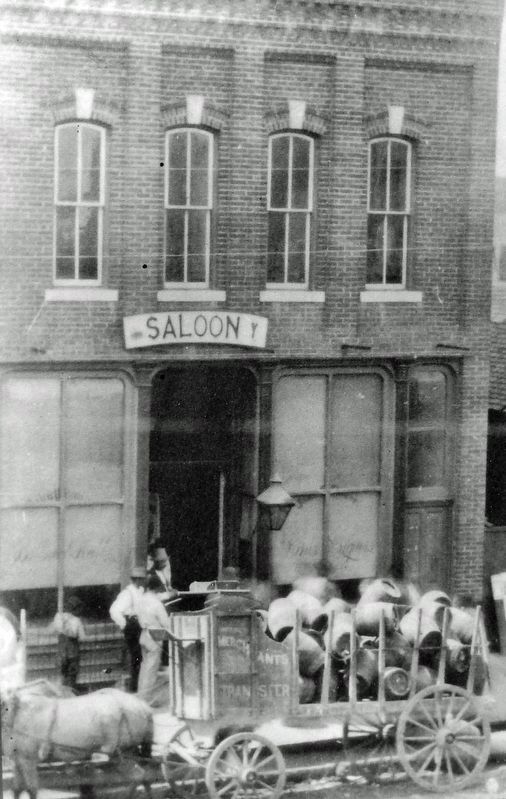
2. Marker detail: The Senate Saloon, Topeka, Kansas
At the time, selling alcohol was prohibited in Kansas, but saloon owners ignored it, much to the frustration of Nation and her fellow “Home Defenders.” In 1899, Nation had a “vision” to go to nearby Kiowa where she wrecked several saloons, beginning a violent streak in her crusade against alcohol. Soon after, Nation moved on to smash bars in Wichita, where she began using her signature hatchet, and then to Enterprise and Hope. Finally, Nation headed to the state capital.
When Nation came to Topeka in 1901, she found many illegal saloons. First, she tried diplomacy, warning taverns to close and encouraging the Governor and legislature to enforce state laws. At almost six feet tall, 175 pounds, and dressed in her long black dress, black bonnet, and white ribbon bow, she cut an intimidating figure. However, diplomacy did not work, and Nation and her followers retaliated by smashing the Senate Saloon and other bars. Over her career, Nation was arrested many times for her “hatchetations.”
Nation passed away in 1911, a year before Kansas permitted women to vote, but she left her mark on Kansas and the nation. She helped lead the way for the 18th and 19th Amendments to the U.S. Constitution, resulting in the prohibition of alcohol and women's right to vote. While not everyone agreed with her point of view or tactics, her dedication was remarkable. Today, her home in Medicine Lodge is a Museum with memorabilia from

3. Marker detail: Woman’s Christian Temperance Union
group portrait
group portrait
Erected by Kansas Byways.
Topics. This historical marker is listed in these topic lists: Civil Rights • Fraternal or Sororal Organizations • Law Enforcement • Women.
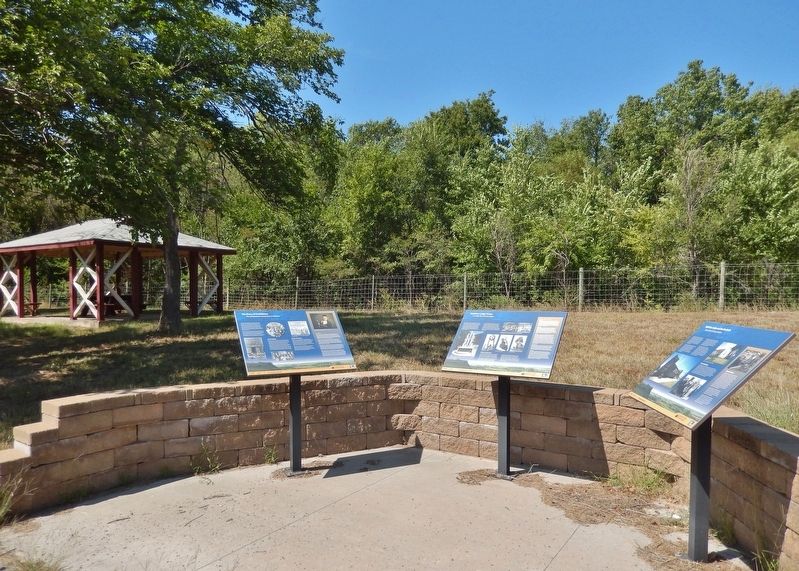
Location. 37° 16.541′ N, 98° 35.757′ W. Marker is in Medicine Lodge, Kansas, in Barber County. It is on West Fowler Avenue (U.S. 160/281) half a mile west of Iliff Street (U.S. 281), on the right when traveling west. The marker is located in a wayside/roadside park on the north side of US Highway 281. Touch for map. Marker is in this post office area: Medicine Lodge KS 67104, United States of America. Touch for directions.

Regionally, this marker is in the American Midwest, in the Corn Belt, on the prairies, on the Great Plains, on the Southern Plains, and specifically on the High Plains. Globally, it is in North America, the Western Hemisphere, the Western World, and the Anglosphere. Historically, it finds itself in what was once New
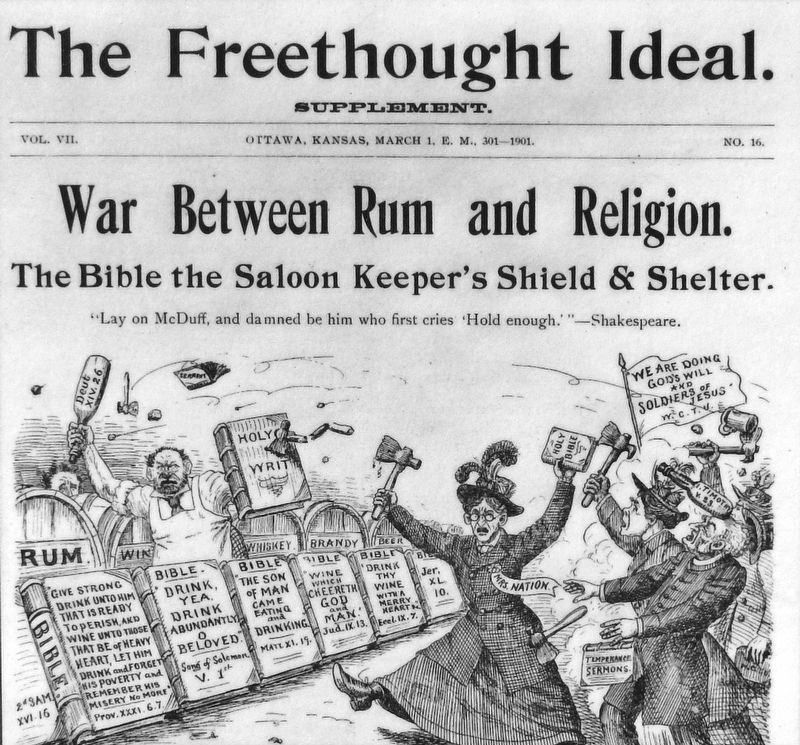
4. Marker detail: War Between Rum and Religion
A newspaper illustration portrays Carry A. Nation leading a group of supporters against a saloon keeper justifying alcohol consumption with bible scriptures.
Other nearby markers. At least 8 other markers are within walking distance of this marker: Medicine Lodge Treaty (here, next to this marker); Medicine Lodge and the Stockade (here, next to this marker); Carry Nation Home (approx. ¾ mile away); Medicine Lodge Stockade (approx. 0.9 miles away); Barber County Veterans Memorial (approx. 0.9 miles away); The Grand Hotel (approx. one mile away); The First National Bank (approx. one mile away); a different marker also named Medicine Lodge Stockade (approx. one mile away). Touch for a list and map of all markers in Medicine Lodge.
Related markers. Click here for a list of markers that are related to this marker. Carry A. Nation
Also see . . .
1. Carrie Nation (Wikipedia).
Excerpt: aroline Amelia Nation (1846-1911), often referred to by Carrie, Carry Nation, Carrie A. Nation, or Hatchet Granny, was an American who was a radical member of the temperance movement, which opposed alcohol before the advent of Prohibition. Nation is noted for attacking alcohol-serving establishments(Submitted on October 16, 2024, by Cosmos Mariner of Cape Canaveral, Florida.)with a hatchet.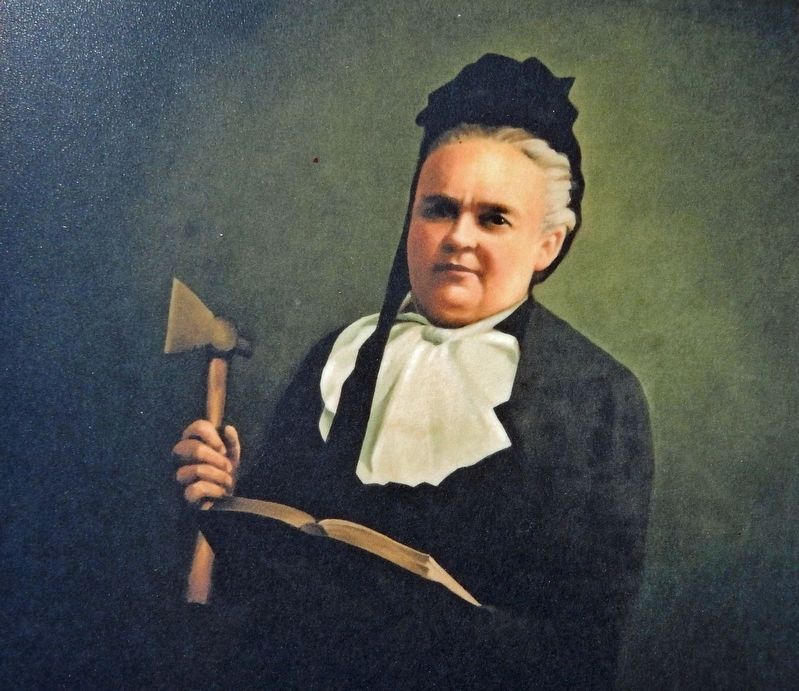 5. Marker detail: Carry A. NationCarrie Nation, or Carry as she preferred later in life, enjoyed stating that prohibition would “Carry A. Nation.”
In her autobiography, The Use and Need of the Life of Carry A. Nation (1908), she also strongly opposed Freemasonry. Nation was also concerned about tight clothing for women; she refused to wear a corset and urged women not to wear them because of their harmful effects on vital organs. She described herself as "a bulldog running along at the feet of Jesus, barking at what He doesn't like", and claimed a divine ordination to promote temperance by destroying bars.
2. Woman's Christian Temperance Union (Wikipedia).
Excerpt: An international temperance organization. Originating among women in the United States Prohibition movement, the organization supported the 18th Amendment and was also influential in social reform issues that came to prominence in the progressive era. It operated at an international level and in the context of religion and reform, including missionary work and women's suffrage. Two years after its founding, the American WCTU sponsored an international conference at which the International Women's Christian(Submitted on October 16, 2024, by Cosmos Mariner of Cape Canaveral, Florida.)Temperance Union was formed. As a consequence of its stated purposes, the WCTU was also very interested in a number of social reform issues, including labor, prostitution, public health, sanitation, and international peace. As the movement grew in numbers and strength, members of the WCTU also focused on suffrage.Photographed by Cosmos Mariner, September 8, 20246. Gypsum Hills Scenic Byway WaysideLeftmost of 3 markers at this location.
Credits. This page was last revised on October 16, 2024. It was originally submitted on October 16, 2024, by Cosmos Mariner of Cape Canaveral, Florida. This page has been viewed 418 times since then and 95 times this year. Photos: 1, 2, 3, 4, 5, 6. submitted on October 16, 2024, by Cosmos Mariner of Cape Canaveral, Florida.
