Penetanguishene in Simcoe County, Ontario — Central Canada (North America)
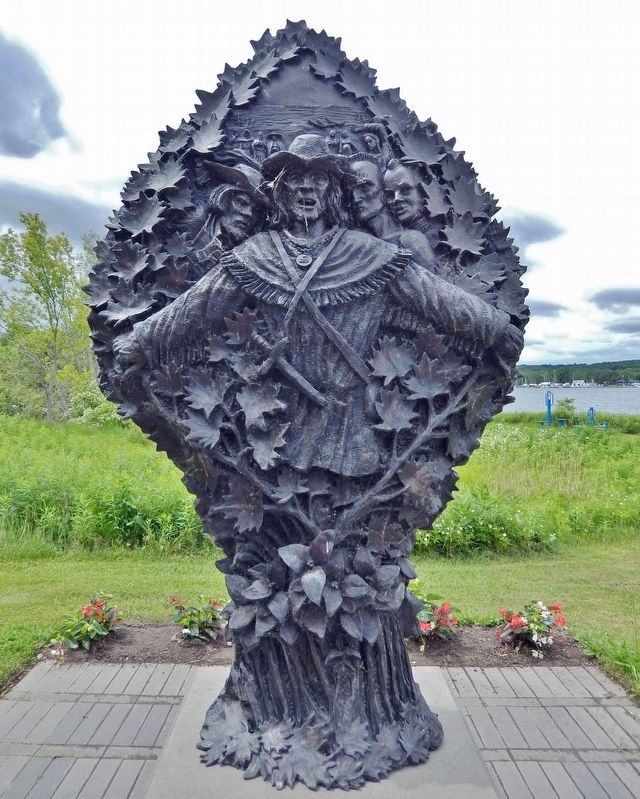
Brûlé
(1592-1633)
Photographed by Cosmos Mariner, June 7, 2024
1. Brûlé Marker
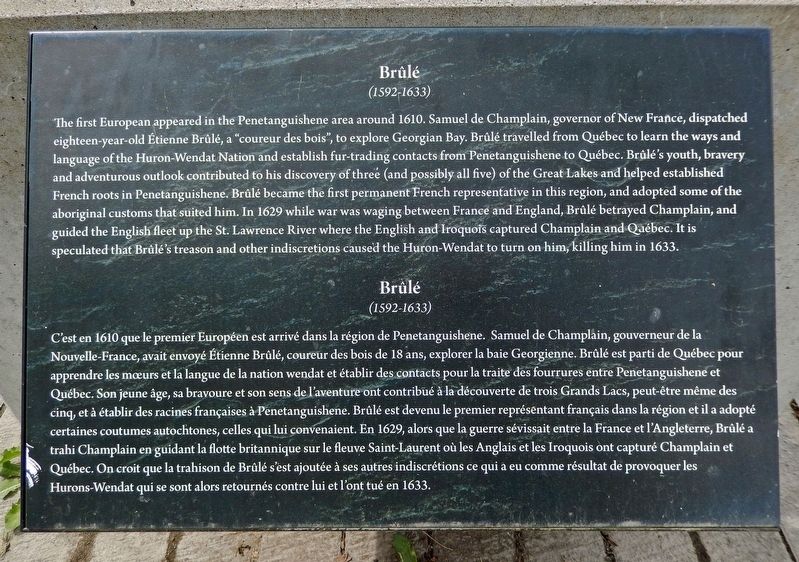
Inscription. [English] The first European appeared in the Penetanguishene area around 1610. Samuel de Champlain, governor of New France, dispatched eighteen-year-old Étienne Brûlé, a "coureur des bois", to explore Georgian Bay. Brûlé travelled from Québec to learn the ways and language of the Huron-Wendat Nation and establish fur-trading contacts from Penetanguishene to Québec. Brûlé’s youth, bravery and adventurous outlook contributed to his discovery of three (and possibly all five) of the Great Lakes and helped established French roots in Penetanguishene. Brûlé became the first permanent French representative in this region, and adopted some of the aboriginal customs that suited him. In 1629 while war was waging between France and England, Brûlé betrayed Champlain, and guided the English fleet up the St. Lawrence River where the English and Iroquois captured Champlain and Québec. It is speculated that Brûlé’s treason and other indiscretions caused the Huron-Wendat to turn on him, killing him in 1633.
[Français] C'est en 1610 que le premier Européen est arrivé dans la région de Penetanguishene. Samuel de Champlain, gouverneur
Click or scan to see this page online
de la Nouvelle-France, avait envoyé Étienne Brûlé, coureur des bois de 18 ans, explorer la baie Georgienne. Brûlé est parti de Québec pour apprendre les mœurs et la langue de la nation wendat et établir des contacts pour la traite des fourrures entre Penetanguishene et Québec. Son jeune âge, sa bravoure et son sens de l'aventure ont contribué à la découverte de trois Grands Lacs, peut-être même des cinq, et à établir des racines françaises à Penetanguishene. Brûlé est devenu le premier représentant français dans la région et il a adopté certaines coutumes autochtones, celles qui lui convenaient. En 1629, alors que la guerre sévissait entre la France et l'Angleterre, Brûlé a trahi Champlain en guidant la flotte britannique sur le fleuve Saint-Laurent où les Anglais et les Iroquois ont capturé Champlain et Québec. On croit que la trahison de Brûlé s'est ajoutée à ses autres indiscrétions ce qui a eu comme résultat de provoquer les Hurons-Wendat qui se sont alors retournés contre lui et l'ont tué en 1633.
• Waterways & Vessels. A significant historical year for this entry is 1629.
Location. 44° 46.19′ N, 79° 56.363′ W. Marker is in Penetanguishene, Ontario, in Simcoe County. It can be reached from Owen Street just north of Water Street. The marker and sculpture are located along the Trans-Canada Trail in Penetanguishene Rotary Champlain Wendat Park. Touch for map. Marker is at or near this postal address: 8 Owen Street, Penetanguishene ON L9M 1M8, Canada. Touch for directions.
Regionally, this marker is in Central Ontario Cottage Country and specifically in Georgian Bay Country. It is also in Central Canada. Globally, it is in North America, on the Great Lakes, in the Western Hemisphere, in the Western World, and in the Anglosphere. Historically, it finds itself in what was once a British colony, the Viceroyalty of New France, the Haudenosaunee (Iroquois) Confederacy, and Rupert’s Land.
Other nearby markers. At least 8 other markers are within walking distance of this marker: The Wendat (a few steps from this marker); Joseph Le Caron (a few steps from this marker); Champlain in Ontario, 1615 (within shouting distance
Photographed by Cosmos Mariner, June 7, 2024
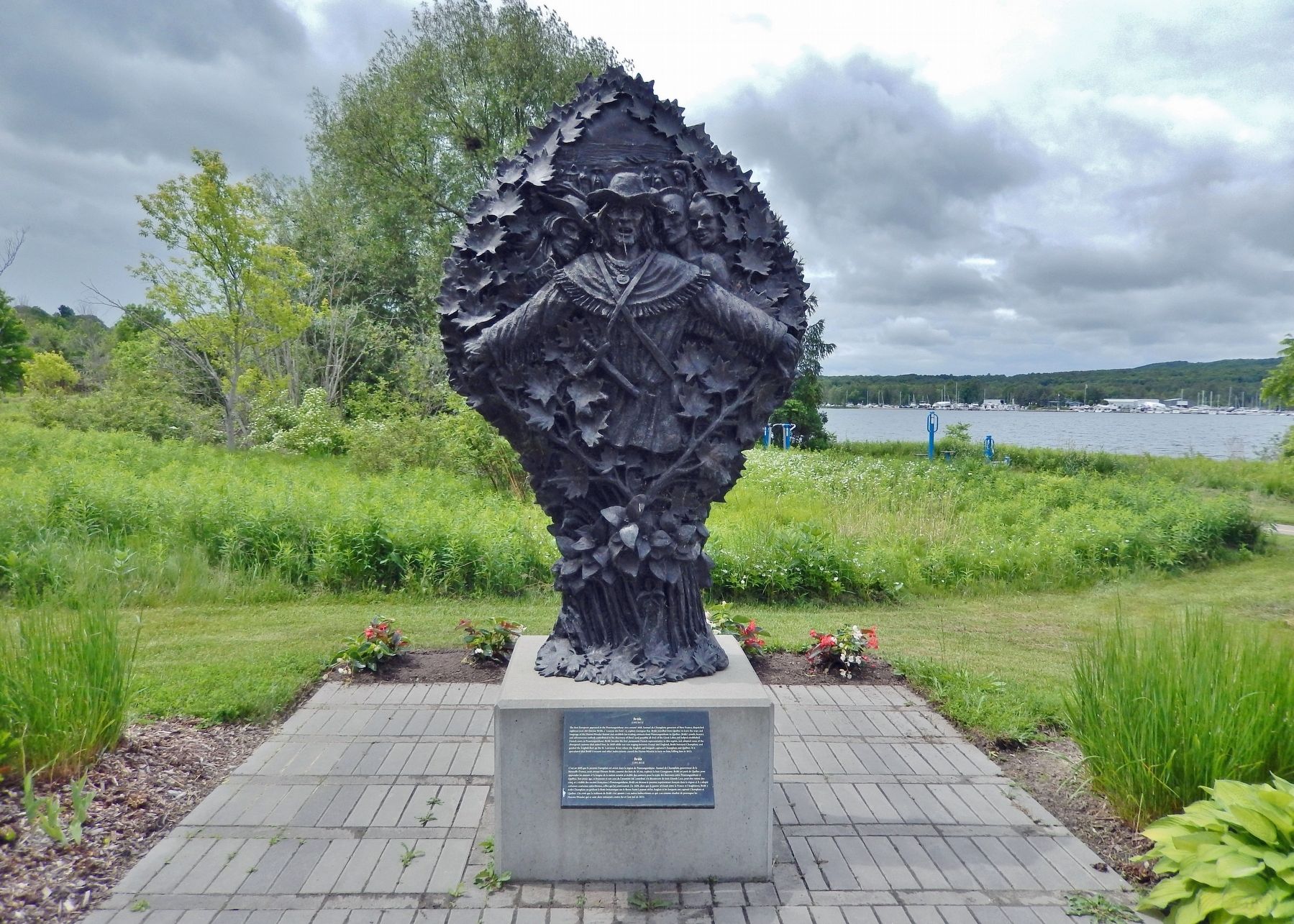
3. Brûlé Marker & Sculpture
Looking west; Penetang Harbour is in the background.
Excerpt: Étienne Brûlé was the first European explorer to journey beyond the St. Lawrence River into what is now known as Canada. He spent much of his early adult life among the Hurons and mastered their language and learned their culture. Brûlé became an interpreter and guide for Samuel de Champlain, who later sent Brûlé on a number of exploratory missions, among which he is thought to have preceded Champlain to the Great Lakes. Among his many travels were explorations of Georgian Bay and Lake Huron. In 1629, during the Anglo-French War, he escaped after being captured by the Seneca tribe. Brûlé was killed by the Bear tribe of the Huron people, who believed he had betrayed them to the Seneca.
(Submitted on November 7, 2024, by Cosmos Mariner of Cape Canaveral, Florida.)
Credits. This page was last revised on November 7, 2024. It was originally submitted on November 4, 2024, by Cosmos Mariner of Cape Canaveral, Florida. This page has been viewed 178 times since then and 31 times this year. Photos:1, 2, 3. submitted on November 7, 2024, by Cosmos Mariner of Cape Canaveral, Florida.