
Penetanguishene in Simcoe County, Ontario — Central Canada (North America)
Champlain in Ontario, 1615
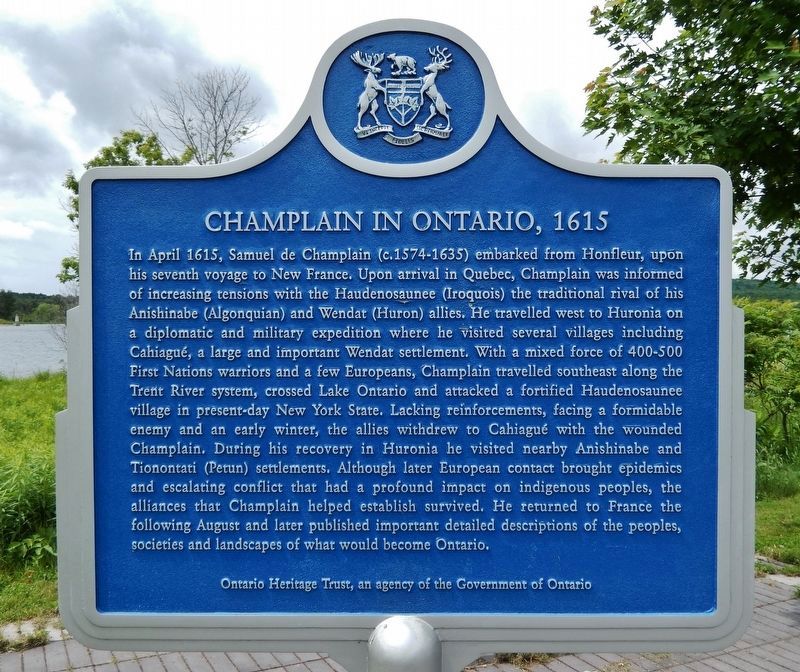
Photographed by Cosmos Mariner, June 7, 2024
1. Champlain in Ontario, 1615
(marker north side • English)
(marker north side • English)

this page online
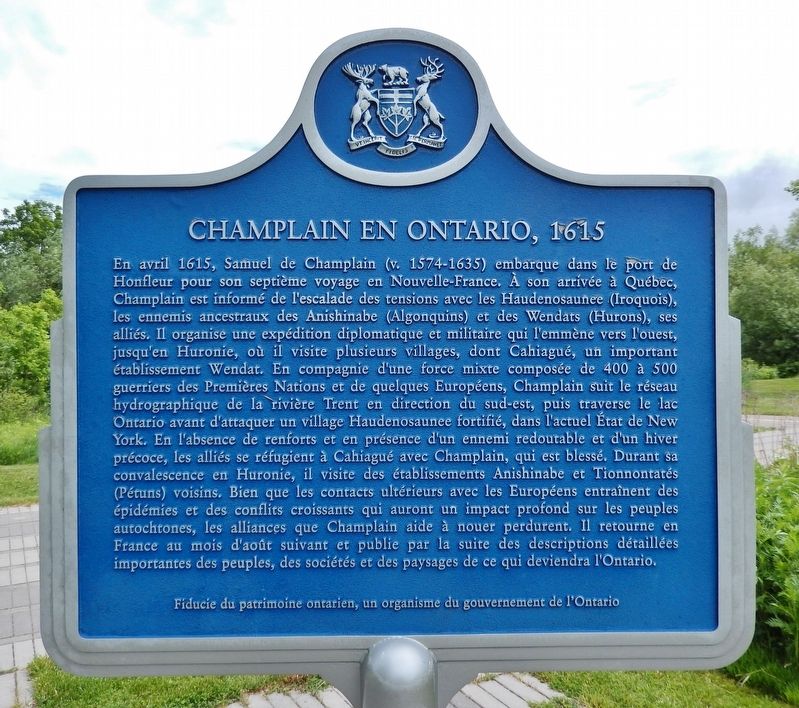
Photographed by Cosmos Mariner, June 7, 2024
2. Champlain in Ontario, 1615
(marker south side • Français)
(marker south side • Français)
Erected by Ontario Heritage Trust / Fiducie du patrimoine ontarien.
Topics and series. This historical marker is listed in these topic lists: Colonial Era • Exploration • Indigenous Peoples and Communities • Waterways & Vessels. In addition, it is included in the Canada, Ontario Heritage Trust series list. A significant historical month for this entry is April 1615.
Location. 44° 46.2′ N, 79° 56.381′ W. Marker is in Penetanguishene, Ontario, in Simcoe County. It can be reached from Owen Street just north of Water Street. The marker is located along the Trans-Canada Trail in Penetanguishene Rotary Champlain Wendat Park. Touch for map. Marker is at or
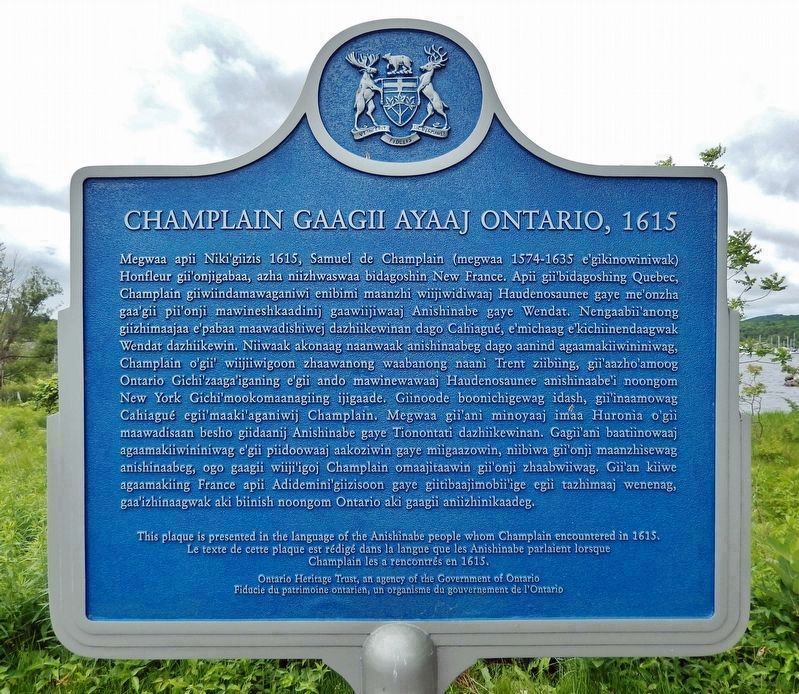
Photographed by Cosmos Mariner, June 7, 2024
3. Champlain in Ontario, 1615 • Anishinabe
———
Le texte de cette plaque est rédigé dans la langue que les Anishinabe parlaient lorsque Champlain les a rencontrés en 1615.

Regionally, this marker is in Central Ontario Cottage Country and specifically in Georgian Bay Country. It is also in Central Canada. Globally, it is in North America, on the Great Lakes, in the Western Hemisphere, in the Western World, and in the Anglosphere. Historically, it finds itself in what was once a British colony, the Viceroyalty of New France, the Haudenosaunee (Iroquois) Confederacy, and Rupert’s Land.
Other nearby markers. At least 8 other markers are within walking distance of this marker: “Bound Together” (Huron Wendat Canoe) / Étroitement liés (canot huron-wendat) (a few steps from this marker); Brûlé (within shouting distance of this marker); The Wendat (within shouting distance of this marker); Joseph Le Caron (within shouting distance of this marker); The Meeting / La rencontre (within shouting distance of this marker); Métis (within shouting distance of this marker); Father Laboureau (about 90 meters away, measured in a direct line); Athol Murray (about 90 meters away). Touch for a list and map
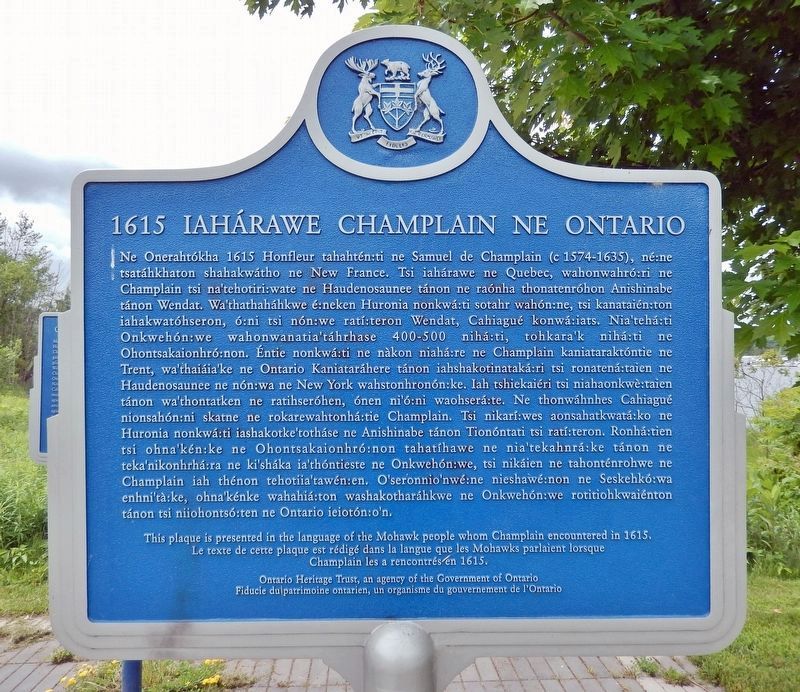
Photographed by Cosmos Mariner, June 7, 2024
4. Champlain in Ontario, 1615 • Mohawk
———
Le texte de cette plaque est rédigé dans la langue que les Mohawks parlaient lorsque Champlain les a rencontrés en 1615.
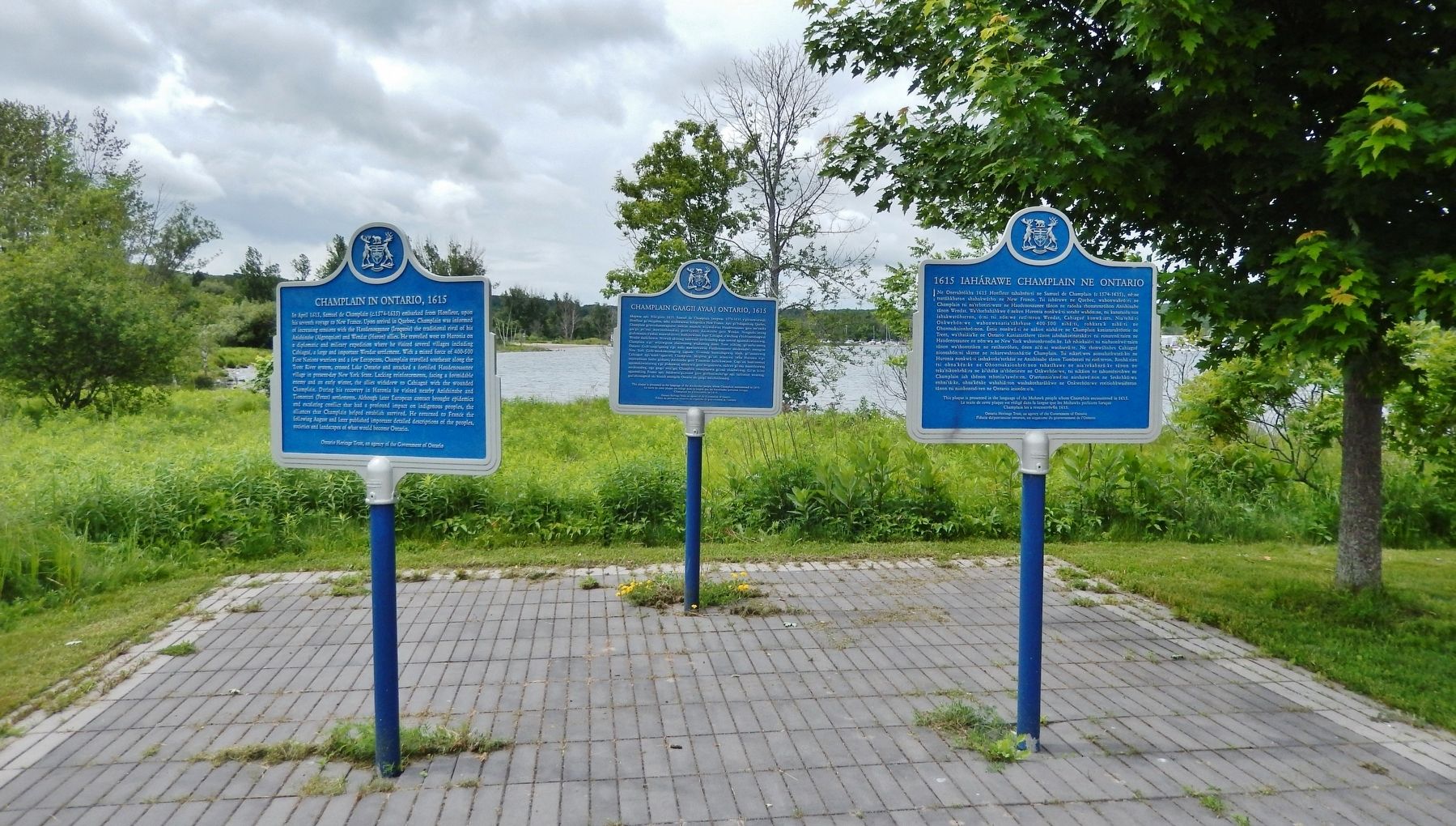
More about this marker. This marker set comprises 3 double-sided markers (6 panels) with the same inscription in English, French, Anishinabe, Mohawk, Montagnais-Innu and Wendat languages.
Also see . . . Tracking Champlain: Plotting the explorer’s epic journey on the 400th anniversary.
Excerpt: In 1615 on another exploration of the new frontier, Champlain made his way down the St. Lawrence River and was greeted by a large contingent from the Huron and Algonquin nations. The explorer met these aboriginal nations before on one of his earlier journeys, and now they asked Champlain to help them defeat the Onondaga and Oneida nations to the south in what is now Upper New York state. In an agreement to help his allies, Champlain returned to Quebec to plan an attack and make the necessary equipment preparations for the journey that would take him and his native companions deep into enemy territory...(Submitted on November 10, 2024, by Cosmos Mariner of Cape Canaveral, Florida.)
Photographed by Cosmos Mariner, June 7, 2024
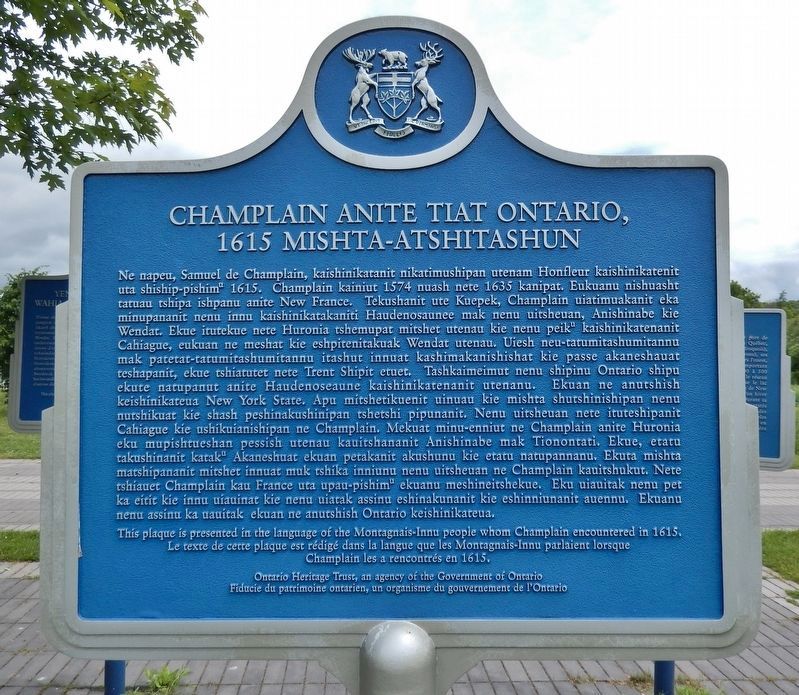
5. Champlain in Ontario, 1615 • Montagnais-Innu
———
Le texte de cette plaque est rédigé dans la langue que les Montagnais-Innu parlaient lorsque Champlain les a rencontrés en 1615.
Photographed by Cosmos Mariner, June 7, 2024
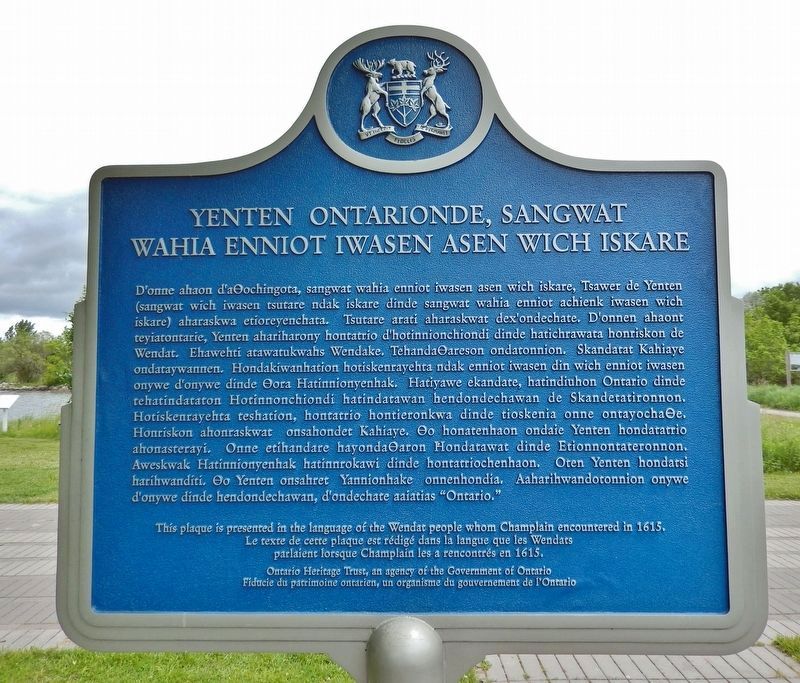
6. Champlain in Ontario, 1615 • Wendat
———
Le texte de cette plaque est rédigé dans la langue que les Wendats parlaient lorsque Champlain les a rencontrés en 1615.
Photographed by Cosmos Mariner, June 7, 2024
7. Champlain in Ontario, 1615
This is a 3-marker set comprising 6 panels with the same inscription in 6 different languages.
Credits. This page was last revised on November 10, 2024. It was originally submitted on November 8, 2024, by Cosmos Mariner of Cape Canaveral, Florida. This page has been viewed 291 times since then and 71 times this year. Photos: 1, 2, 3, 4, 5, 6, 7. submitted on November 10, 2024, by Cosmos Mariner of Cape Canaveral, Florida.
