Golden Gate in Chicago in Cook County, Illinois — The American Midwest (Great Lakes)
Activists in the Anti-Slavery Movement
Photographed by Sean P. Flynn, November 16, 2024
1. Activists in the Anti-Slavery Movement Marker
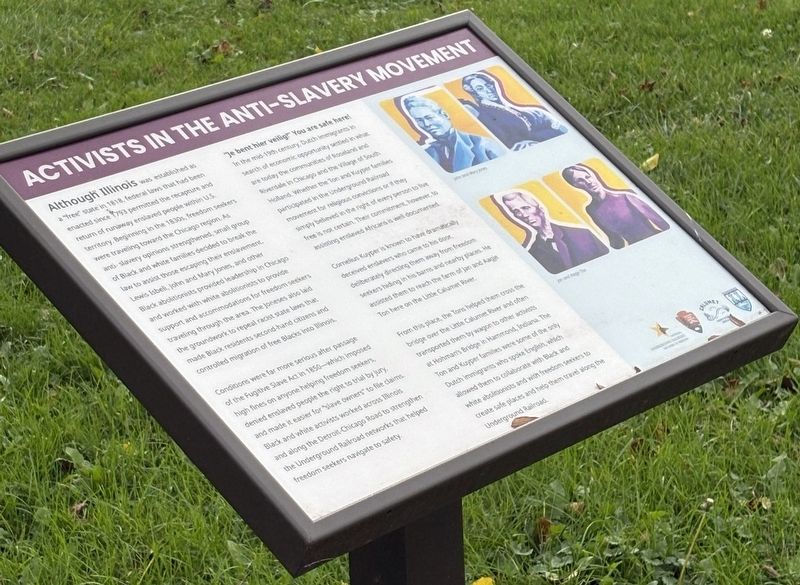
Although Illinois was established as a "free" state in 1818, federal laws that had been enacted since 1793 permitted the recapture and return of runaway enslaved people within U.S. territory. Beginning in the 1830s, freedom seekers were traveling toward the Chicago region. As anti-slavery opinions strengthened, small group of Black and white families decided to break the law to assist those escaping their enslavement. Lewis Isbell, John and Mary Jones, and other Black abolitionists provided leadership in Chicago and worked with white abolitionists to provide support and accommodations for freedom seekers traveling through the area. The Joneses also led the groundwork to repeal racist state laws that made Black residents second-hand citizens and controlled migration of free Blacks into Illinois.
Conditions were far more serious after passage of the Fugitive Slave Act in 1850—which imposed high fines on anyone helping freedom seekers, denied enslaved people the right to trial by jury, and made it easier for "slave owners" to file claims. Black and white activists worked across Illinois and along the Detroit-Chicago Road
this page online
"Je bent hier veilig!" You are safe here! In the mid-19th century, Dutch immigrants in search of economic opportunity settled in what are today the communities of Roseland and Riverdale in Chicago and the Village of South Holland. Whether the Ton and Kuyper families participated in the Underground Railroad movement for religious convictions or if they simply believed in the right of every person to live free is not certain. Their commitment, however, to assisting enslaved Africans is well documented.
Cornelius Kuyper is known to have dramatically deceived enslavers who came to his door, deliberately directing them away from freedom seekers hiding in his barns and nearby places. He assisted them to reach the farm of Jan and Aagje Ton here on the Little Calumet River.
From this place, the Tons helped them cross the bridge over the Little Calumet River and often transported them by wagon to other activists at Hohman's Bridge in Hammond, Indiana. The Ton and Kuyper families were some of the only Dutch immigrants who spoke English, which
Photographed by Sean P. Flynn, November 16, 2024
2. Activists in the Anti-Slavery Movement Marker
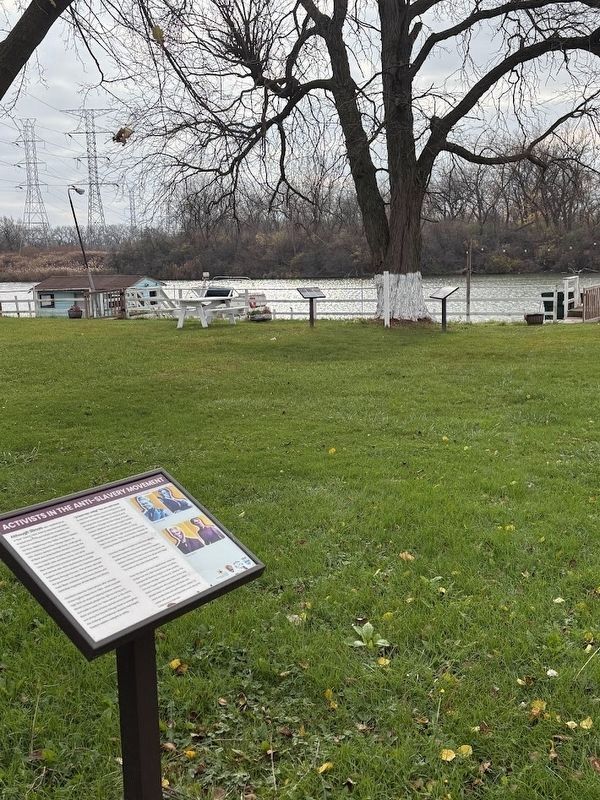
This marker and two others near the Little Calumet River are visible by peering through the fence.
Erected 2022 by National Park Service Network to Freedom; Calumet Heritage Area; Chicago's Finest Marina.
Topics and series. This historical marker is listed in these topic lists: Abolition & Underground RR • African Americans • Immigration • Waterways & Vessels. In addition, it is included in the Network to Freedom series list. A significant historical year for this entry is 1850.
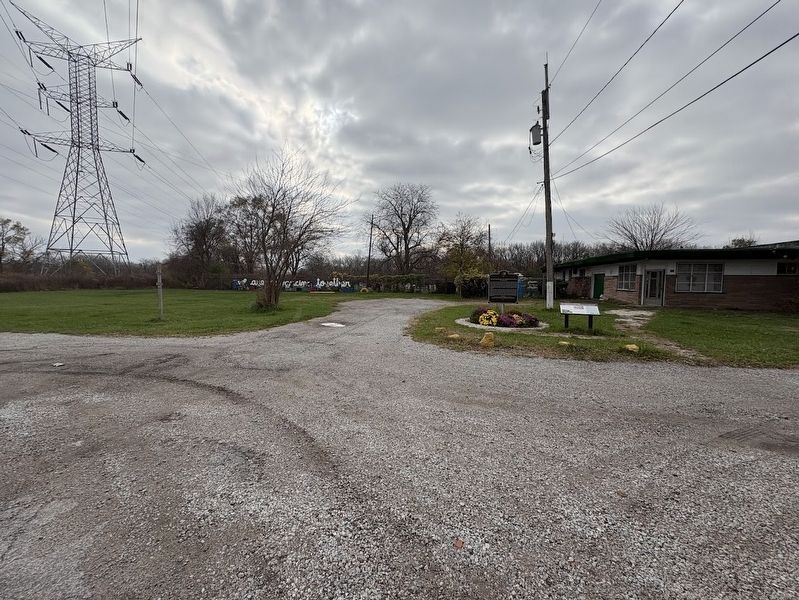
Location. 41° 39.036′ N, 87° 36.453′ W. Marker is in Chicago, Illinois, in Cook County. It is in Golden Gate. It can be reached from the intersection of 134th Place and St. Lawrence Avenue, on the right when traveling east. The marker is behind and right next to a fence on the property of Chicago's Finest Marina. Touch for map. Marker is at or near this postal address: 554 East 134th Place, Riverdale IL 60827, United States of America. Touch for directions.

Regionally, this marker is in Illinois’ Calumet Region. It is also in the American Midwest. Globally, it is in
Photographed by Sean P. Flynn, November 16, 2024
3. Chicago's Finest Marina
In addition to the two visible markers, three markers are behind the fence, near the Little Calumet River.
Other nearby markers. At least 8 other markers are within 3 miles of this marker, measured as the crow flies: Freedom Seekers and the Underground Railroad: Ton Farm Site (within shouting distance of this marker); Pathways to Freedom: The Underground Railroad in Chicago (within shouting distance of this marker); Arcade Park & The Pullman Stables (approx. 2.8 miles away); Pullman 1894 Strike Memorial Rose & Herb Garden (approx. 2.9 miles away); The Arcade (approx. 2.9 miles away); The Pullman Freight Depot & The Gas Works (approx. 2.9 miles away); Lake Vista & Illinois Central Railroad Depot (approx. 2.9 miles away); Welcome to Pullman (approx. 2.9 miles away). Touch for a list and map of all markers in Chicago.
More about this marker. There are at least two more markers that were visible next to the Little Calumet River, a little bit south of this marker, but could
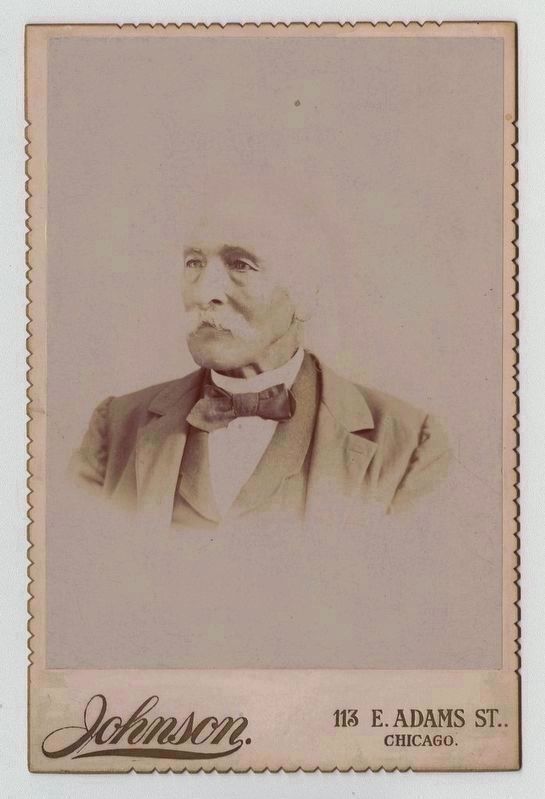
Photo by Johnson; courtesy of Chicago History Museum (ICHi-022359), circa 1892
4. Lewis Isbell (1818-1905)
Lewis Isbell, who is referenced on this sign as one of the early Black leaders helping lead enslaved people to their freedom, arrived in Chicago in 1838 as one of the city's earliest African-American settlers. He also participated in and won what is considered the first sporting event in Chicago's history, a foot race where he beat a Native American man named White Foot and a white man riding a horse. Isbell later set up as a barber in downtown Chicago, and during the Civil War he was commissioned to recruit Black soldiers to fight for the Union cause. Isbell died in 1905 and is buried in an unmarked grave at Mount Olivet Catholic Cemetery, about seven miles northwest of this historical marker.
The markers at this site — some 17 miles due south of Chicago's Loop — are almost certainly the southernmost historical markers inside Chicago's city limits. The city's farthest southern boundary is less than a half-mile south of here at 138th Street.
Also see . . .
1. Chicago Marina Holds Remarkable Connection to the Underground Railroad. From NBC5 Chicago. (Submitted on November 17, 2024, by Sean P. Flynn of Oak Park, Illinois.)
2. African American Life in the Nineteenth Century: Meet John and Mary Jones. This Chicago History Museum-produced booklet for educators includes a biography of John and Mary Jones, two of Chicago's prominent African Americans from the 19th century.
Exerpt: "In 1845, the couple and their infant daughter arrived in Chicago. John eventually opened a tailor shop on Clark Street between Randolph and Lake Streets. Through hard work and industriousness, he became(Submitted on March 20, 2025, by Sean P. Flynn of Oak Park, Illinois.)one of the wealthiest African American men in the United States. His activities, however, were hardly limited to the business world. John became a noted civic leader, writer, orator, and philanthropist. He helped found the Olivet Baptist Church, Chicago's second oldest church, which later became one of the most prominent Baptist congregations in the country. He also donated land at the corner of Plymouth Court and Harrison Street to the city of Chicago for a school, which was later named in his honor."Courtesy of the Chicago History Museum5. John and Mary JonesJohn and Mary Jones, referenced on this historical marker, were two of Chicago's most prominent early Black settlers and active participants in the Underground Railroad. John Jones was the first African American to hold elected office in Illinois, being elected as Cook County Commissioner in 1871. The site of one of their homes, at 9th St. and Plymouth Ct. in Chicago's South Loop neighborhood, was designated a Chicago Landmark in 2003.

Additional commentary.
1. Lewis Isbell
Lewis Isbell was the brother-in-law to John Jones - Isbell's wife [Margaret E Richardson] and Jones' wife [Mary Jane Richardson] were sisters, were both born in Alton, Illinois and both women and their husbands were actively involved in the Anti-Slavery/Abolition Movement to repeal Illinois' Black Laws and in the Underground Railroad along with others including John Jones and the famous detective, Allan Pinkerton. Jones went on to become the first Black commissioner elected to the Cook County Board following The Great Chicago Fire.
Lewis Isbell was born under the slave name Pompey in Floyd County, KY in March 1819 to a household slave. His mother (Nancy), his sister (Caroline) and he were emancipated in 1825. They relocated in late 1825 to Edgar County, IL along with the family of their former master. Isbell moved to Chicago, IL in 1838. He was the second, and he said "the best" barber in Chicago, had his own barber shop in the Sherman House Hotel, shaved attorney Abraham Lincoln and other prominent political and business leaders in Chicago.
Isbell was shot at with four bullets all missing him as he protected freedom seekers. He was appointed a recruiter of Colored Troops during the Civil War. He helped form the first Prince Hall North Star Masonic Freemaston Lodge in Chicago.
He died in October 1905 and is buried in an unmarked grave. Note To Editor only visible by Contributor and editor
— Submitted March 16, 2025, by Mark Mayo of Round Lake, Illinois.
Credits. This page was last revised on August 6, 2025. It was originally submitted on November 17, 2024, by Sean P. Flynn of Oak Park, Illinois. This page has been viewed 634 times since then and 88 times this year. Photos: 1, 2, 3. submitted on November 17, 2024, by Sean P. Flynn of Oak Park, Illinois. 4. submitted on March 18, 2025, by Sean P. Flynn of Oak Park, Illinois. 5. submitted on March 20, 2025, by Sean P. Flynn of Oak Park, Illinois.
