Breckenridge in Wilkin County, Minnesota — The American Midwest (Upper Plains)
Red River of the North
A Canoe and Boating Guide
| — | Section 1 of 3 | — |
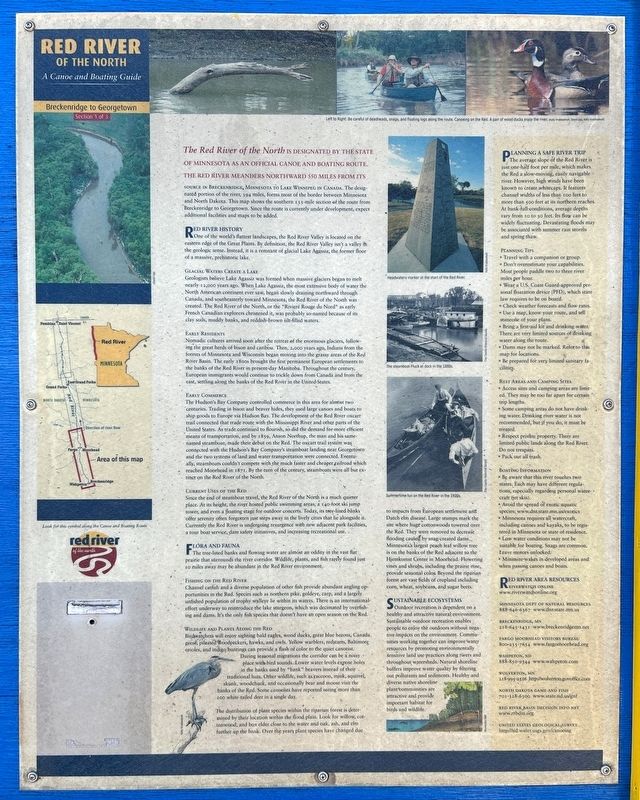
October 25, 2024
1. Red River of the North Marker
Red River History
One of the world's flattest landscapes, the Red River Valley is located on the eastern edge of the Great Plains. By definition, the Red River Valley isn't a valley in the geologic sense. Instead, it is a remnant of glacial Lake Agassiz, the former floor of a massive, prehistoric lake.
Glacial Waters Create a Lake
Geologists believe Lake Agassiz was formed when massive glaciers began to melt nearly 12,000 years ago. When Lake Agassiz, the most extensive body of water the North American continent ever saw, began slowly draining northward through Canada, and southeasterly toward Minnesota,
this page online
Early Residents
Nomadic cultures arrived soon after the retreat of the enormous glaciers, following the great herds of bison and caribou. Then, 2,000 years ago, Indians from the forests of Minnesota and Wisconsin began moving into the grassy areas of the Red River Basin. The early 1800s brought the first permanent European settlements to the banks of the Red River in present-day Manitoba. Throughout the century, European immigrants would continue to trickle down from Canada and from the east, settling along the banks of the Red River in the United States.
Early Commerce
The Hudson's Bay Company controlled commerce in this area for almost two centuries. Trading in bison and beaver hides, they used large canoes and boats to ship goods to Europe via Hudson Bay. The development of the Red River oxcart trail connected that trade route with the Mississippi River and other parts of the United
October 25, 2024
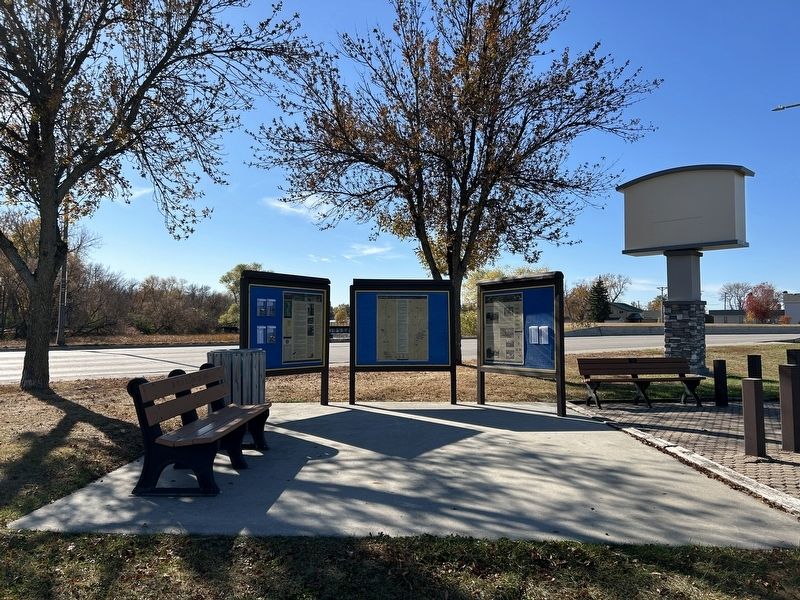
2. Red River of the North Marker (left)
Current Uses of the Red
Since the end of steamboat travel, the Red River of the North is a much quieter place. At its height, the river hosted public swimming areas, a 140-foot ski jump tower, and even a floating stage for outdoor concerts. Today, its tree-lined banks offer serenity often forgotten just steps away in the lively cities that lie alongside it. Currently the Red River is undergoing resurgence with new adjacent park facilities, a tour boat service, dam safety initiatives, and increasing recreational use.
Flora and Fauna
The tree-lined banks and flowing
October 25, 2024
3. Red River of the North Marker (right)
Fishing on the Red River
Channel catfish and a diverse population of other fish provide abundant angling opportunities in the Red. Species such as northern pike, goldeye, carp, and a largely unfished population of trophy walleye lie within its waters. There is an international effort underway to reintroduce the lake sturgeon, which was decimated by overfishing and dams. It's the only fish species that doesn't have an open season on the Red.
Wildlife and Plants Along the Red
Birdwatchers will enjoy sighting bald eagles, wood ducks, great blue herons, Canada geese, pileated woodpeckers, hawks, and owls. Yellow warblers, redstarts, Baltimore orioles, and indigo buntings can provide a flash of color to the quiet canoeist. During seasonal migrations the corridor can be a noisy place with bird sounds. Lower water levels expose holes in the banks used by "bank" beavers instead of their traditional huts. Other wildlife, such as raccoon, mink, squirrel,
October 25, 2024
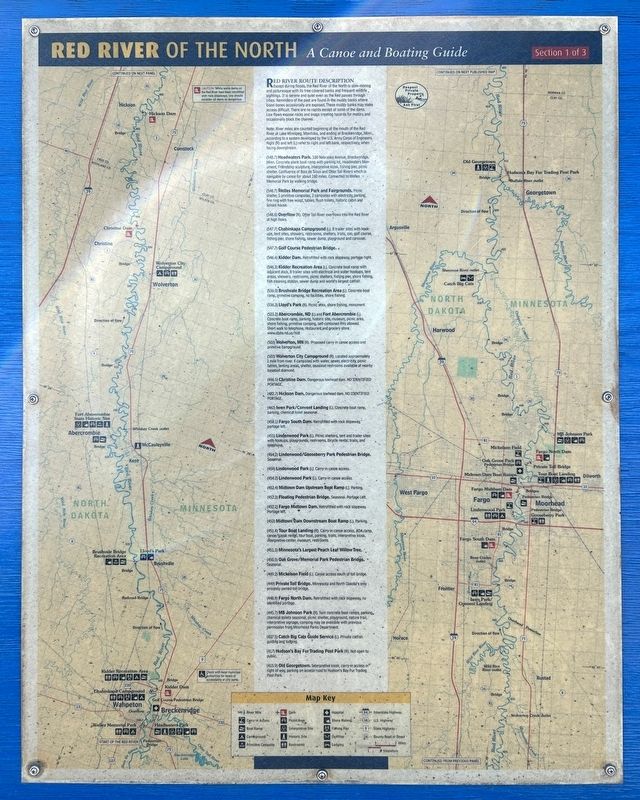
4. Red River of the North Marker, Panel Two
The distribution of plant species within the riparian forest is determined by their location within the flood plain. Look for willow, cottonwood, and box elder close to the water and oak, ash, and elm further up the bank. Over the years plant species have changed due to impacts from European settlement and Dutch elm disease. Large stumps mark the site where huge cottonwoods towered over the Red. They were removed to decrease flooding cause by snag-created dams. Minnesota's largest peach leaf willow tree is on the banks of the Red adjacent to the Hjemkomst Center in Moorhead. Flowering vines and shrubs, including the prairie rose, provide seasonal color. Beyond the riparian forest are vast fields of cropland including corn, wheat, soybeans, and sugar beets.
Sustainable Ecosystems
Outdoor recreation is dependent on a healthy and attractive natural environment. Sustainable outdoor recreation enables people to enjoy the outdoors without negative impacts on the environment.
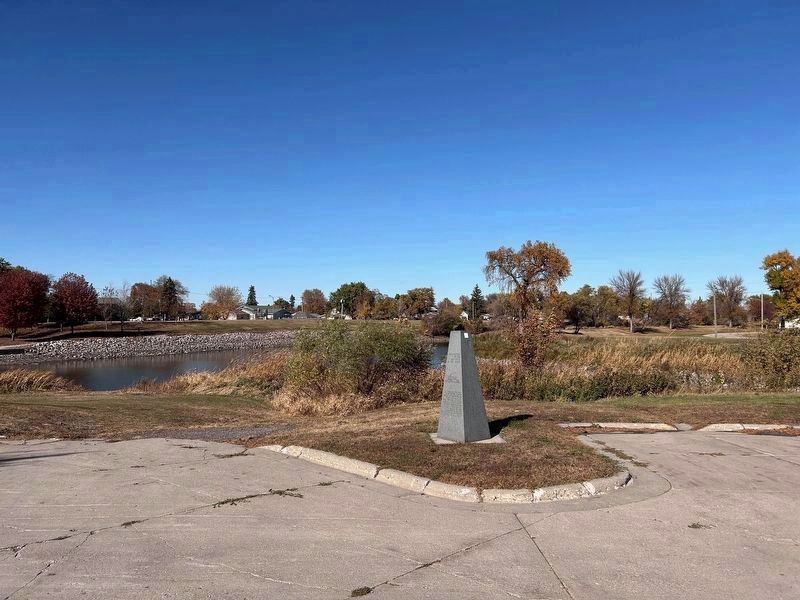
October 25, 2024
5. Headwaters Marker, nearby
The headwaters of the Red River of the North are in the background.
Captions:
Left to Right: Be careful of deadheads, snags, and floating logs along the route. Canoeing on the Red. A pair of wood ducks enjoy the river. (Kelly Krabbenhoft, David Lipp, Kelly Krabbenhoft)
Headwaters marker at the start of the Red River. Kelly Krabbenhoft
The steamboat Pluck at dock in the 1880s. Clay County Historical Society
Summertime fun of the Red River in the 1920s. Clay County Historical Society
Planning a Safe River Trip
The average slope of the Red River is just one-half foot per mile, which makes the Red a slow-moving, easily navigable river. However, high winds have been known to create whitecaps. It features channel widths of less than 100 feet to more than 500 feet at its northern reaches. At bank-full conditions, average depths vary
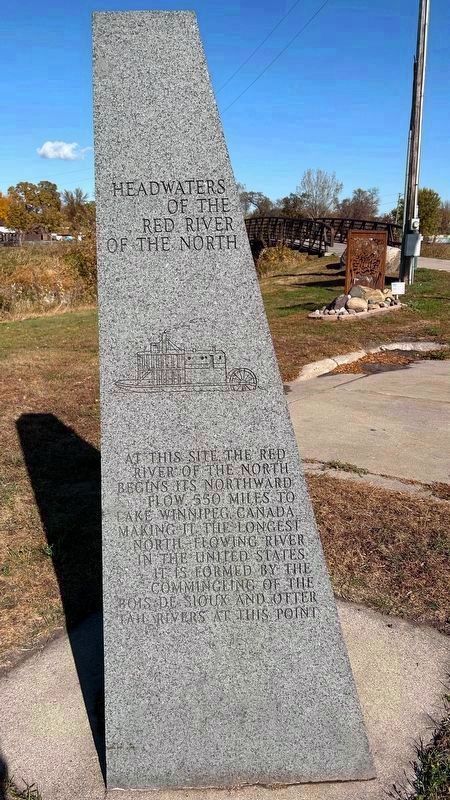
October 25, 2024
6. Headwaters Marker, nearby
Side One:
Headwaters of the Red River of the North
At this site, the Red River of the North begins its northward flow, 550 miles to Lake Winnipeg, Canada, making it the longest north-flowing river in the United States. It is formed by commingling of the Bois de Sioux and Otter Tail Rivers at this point.
Headwaters of the Red River of the North
At this site, the Red River of the North begins its northward flow, 550 miles to Lake Winnipeg, Canada, making it the longest north-flowing river in the United States. It is formed by commingling of the Bois de Sioux and Otter Tail Rivers at this point.
Planning Tips
• Travel with a companion or group.
• Don't overestimate your capabilities. Most people paddle two to three river miles per hour.
• Wear a U.S. Coast Guard-approved personal floatation device (PFD), which state law requires to be on board.
• Check weather forecasts and flow rates.
• Use a map, know your route, and tell someone of your plans.
• Bring a first-aid kit and drinking water. There are very limited sources of drinking water along the route.
• Dams may not be marked. Refer to this map for locations.
• Be prepared for very limited sanitary facilities.
Rest Areas and Camping Sites
• Access sites and camping areas are limited. They may be too far apart for certain trip lengths.
• Some camping areas do not have drinking water. Drinking river water is not recommended, but if you do, it must be treated.
• Respect private property. There are limited public lands along the Red River. Do not trespass.
• Pack out all trash.
Boating Information
• Be aware that this river
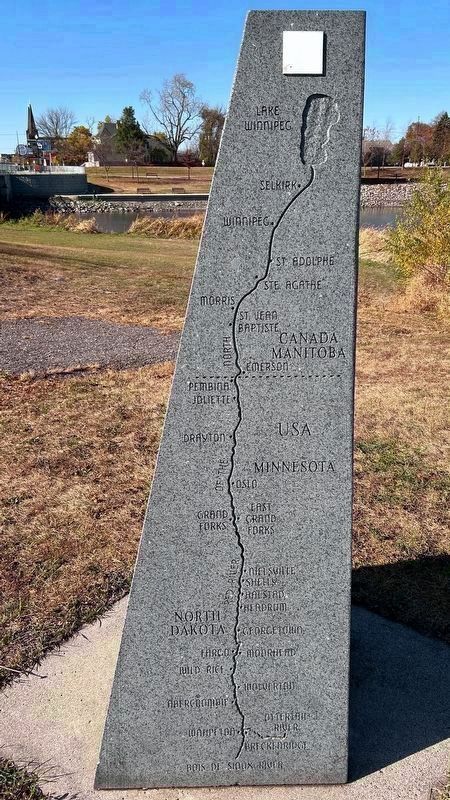
October 25, 2024
7. Headwaters Marker, Side Two
Map of the Red River of the North from Breckenridge, Minnesota to Lake Winnipeg in Manitoba, Canada
Side Three (not shown):
Project Breckenridge 2000
Side Three (not shown):
Project Breckenridge 2000
• Avoid the spread of exotic aquatic species: www.dnr.state.mn.us/exotics
• Minnesota requires all watercraft, including canoes and kayaks, to be registered in Minnesota or state of residence.
• Low water conditions may not be suitable for boating. Snags are common. Leave motors unlocked.
• Minimize wakes in developed areas and when passing canoes and boats.
Red River Area Resources
Riverwatch Online
www.riverwatchonline.org
Minnesota Dept of Natural Resources
888-646-6367 www.dnr.state.mn.us
Breckenridge, MN
218-643-1431 www. breckenridgemn.net
Fargo Moohead Visitors Bureau
800-235-7654 www.fargomoorhead.org
Wahpeton, ND
888-850-9544 www.wahpeton.com
Wolverton, MN
218-995-2526 http://wolverton.govoffice.com
North Dakota Game and Fish
701-328-6300 www.state.nd.us/gnf
Red River Basin Decision Info Net
www.rrbdin.org
United States Geological Survey
http://nd.water.usgs.gov/canoeing
Topics. This historical marker is listed in these topic lists: Environment • Industry & Commerce • Parks & Recreational Areas • Waterways & Vessels. A significant historical year for this entry is 1859.
Location. 46° 15.826′ N, 96° 35.9′ W. Marker is in Breckenridge, Minnesota, in Wilkin County. It is on Minnesota Avenue west of Pope Street, on the right when traveling west. Located in Headwaters Park. Touch for map. Marker is at or near this postal address: 46 Minnesota Ave, Breckenridge MN 56520, United States of America. Touch for directions.

Regionally, this marker is in the American Midwest, in the Corn Belt, on the prairies, on the Great Plains, and specifically on the Northern Plains. Globally, it is in North America, the Western Hemisphere, the Western World, and the Anglosphere. Historically, it finds itself in what was once Rupert’s Land, the territory of the Mississippian Culture, and the Louisiana Purchase.
Other nearby markers. At least 8 other markers are within walking distance of this marker: Breckenridge / Steamboats (here, next to this marker); Historic Breckenridge (within shouting distance of this marker); First Expedition in Breckenridge Cabin Site (approx. 0.2 miles away); By the Waters of Three Rivers (approx. 0.2 miles away); Richland County World War I Memorial (approx. 0.4 miles away in North Dakota); Richland County Courthouse Veterans Memorial (approx. 0.4 miles away in North Dakota); Union Veterans Memorial (approx. 0.4 miles away in North Dakota); "Boomer" (approx. 0.4 miles away). Touch for a list and map of all markers in Breckenridge.
Also see . . . Red River of the North State Water Trail | Minnesota DNR. (Submitted on November 26, 2024.)
Credits. This page was last revised on November 26, 2024. It was originally submitted on November 26, 2024. This page has been viewed 236 times since then and 46 times this year. Photos: 1, 2, 3, 4, 5, 6, 7. submitted on November 26, 2024.
