Jordan Park in St. Petersburg in Pinellas County, Florida — The American South (South Atlantic)
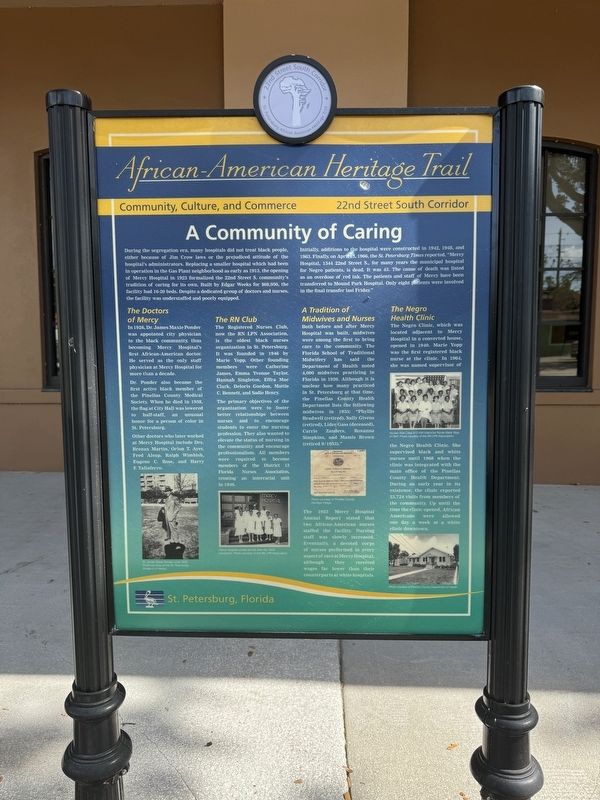
A Community of Caring
Community, Culture, and Commerce • 22nd Street South Corridor
| — | St. Petersburg African-American Heritage Trail | — |
Photographed by Brandon D Cross
1. A Community of Caring Marker
Initially, additions to the hospital were constructed in 1942, 1948, and 1963. Finally, on Aprif 13, 1966, the St. Petersburg Times reported, "Mercy Hospital, 1344 22nd Street S., for many years the municipal hospital for Negro patients, is dead. It was 43. The cause of death was listed as an overdose of red ink. The patients and staff of Mercy have been transferred to Mound Park Hospital. Only eight patients were involved in the final transfer last Friday."
The Doctors of Mercy
In 1926, Dr. James Maxie Ponder was appointed city physician to the black community, thus becoming Mercy
this page online
Dr. Ponder also became the first active black member of the Pinellas County Medical Society. When he died in 1958, the flag at City Hall was lowered to half-staff, an unusual honor for a person of color in St. Petersburg.
Other doctors who later worked at Mercy Hospital include Drs. Breaux Martin, Orion T. Ayer, Fred Alsup, Ralph Wimbish, Eugene C. Rose, and Harry E. Taliaferro.
The RN Club
The Registered Nurses Club, now the RN LPN Association, is the oldest black nurses organization in St. Petersburg. it was founded in 1946 by Marie Yopp. Other founding members were Catherine James, Emma Yvonne Taylor, Hannah Singleton, Efrain Mar Clark, Deloris Gordon, Mattie C. Bennett, and Sadie Henry.
The primary objectives of the organization were to foster better relationships between nurses and to encourage students to enter the nursing profession. They also wanted to elevate the status of nursing in the community and encourage professionalism. All members were required to become members of the District 13 Florida
Photographed by Brandon D Cross
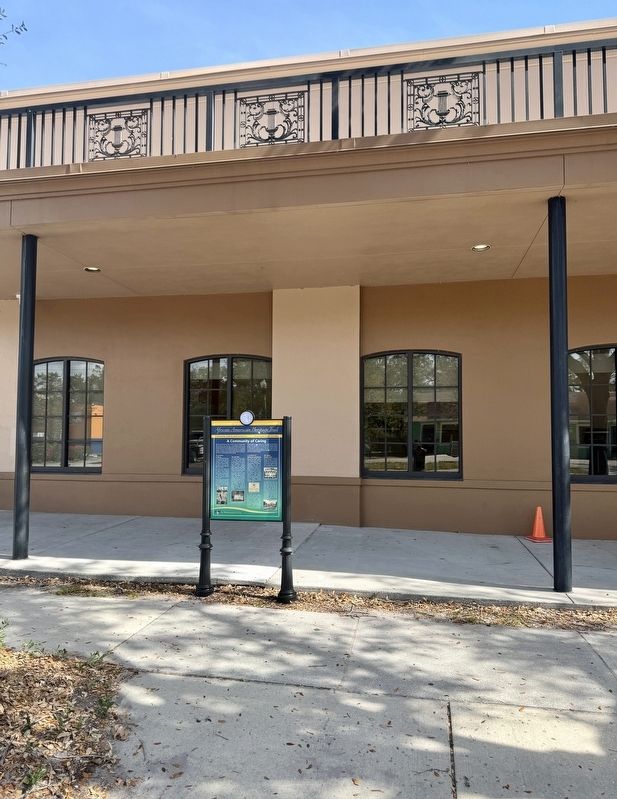
2. A Community of Caring Marker
A Tradition of Midwives and Nurses
Both before and after Mercy Hospital was built, midwives were among the first to bring care to the community. The Florida School of Traditional Midwifery has said the Department of Health noted 4,000 midwives practicing in Florida in 1920. Although it is unclear how many practiced in St. Petersburg at that time, the Pinellas County Health Department lists the following midwives in 1953: "Phyllis Bradwell (retired), Sally Givens (retired), Lider Gass (deceased), Carrie Zanders, Roxanna Simpkins, and Mamie Brown (retired 9/1953)."
The 1923 Mercy Hospital Annual Report stated that two African-American nurses staffed the facility. Nursing staff was slowly increased. Eventually, a devoted corps of nurses performed in every aspect of care at Mercy Hospital, although they received wages far lower than their counterparts at white hospitals.
The Negro Health Clinic
The Negro Clinic, which was located adjacent to Mercy Hospital in a converted house, opened in 1940. Marie Yopp was the first registered black nurse at the clinic. In 1964, she was named supervisor of the Negro Health Clinic. She supervised black and white nurses nurses until 1968 when the clinic was integrated with the main office of the Pinellas County Health Department. During an early year in its existence, the clinic reported 23,724 visits from members of the community. Up until the time the clinic opened, African Ameicans were allowed one day a week at a white clinic downtown.
(captions)
Dr. James Maxie Ponder, circa 1935. Photo courtesy of the St. Petersburg Museum of History.
Mercy Hospital nurses shortly after the 1948 expansion. Photo courtesy of the RN LPN Association.
Photo courtesy of Pinellas County Heritage Village.
Nurses Aide Class #13 with instructor Nurse Marie Yopp in 1947. Photo courtesy of the RN LPN Association.
Photo courtesy of Pinellas County Department of Health
Erected by National Park Service, Florida Department of State, the City of St. Petersburg and the Dr. Carter G. Woodson African American History Museum.
Topics. This historical marker is listed in these topic lists: African Americans • Civil Rights • Science & Medicine • Women. A significant historical year for this entry is 1923.
Location. 27° 45.422′ N, 82° 39.775′ W. Marker is in St. Petersburg, Florida, in Pinellas County. It is in Jordan Park. It is at the intersection of 22nd Street South and Melrose Avenue S, on the right when traveling north on 22nd Street South. Touch for map. Marker is at or near this postal address: 1344 22nd Street S, Saint Petersburg FL 33712, United States of America. Touch for directions.

Regionally, this marker is on the Gulf Coast and on Tampa Bay. It is also in the American South and on the Gulf Coast. Globally, it is in the North Atlantic Region, North America, a Gulf of Mexico state, the Western Hemisphere, the Western World, and the Anglosphere. Historically, it finds itself in what was once New Spain, the territory of the Mississippian Culture, one of the Confederate States of America, and the Antebellum South.
Other nearby markers. At least 8 other markers are within walking distance of this marker: 22nd Street South Corridor (about 700 feet away, measured in a direct line); Faces and Stories (about 700 feet away); Campbell Park (about 700 feet away); Royal Theater (approx. 0.2 miles away); a different marker also named 22nd Street South Corridor (approx. ¼ mile away); Building 22nd Street S. (approx. ¼ mile away); Civic Associations (approx. 0.3 miles away); The Beginning (approx. 0.3 miles away). Touch for a list and map of all markers in St. Petersburg.
Also see . . .
1. Segregated Health Care. (Submitted on November 27, 2024, by Brandon D Cross of Flagler Beach, Florida.)
2. The Heritage Trail. (Submitted on November 27, 2024, by Brandon D Cross of Flagler Beach, Florida.)
3. The Deuces Live. (Submitted on November 27, 2024, by Brandon D Cross of Flagler Beach, Florida.)
Credits. This page was last revised on December 5, 2024. It was originally submitted on November 27, 2024, by Brandon D Cross of Flagler Beach, Florida. This page has been viewed 230 times since then and 54 times this year. Photos: 1, 2. submitted on November 27, 2024, by Brandon D Cross of Flagler Beach, Florida. • Bernard Fisher was the editor who published this page.
